Mobile-area leaders seek $30 million from state fund for new maritime-focused career tech center
February 12, 2026 | Joint Interim Committees, Alabama Legislative Sessions, Alabama
This article was created by AI summarizing key points discussed. AI makes mistakes, so for full details and context, please refer to the video of the full meeting. Please report any errors so we can fix them. Report an error »
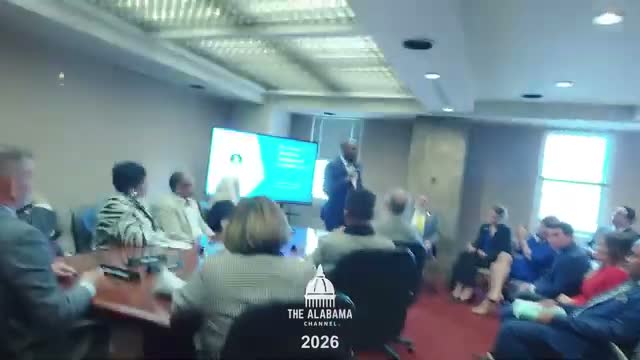
Mobile-area education and economic-development leaders on Friday asked state lawmakers to back a new career and technical education center aimed at preparing local students for maritime and advanced manufacturing jobs tied to major regional investments.
At a briefing before a Joint Interim Committees panel, Dr. William White, identified in the session as Mobile County Public Schools' career and workforce development director, described the district's existing programs and the limits of current facilities. "We have approximately 35 career technical education programs," White said, noting the district runs programs across 12 comprehensive high schools and three career-technical centers.
Presenters said the proposed center would sit on district-owned property near Interstate 10, encompass about 100,000 square feet and initially serve 750–1,000 students. The speakers estimated the project's total cost at a little over $67 million and said the district plans to request $30 million from a $150 million state advanced technology fund; the application window is projected to open April 1 and the district targeted opening in 2028. "We are asking for $30,000,000," one presenter said.
Why now: growth, capacity and skills gaps
Speakers argued the center is needed to match a rapid wave of local economic development. A presentation from local economic-development representatives pointed to multiple maritime and manufacturing expansions and said the region could see "10 to 15,000" new jobs in the coming phase, creating urgent demand for skilled technicians and tradespeople.
At the same time, presenters said training capacity is constrained. They reported that roughly 11,000 students take CTE classes districtwide but only about 6% of those students are enrolled in architecture and construction pathways that feed trades such as welding and pipefitting. As one presenter summarized: many specialized CTE programs require large equipment and cannot be offered at every high school.
Partners and program design
Mobile County Public Schools described the center as a countywide, multi-system facility. The district said it has reached out to neighboring systems — Satsuma, Chickasaw and others — and has received three verbal commitments to join a multi-system application, a stated eligibility requirement for the state fund. Bishop State will be listed as a postsecondary partner and, according to the presenters, will share instructors and equipment.
"This is a game changer in our community," the lead presenter said, asking legislators to advocate for the grant despite acknowledging that the Alabama State Department controls the awards.
Presenters emphasized collaboration with the Mobile Chamber and business partners. The district reported placing about 400 job-shadow students and more than 200 paid internships last year, enabled by more than 80 business partners. Those partnerships, they said, will provide pathways from high-school credentials into local employers.
Legislative outreach and next steps
Speakers described ongoing outreach to state leaders including the governor's office, the lieutenant governor, the House speaker and state senators. They asked committee members to consider a coordinated letter of support from the legislators present; a member asked the presenters to assemble a letter with signatures, and presenters agreed to coordinate quickly given the fast-moving session.
What was not decided
There was no formal vote or motion on the project during the briefing. Presenters acknowledged several unresolved details, including finalized funding sources, transportation logistics, schedules and some site planning elements. They noted instructor recruitment is a known challenge and said shared staffing arrangements with Bishop State and employers would be part of the approach.
The committee did not take formal action at the session; presenters said they would provide follow-up materials and seek signatures for an advocacy letter to state officials.
At a briefing before a Joint Interim Committees panel, Dr. William White, identified in the session as Mobile County Public Schools' career and workforce development director, described the district's existing programs and the limits of current facilities. "We have approximately 35 career technical education programs," White said, noting the district runs programs across 12 comprehensive high schools and three career-technical centers.
Presenters said the proposed center would sit on district-owned property near Interstate 10, encompass about 100,000 square feet and initially serve 750–1,000 students. The speakers estimated the project's total cost at a little over $67 million and said the district plans to request $30 million from a $150 million state advanced technology fund; the application window is projected to open April 1 and the district targeted opening in 2028. "We are asking for $30,000,000," one presenter said.
Why now: growth, capacity and skills gaps
Speakers argued the center is needed to match a rapid wave of local economic development. A presentation from local economic-development representatives pointed to multiple maritime and manufacturing expansions and said the region could see "10 to 15,000" new jobs in the coming phase, creating urgent demand for skilled technicians and tradespeople.
At the same time, presenters said training capacity is constrained. They reported that roughly 11,000 students take CTE classes districtwide but only about 6% of those students are enrolled in architecture and construction pathways that feed trades such as welding and pipefitting. As one presenter summarized: many specialized CTE programs require large equipment and cannot be offered at every high school.
Partners and program design
Mobile County Public Schools described the center as a countywide, multi-system facility. The district said it has reached out to neighboring systems — Satsuma, Chickasaw and others — and has received three verbal commitments to join a multi-system application, a stated eligibility requirement for the state fund. Bishop State will be listed as a postsecondary partner and, according to the presenters, will share instructors and equipment.
"This is a game changer in our community," the lead presenter said, asking legislators to advocate for the grant despite acknowledging that the Alabama State Department controls the awards.
Presenters emphasized collaboration with the Mobile Chamber and business partners. The district reported placing about 400 job-shadow students and more than 200 paid internships last year, enabled by more than 80 business partners. Those partnerships, they said, will provide pathways from high-school credentials into local employers.
Legislative outreach and next steps
Speakers described ongoing outreach to state leaders including the governor's office, the lieutenant governor, the House speaker and state senators. They asked committee members to consider a coordinated letter of support from the legislators present; a member asked the presenters to assemble a letter with signatures, and presenters agreed to coordinate quickly given the fast-moving session.
What was not decided
There was no formal vote or motion on the project during the briefing. Presenters acknowledged several unresolved details, including finalized funding sources, transportation logistics, schedules and some site planning elements. They noted instructor recruitment is a known challenge and said shared staffing arrangements with Bishop State and employers would be part of the approach.
The committee did not take formal action at the session; presenters said they would provide follow-up materials and seek signatures for an advocacy letter to state officials.
Don't Miss a Word: See the Full Meeting!
Go beyond summaries. Unlock every video, transcript, and key insight with a Founder Membership.
✓
Get instant access to full meeting videos
✓
Search and clip any phrase from complete transcripts
✓
Receive AI-powered summaries & custom alerts
✓
Enjoy lifetime, unrestricted access to government data
30-day money-back guarantee
