Vermont Department of Labor briefs House committee on budget risks, apprenticeship push and UI modernization
February 12, 2026 | Commerce & Economic Development, HOUSE OF REPRESENTATIVES, Committees, Legislative , Vermont
This article was created by AI summarizing key points discussed. AI makes mistakes, so for full details and context, please refer to the video of the full meeting. Please report any errors so we can fix them. Report an error »
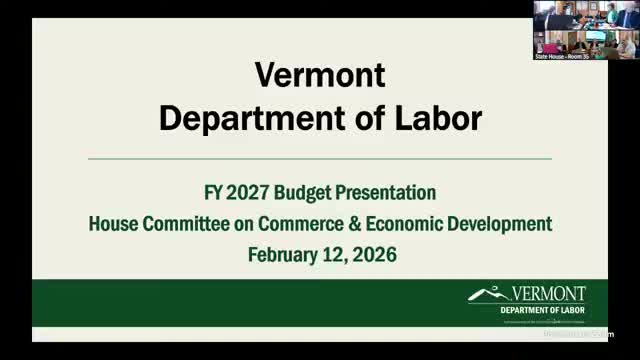
Vermont Department of Labor Commissioner Kendall Smith told the Dumont House Committee on Commerce & Economic Development on Feb. 12 that the department’s published budget figures use last year’s federal allocations and could change once final federal awards arrive.
Smith said the department is about half federally funded overall, with roughly 25% general fund and 25% special funds. "Anywhere you see a federal number plugged in here, it is last year’s federal allocation," she said, adding the state will share updated allocations with the governor’s office and the legislature when they are available.
Why it matters: federal formula shifts can change how the department staffs regional job centers and runs federally funded programs such as WIOA (the Workforce Innovation and Opportunity Act), RESEA (reemployment services and eligibility assessment) and VOSHA (Vermont Occupational Safety and Health). Committee members used the briefing to press for clearer outcome reporting on grant pilots and to assess whether reverted one-time appropriations should be restored.
On specific program dollars, Smith told legislators that the federal WIOA adult line item ‘‘is gonna be down by $10,000,000’’ under the recently acted federal bill; she cautioned that spread across 50 states that is unlikely to be catastrophic for Vermont but could force program adjustments if the state’s share is large. By contrast, she said RESEA funding is increasing nationally and could generate a higher allocation for staff who administer that program.
The department also reported program-level details: Jay Ramsey, director of workforce development, said an outreach sprint had increased construction-tagged jobs in Vermont JobLink from a few dozen to several hundred, and Commissioner Smith urged lawmakers to promote a statewide construction job fair set for Feb. 25.
On administration and operations, Smith said the department has about 263 employees with a 5.6% vacancy rate (about 13 positions) and that average phone wait time for UI calls ‘‘was back down to 20 minutes’’ as of the prior week. She also confirmed a multi-year replacement for the department’s workers’ compensation back end is in procurement after a vendor failed to deliver.
Technology and modernization: Smith said the department’s new unemployment insurance system is on schedule and on budget and is expected to launch in spring or summer. "We're not committing to a date quite yet, but we will be soon," she said, and added the department is budgeting time for testing and training to minimize rollout problems.
Apprenticeships and work-based learning: Smith highlighted roughly $35.8 million of national apprenticeship-related incentives and described efforts to make registered apprenticeship more accessible to small employers, including possible technical assistance from the department. She also said $1 million assigned for work-based learning and a related $1.5 million appropriation had not been fully spent and were proposed to be reverted to the general fund; some committee members pressed for a post‑mortem report to capture lessons from grants that did run.
Grant administration and evaluation: Jay Ramsey described a phased grant rollout for returnship/work‑based learning awards (42 grants, award sizes between about $6,000 and a maximum of $75,000) and said the department relied on grantee narrative reports and some payroll records to verify placements. Ramsey acknowledged monitoring capacity was limited and said the new data systems will make verification easier over time.
Office of Workforce Strategy and Development: Sabina Haskell and Drake Turner described a small, stand‑alone office (about $423,000 total) that is roughly $51,000 above the 3% target this year to fund full staffing. They said the office is building subcommittees for the State Workforce Development Board, launching an inventory of workforce programs and preparing to administer federal reporting obligations such as Workforce Pell where the board will advise the governor on priority sectors.
Audit and oversight: Department finance staff reviewed recent single-audit work for UI administration, reporting three minor documentation findings last fiscal year that have been corrected; staff said the current-year audit (in progress at the time of the briefing) was not showing new findings.
Next steps: Smith asked the committee to consider moving a "registered apprenticeship statute technical corrections" bill before crossover and said the department will update the committee when final federal allocations are received. The committee adjourned with plans to reconvene the next day.
(Reporting note: Quotes and attributions are drawn from the transcript of the Feb. 12 Dumont House Committee on Commerce & Economic Development.)
Smith said the department is about half federally funded overall, with roughly 25% general fund and 25% special funds. "Anywhere you see a federal number plugged in here, it is last year’s federal allocation," she said, adding the state will share updated allocations with the governor’s office and the legislature when they are available.
Why it matters: federal formula shifts can change how the department staffs regional job centers and runs federally funded programs such as WIOA (the Workforce Innovation and Opportunity Act), RESEA (reemployment services and eligibility assessment) and VOSHA (Vermont Occupational Safety and Health). Committee members used the briefing to press for clearer outcome reporting on grant pilots and to assess whether reverted one-time appropriations should be restored.
On specific program dollars, Smith told legislators that the federal WIOA adult line item ‘‘is gonna be down by $10,000,000’’ under the recently acted federal bill; she cautioned that spread across 50 states that is unlikely to be catastrophic for Vermont but could force program adjustments if the state’s share is large. By contrast, she said RESEA funding is increasing nationally and could generate a higher allocation for staff who administer that program.
The department also reported program-level details: Jay Ramsey, director of workforce development, said an outreach sprint had increased construction-tagged jobs in Vermont JobLink from a few dozen to several hundred, and Commissioner Smith urged lawmakers to promote a statewide construction job fair set for Feb. 25.
On administration and operations, Smith said the department has about 263 employees with a 5.6% vacancy rate (about 13 positions) and that average phone wait time for UI calls ‘‘was back down to 20 minutes’’ as of the prior week. She also confirmed a multi-year replacement for the department’s workers’ compensation back end is in procurement after a vendor failed to deliver.
Technology and modernization: Smith said the department’s new unemployment insurance system is on schedule and on budget and is expected to launch in spring or summer. "We're not committing to a date quite yet, but we will be soon," she said, and added the department is budgeting time for testing and training to minimize rollout problems.
Apprenticeships and work-based learning: Smith highlighted roughly $35.8 million of national apprenticeship-related incentives and described efforts to make registered apprenticeship more accessible to small employers, including possible technical assistance from the department. She also said $1 million assigned for work-based learning and a related $1.5 million appropriation had not been fully spent and were proposed to be reverted to the general fund; some committee members pressed for a post‑mortem report to capture lessons from grants that did run.
Grant administration and evaluation: Jay Ramsey described a phased grant rollout for returnship/work‑based learning awards (42 grants, award sizes between about $6,000 and a maximum of $75,000) and said the department relied on grantee narrative reports and some payroll records to verify placements. Ramsey acknowledged monitoring capacity was limited and said the new data systems will make verification easier over time.
Office of Workforce Strategy and Development: Sabina Haskell and Drake Turner described a small, stand‑alone office (about $423,000 total) that is roughly $51,000 above the 3% target this year to fund full staffing. They said the office is building subcommittees for the State Workforce Development Board, launching an inventory of workforce programs and preparing to administer federal reporting obligations such as Workforce Pell where the board will advise the governor on priority sectors.
Audit and oversight: Department finance staff reviewed recent single-audit work for UI administration, reporting three minor documentation findings last fiscal year that have been corrected; staff said the current-year audit (in progress at the time of the briefing) was not showing new findings.
Next steps: Smith asked the committee to consider moving a "registered apprenticeship statute technical corrections" bill before crossover and said the department will update the committee when final federal allocations are received. The committee adjourned with plans to reconvene the next day.
(Reporting note: Quotes and attributions are drawn from the transcript of the Feb. 12 Dumont House Committee on Commerce & Economic Development.)
View the Full Meeting & All Its Details
This article offers just a summary. Unlock complete video, transcripts, and insights as a Founder Member.
✓
Watch full, unedited meeting videos
✓
Search every word spoken in unlimited transcripts
✓
AI summaries & real-time alerts (all government levels)
✓
Permanent access to expanding government content
30-day money-back guarantee
