Annapolis committee reviews stormwater fee overhaul, links funding to tree‑planting push
February 12, 2026 | Annapolis, Anne Arundel County, Maryland
This article was created by AI summarizing key points discussed. AI makes mistakes, so for full details and context, please refer to the video of the full meeting. Please report any errors so we can fix them. Report an error »
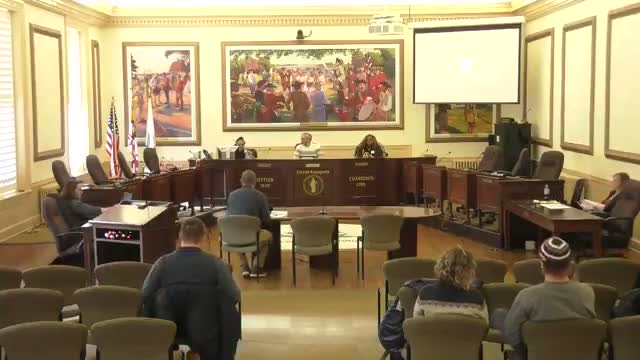
Annapolis stormwater and planning staff on Feb. 12 laid out a package of proposed changes to the city’s stormwater utility fee and a parallel expansion of the urban tree canopy program intended to fund restoration and reduce runoff.
Bridal Adams, the city’s urban forester, told the Bridal Matters Committee the city’s canopy sits at about 43% and that the comp‑plan canopy target was revised from 50% by 2036 to 50% by 2050 to reflect tree maturation timelines. “With proper funding, we’re hoping that now that goal is much more attainable,” Adams said, noting recent plantings, a front‑yard and street tree program, and a Chesapeake Bay Trust grant opportunity that can provide up to $55,000 for community planting and invasive species management.
Public works stormwater staff gave the technical briefing. Anne Roterer, stormwater engineer, and Mike Rosberg, stormwater program manager, described the city’s MS4 permit obligations and how the watershed restoration fund supports capital and operational projects, from stream/wetland restoration to maintenance of existing BMPs. Roterer summarized that the MS4 permit’s restoration target requires a 20% reduction from the 2018 impervious baseline and stressed the need to align funding and regulatory changes with that requirement.
The most consequential billing proposal would change nonresidential billing from a four‑tier flat structure to a measured ERU (equivalent residential unit) approach based on impervious area, using 2,100 square feet as one ERU. Under the ERU model, a site with 21,000 square feet of impervious surface — about 10 ERUs — would see quarterly charges rise from roughly $170.86 to roughly $345.30, staff said. “Property owners with more impervious cover will pay more to fund the stormwater system,” Roterer said.
Staff showed modeled distributional impacts: most nonresidential properties would experience modest increases (0–$200 quarterly), some would see decreases if they are currently at the low end of a tier, and a small number of very large, parking‑intensive sites would face substantial increases because the tier cap would be removed.
Adams and stormwater staff emphasized a complementary set of code and program changes intended to both preserve the existing canopy and expand plantings: revisions to the city’s Forest Conservation Act ordinance, enhancements to site design standards (soil volumes and required street trees), targeted impervious‑conversion projects funded through watershed/critical area fees, and an outreach push to increase resident and institutional participation in tree programs.
Committee members pressed staff on: who maintains city-owned stormwater facilities (public works versus other departments), staffing and budget placeholders for an additional forestry position, how tree loss and natural attrition are factored into planting targets, and whether fee revenues and ordinance changes would be sufficient to meet long‑term restoration and bonding needs. Adams said the five‑year canopy inventory update and a continued emphasis on preservation, enforcement and planting would be required to demonstrate progress.
The committee paused the discussion because of time and asked staff to return next month to finish discussion of residential fee options, the credit program and alternative compliance measures. Staff noted the nonresidential ERU approach had already been modeled and could be introduced later as an amendment; the residential conversion requires more analysis and broader outreach.
What’s next: staff will return with additional analysis and proposals. The committee also asked for bond‑forecasting and Stantec modeling showing how fee changes affect the long‑term health of the watershed restoration fund before any final ordinance change is forwarded to the full council.
Bridal Adams, the city’s urban forester, told the Bridal Matters Committee the city’s canopy sits at about 43% and that the comp‑plan canopy target was revised from 50% by 2036 to 50% by 2050 to reflect tree maturation timelines. “With proper funding, we’re hoping that now that goal is much more attainable,” Adams said, noting recent plantings, a front‑yard and street tree program, and a Chesapeake Bay Trust grant opportunity that can provide up to $55,000 for community planting and invasive species management.
Public works stormwater staff gave the technical briefing. Anne Roterer, stormwater engineer, and Mike Rosberg, stormwater program manager, described the city’s MS4 permit obligations and how the watershed restoration fund supports capital and operational projects, from stream/wetland restoration to maintenance of existing BMPs. Roterer summarized that the MS4 permit’s restoration target requires a 20% reduction from the 2018 impervious baseline and stressed the need to align funding and regulatory changes with that requirement.
The most consequential billing proposal would change nonresidential billing from a four‑tier flat structure to a measured ERU (equivalent residential unit) approach based on impervious area, using 2,100 square feet as one ERU. Under the ERU model, a site with 21,000 square feet of impervious surface — about 10 ERUs — would see quarterly charges rise from roughly $170.86 to roughly $345.30, staff said. “Property owners with more impervious cover will pay more to fund the stormwater system,” Roterer said.
Staff showed modeled distributional impacts: most nonresidential properties would experience modest increases (0–$200 quarterly), some would see decreases if they are currently at the low end of a tier, and a small number of very large, parking‑intensive sites would face substantial increases because the tier cap would be removed.
Adams and stormwater staff emphasized a complementary set of code and program changes intended to both preserve the existing canopy and expand plantings: revisions to the city’s Forest Conservation Act ordinance, enhancements to site design standards (soil volumes and required street trees), targeted impervious‑conversion projects funded through watershed/critical area fees, and an outreach push to increase resident and institutional participation in tree programs.
Committee members pressed staff on: who maintains city-owned stormwater facilities (public works versus other departments), staffing and budget placeholders for an additional forestry position, how tree loss and natural attrition are factored into planting targets, and whether fee revenues and ordinance changes would be sufficient to meet long‑term restoration and bonding needs. Adams said the five‑year canopy inventory update and a continued emphasis on preservation, enforcement and planting would be required to demonstrate progress.
The committee paused the discussion because of time and asked staff to return next month to finish discussion of residential fee options, the credit program and alternative compliance measures. Staff noted the nonresidential ERU approach had already been modeled and could be introduced later as an amendment; the residential conversion requires more analysis and broader outreach.
What’s next: staff will return with additional analysis and proposals. The committee also asked for bond‑forecasting and Stantec modeling showing how fee changes affect the long‑term health of the watershed restoration fund before any final ordinance change is forwarded to the full council.
View the Full Meeting & All Its Details
This article offers just a summary. Unlock complete video, transcripts, and insights as a Founder Member.
✓
Watch full, unedited meeting videos
✓
Search every word spoken in unlimited transcripts
✓
AI summaries & real-time alerts (all government levels)
✓
Permanent access to expanding government content
30-day money-back guarantee
