Draft bill would create a statewide CTE Education Service Agency, shifting governance and funding; lawmakers press for financial and operational details
February 12, 2026 | Commerce & Economic Development, HOUSE OF REPRESENTATIVES, Committees, Legislative , Vermont
This article was created by AI summarizing key points discussed. AI makes mistakes, so for full details and context, please refer to the video of the full meeting. Please report any errors so we can fix them. Report an error »
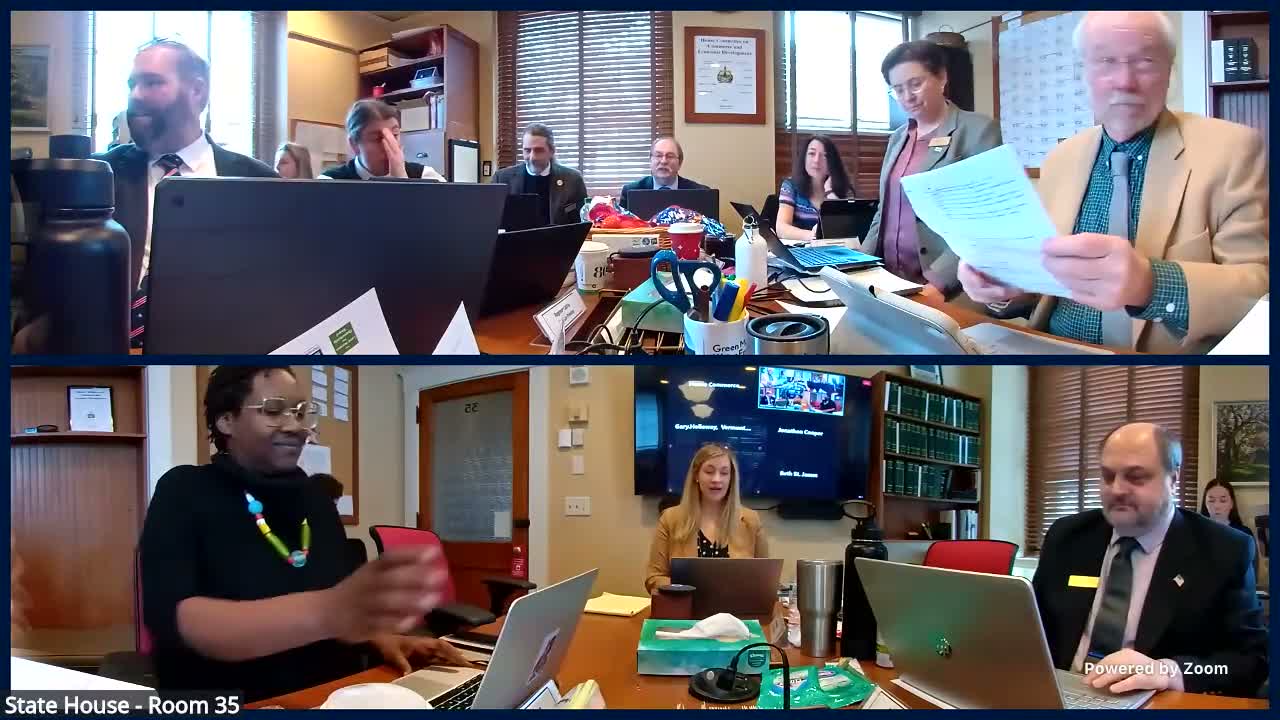
Legislative counsel and Agency of Education (AOE) staff walked the House Commerce & Economic Development committee through draft 2.1 of a proposal to transform Vermont’s career and technical education system on Feb. 11.
The draft introduces a new CTE Education Service Agency (CTE ESSA) defined as "the entity appointed by the Agency of Education to oversee and ensure the provision of CTE programming at all regional CTE centers and comprehensive high schools and to receive an appropriation and support of secondary CTE for all secondary students in the state," and specifies that "the CTE ESSA shall be a public body" subject to open meeting law. The bill retains rulemaking authority with the State Board of Education while moving operational responsibilities, program oversight and a new funding mechanism to the ESSA.
Under the draft, local school boards would no longer be described as operating CTE centers; instead they would 'house' centers and enter into operating agreements with the ESSA governing facility use, staffing and shared services. The proposal removes statutory requirements for regional advisory boards and would eliminate standalone regional CTE school districts, replacing them with a single governance structure under the ESSA. Draft language repeals many current funding and tuition mechanics in favor of a new approach in which "the governor shall include in the governor's recommended budget an amount projected by the CTE ESSA to be necessary for the support of CTE in Vermont," with a floor tied to fiscal year 2026 CTE center expenditures indexed forward.
AOE staff and counsel said the proposal’s purpose is to achieve "universal CTE," create consistent statewide program quality, and allow strategic budgeting to expand high-demand programs and reduce wait lists. The draft outlines duties for the ESSA including proposing an annual budget, establishing tuition rates for out-of-state students, overseeing program evaluation and establishing fees for facility use; many current school-board responsibilities (admissions policies, program evaluation, establishing tuition) are shifted to the ESSA.
Committee members raised detailed operational and fiscal questions. Lawmakers pressed on the legal and practical difference between a student "attending" versus "enrolling" in a CTE program; AOE and counsel explained the draft intends to keep a student’s legal enrollment in their sending district while enabling flexible attendance at ESSA-operated programs so students can access CTE without triggering a funding-status change. Members also asked how transportation will be assured if funding follows the ESSA instead of districts; AOE acknowledged open policy choices and said transportation policy recommendations and modeling will be part of work with JFO and an education finance consultant.
Other concerns included: how the ESSA’s contracting process will guarantee meaningful integration with local schools (calendars, shared staffing, curriculum alignment), whether the day-to-day operation and human resources functions will be absorbed into the ESSA, how collective-bargaining obligations and facility maintenance will transfer, and whether the proposed five-member governing board would have sufficient statewide representation. AOE officials said the ESSA would be a separate entity with a governing board and executive director; the Agency of Education would support start-up administrative work and retain oversight and accountability responsibilities.
The draft sets procedural deadlines: AOE must submit proposed rule language to the State Board by Sept. 18, 2026, and the State Board should file proposed CTE rules with ICAR by Nov. 27, 2026. The bill’s draft effective date is July 1, 2027, with a target of full operation by July 1, 2028—dates that prompted committee members to ask for more detailed transition planning.
Legislative staff and AOE said they are coordinating with JFO and a contracted education finance expert to model the funding mechanics, staffing needs and transition costs; they offered to return with more specific proposals on contractual minimums, money flows, transportation policy, staffing models and implementation steps. The committee recessed for lunch and scheduled continued deliberations.
The draft introduces a new CTE Education Service Agency (CTE ESSA) defined as "the entity appointed by the Agency of Education to oversee and ensure the provision of CTE programming at all regional CTE centers and comprehensive high schools and to receive an appropriation and support of secondary CTE for all secondary students in the state," and specifies that "the CTE ESSA shall be a public body" subject to open meeting law. The bill retains rulemaking authority with the State Board of Education while moving operational responsibilities, program oversight and a new funding mechanism to the ESSA.
Under the draft, local school boards would no longer be described as operating CTE centers; instead they would 'house' centers and enter into operating agreements with the ESSA governing facility use, staffing and shared services. The proposal removes statutory requirements for regional advisory boards and would eliminate standalone regional CTE school districts, replacing them with a single governance structure under the ESSA. Draft language repeals many current funding and tuition mechanics in favor of a new approach in which "the governor shall include in the governor's recommended budget an amount projected by the CTE ESSA to be necessary for the support of CTE in Vermont," with a floor tied to fiscal year 2026 CTE center expenditures indexed forward.
AOE staff and counsel said the proposal’s purpose is to achieve "universal CTE," create consistent statewide program quality, and allow strategic budgeting to expand high-demand programs and reduce wait lists. The draft outlines duties for the ESSA including proposing an annual budget, establishing tuition rates for out-of-state students, overseeing program evaluation and establishing fees for facility use; many current school-board responsibilities (admissions policies, program evaluation, establishing tuition) are shifted to the ESSA.
Committee members raised detailed operational and fiscal questions. Lawmakers pressed on the legal and practical difference between a student "attending" versus "enrolling" in a CTE program; AOE and counsel explained the draft intends to keep a student’s legal enrollment in their sending district while enabling flexible attendance at ESSA-operated programs so students can access CTE without triggering a funding-status change. Members also asked how transportation will be assured if funding follows the ESSA instead of districts; AOE acknowledged open policy choices and said transportation policy recommendations and modeling will be part of work with JFO and an education finance consultant.
Other concerns included: how the ESSA’s contracting process will guarantee meaningful integration with local schools (calendars, shared staffing, curriculum alignment), whether the day-to-day operation and human resources functions will be absorbed into the ESSA, how collective-bargaining obligations and facility maintenance will transfer, and whether the proposed five-member governing board would have sufficient statewide representation. AOE officials said the ESSA would be a separate entity with a governing board and executive director; the Agency of Education would support start-up administrative work and retain oversight and accountability responsibilities.
The draft sets procedural deadlines: AOE must submit proposed rule language to the State Board by Sept. 18, 2026, and the State Board should file proposed CTE rules with ICAR by Nov. 27, 2026. The bill’s draft effective date is July 1, 2027, with a target of full operation by July 1, 2028—dates that prompted committee members to ask for more detailed transition planning.
Legislative staff and AOE said they are coordinating with JFO and a contracted education finance expert to model the funding mechanics, staffing needs and transition costs; they offered to return with more specific proposals on contractual minimums, money flows, transportation policy, staffing models and implementation steps. The committee recessed for lunch and scheduled continued deliberations.
View the Full Meeting & All Its Details
This article offers just a summary. Unlock complete video, transcripts, and insights as a Founder Member.
✓
Watch full, unedited meeting videos
✓
Search every word spoken in unlimited transcripts
✓
AI summaries & real-time alerts (all government levels)
✓
Permanent access to expanding government content
30-day money-back guarantee
