Monterey County planning commissioners vote to deny staff-drafted amendments that would bar vacation rentals in most residential zones
February 12, 2026 | Monterey County, California
This article was created by AI summarizing key points discussed. AI makes mistakes, so for full details and context, please refer to the video of the full meeting. Please report any errors so we can fix them. Report an error »
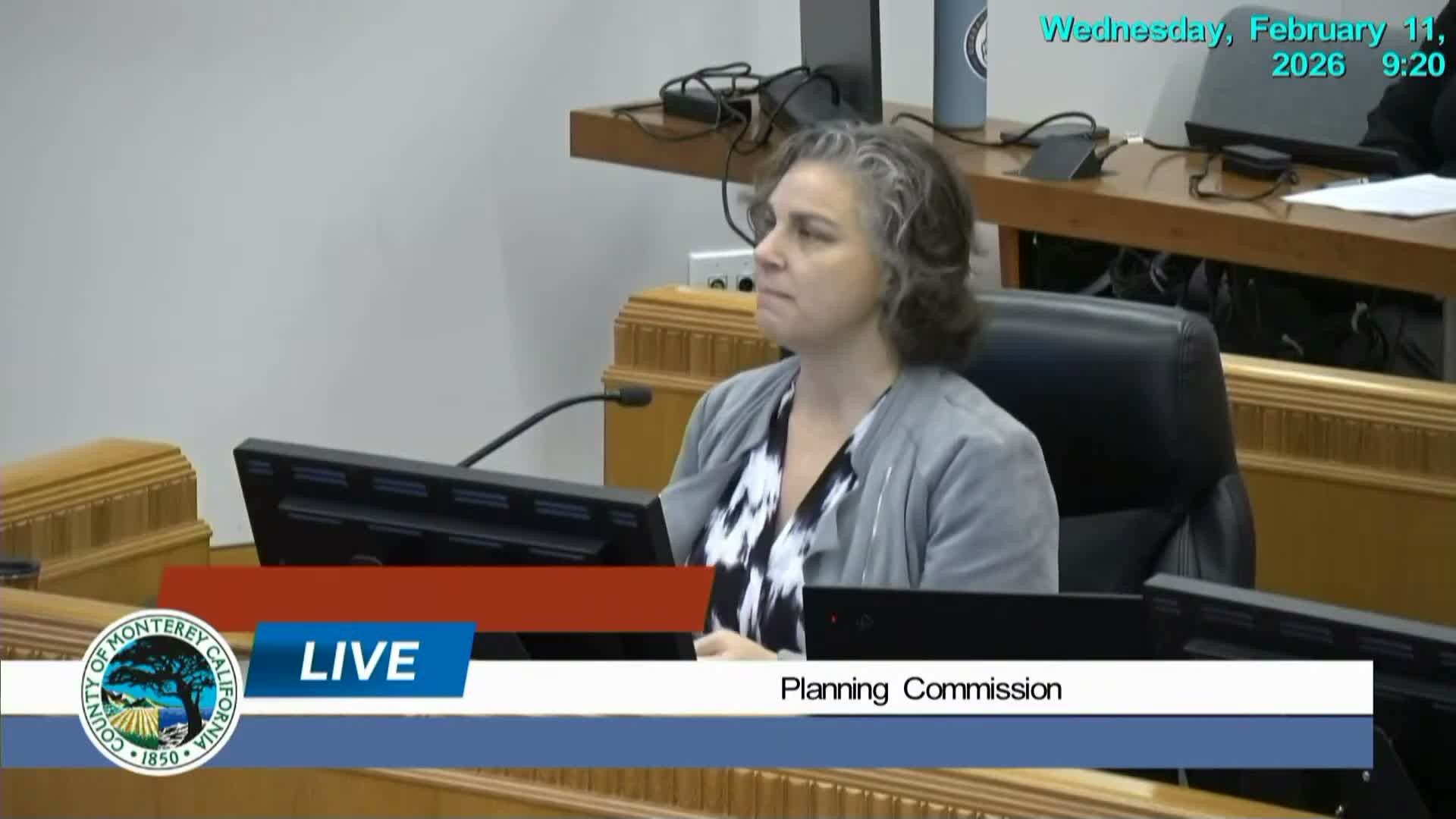
The Monterey County Planning Commission voted Feb. 11 to recommend denial of staff-proposed amendments to the county’s vacation-rental ordinances that would have banned vacation rentals in low-, medium- and high-density residential zones while allowing narrow exceptions for certain agricultural properties.
Melanie Berretti, chief of planning for Monterey County, told the commission staff drafted the changes after the Board of Supervisors directed amendments in response to ongoing litigation. "The board directed that the staff bring back amended ordinances that prohibit vacation rentals in residential zoning districts," Berretti said in her presentation, describing the goal as balancing residents’ access to long-term housing with opportunities for agricultural farm-stays in limited cases.
The staff proposal would recast homestays as "hosted" rentals — where the operator must occupy at least one bedroom and maintain the unit as a primary residence — and consolidate limited and commercial non-hosted categories into a single non-hosted class capped at 4% of single-family dwelling units by planning area. Staff also proposed making non-hosted approvals ministerial in allowed commercial, visitor-serving and some agricultural or rural-density residential locations, and adding enforcement tools for hosting platforms and administrative subpoenas to obtain listings data.
Craig Spencer, director of Housing and Community Development, placed the changes in a legal context: staff suspended enforcement of two ownership-related code provisions after a legal challenge and the board directed regulatory changes while litigation proceeds. "We are enforcing the existing regulations," Spencer said of current county practice, but added the proposed changes were intended to reduce county exposure while protecting neighborhoods.
Commissioners questioned the practical reach of the agricultural exception: under the draft, non-hosted vacation rentals could be allowed in rural-density residential zoning only when accessory to a "vetted commercial agricultural operation." Nadia Ochoa of the Agricultural Commissioner’s Office described the county’s vetting tools — including pesticide permits, organic certification and Williamson Act enrollment — that could be used to confirm a commercial agricultural operation.
Public comment ran for more than an hour, with a roughly even mix of residents urging stronger limits to protect neighborhood character and affordable workforce housing and homeowners and managers warning that a broad ban would destroy household income and reduce tourism revenue. "Every summer, we move into my mother’s home so that we can rent our home out responsibly and put income directly toward college savings," said Brianna Tringale, a Carmel resident and permit holder who urged the commission to consider local families who rely on rental income.
Speakers representing neighborhood groups and LandWatch urged the county to keep limits in place in residential neighborhoods to preserve housing for workers and reduce nuisance impacts. Industry representatives and members of the Monterey County Vacation Rental Alliance warned the proposal would eliminate lawful, permitted operations and urged alternatives such as removing the two legally vulnerable ownership provisions instead of a broad ban.
After deliberations, Commissioner Shaw moved — and Commissioner Gomez seconded — a motion to deny the staff-drafted ordinances as presented. The chair announced the motion passed before the meeting recessed for lunch. The motion denies the version that staff recommended to the Board of Supervisors and sends the commission’s recommendation back to the board.
What happens next: the Planning Commission’s recommendation now goes to the Board of Supervisors. If the board pursues ordinance changes, amendments for inland areas would take effect 30 days after board adoption; coastal-area changes would require submittal to and certification by the California Coastal Commission before final local adoption, per staff’s presentation.
The record: staff provided an addendum (Exhibit C) to the prior environmental review and submitted redline and clean draft ordinances for Titles 7, 20 and 21 as part of Exhibit A. Berretti said staff recorded 297 applications for vacation rentals across inland and coastal areas, including 36 approved hosted homestays and 3 approved commercial permits as of the date of her presentation.
The commission’s recorded recommendation does not change existing adopted regulations; the county has suspended enforcement of the two ownership provisions while litigation is pending, per staff and counsel statements during the hearing. The matter will next be considered by the Board of Supervisors.
Melanie Berretti, chief of planning for Monterey County, told the commission staff drafted the changes after the Board of Supervisors directed amendments in response to ongoing litigation. "The board directed that the staff bring back amended ordinances that prohibit vacation rentals in residential zoning districts," Berretti said in her presentation, describing the goal as balancing residents’ access to long-term housing with opportunities for agricultural farm-stays in limited cases.
The staff proposal would recast homestays as "hosted" rentals — where the operator must occupy at least one bedroom and maintain the unit as a primary residence — and consolidate limited and commercial non-hosted categories into a single non-hosted class capped at 4% of single-family dwelling units by planning area. Staff also proposed making non-hosted approvals ministerial in allowed commercial, visitor-serving and some agricultural or rural-density residential locations, and adding enforcement tools for hosting platforms and administrative subpoenas to obtain listings data.
Craig Spencer, director of Housing and Community Development, placed the changes in a legal context: staff suspended enforcement of two ownership-related code provisions after a legal challenge and the board directed regulatory changes while litigation proceeds. "We are enforcing the existing regulations," Spencer said of current county practice, but added the proposed changes were intended to reduce county exposure while protecting neighborhoods.
Commissioners questioned the practical reach of the agricultural exception: under the draft, non-hosted vacation rentals could be allowed in rural-density residential zoning only when accessory to a "vetted commercial agricultural operation." Nadia Ochoa of the Agricultural Commissioner’s Office described the county’s vetting tools — including pesticide permits, organic certification and Williamson Act enrollment — that could be used to confirm a commercial agricultural operation.
Public comment ran for more than an hour, with a roughly even mix of residents urging stronger limits to protect neighborhood character and affordable workforce housing and homeowners and managers warning that a broad ban would destroy household income and reduce tourism revenue. "Every summer, we move into my mother’s home so that we can rent our home out responsibly and put income directly toward college savings," said Brianna Tringale, a Carmel resident and permit holder who urged the commission to consider local families who rely on rental income.
Speakers representing neighborhood groups and LandWatch urged the county to keep limits in place in residential neighborhoods to preserve housing for workers and reduce nuisance impacts. Industry representatives and members of the Monterey County Vacation Rental Alliance warned the proposal would eliminate lawful, permitted operations and urged alternatives such as removing the two legally vulnerable ownership provisions instead of a broad ban.
After deliberations, Commissioner Shaw moved — and Commissioner Gomez seconded — a motion to deny the staff-drafted ordinances as presented. The chair announced the motion passed before the meeting recessed for lunch. The motion denies the version that staff recommended to the Board of Supervisors and sends the commission’s recommendation back to the board.
What happens next: the Planning Commission’s recommendation now goes to the Board of Supervisors. If the board pursues ordinance changes, amendments for inland areas would take effect 30 days after board adoption; coastal-area changes would require submittal to and certification by the California Coastal Commission before final local adoption, per staff’s presentation.
The record: staff provided an addendum (Exhibit C) to the prior environmental review and submitted redline and clean draft ordinances for Titles 7, 20 and 21 as part of Exhibit A. Berretti said staff recorded 297 applications for vacation rentals across inland and coastal areas, including 36 approved hosted homestays and 3 approved commercial permits as of the date of her presentation.
The commission’s recorded recommendation does not change existing adopted regulations; the county has suspended enforcement of the two ownership provisions while litigation is pending, per staff and counsel statements during the hearing. The matter will next be considered by the Board of Supervisors.
Don't Miss a Word: See the Full Meeting!
Go beyond summaries. Unlock every video, transcript, and key insight with a Founder Membership.
✓
Get instant access to full meeting videos
✓
Search and clip any phrase from complete transcripts
✓
Receive AI-powered summaries & custom alerts
✓
Enjoy lifetime, unrestricted access to government data
30-day money-back guarantee
