Va. subcommittee advances bill tightening who can sue over local land‑use approvals
February 12, 2026 | 2026 Legislature VA, Virginia
This article was created by AI summarizing key points discussed. AI makes mistakes, so for full details and context, please refer to the video of the full meeting. Please report any errors so we can fix them. Report an error »
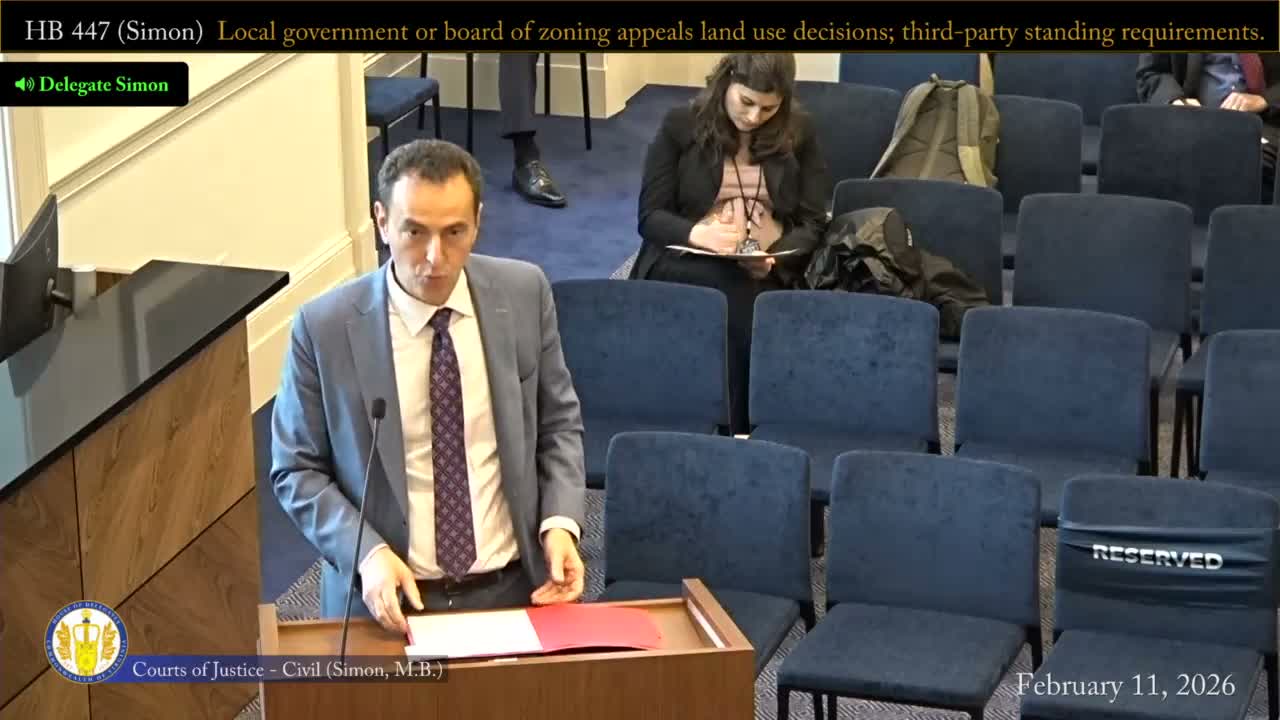
A House subcommittee voted 5–4 on Feb. 12 to report HB 447, legislation that would narrow who may sue to challenge local land‑use approvals by codifying the Friends of the Rappahannock standard and reversing the reasoning in the Wegmans decision.
The bill’s sponsor, Delegate Simon, told the panel the measure seeks to prevent what he called repetitive, speculative lawsuits that relitigate transportation studies, traffic and other generalized concerns in circuit court rather than in the local planning process. He said HB 447 would remove alleged changes in property values, traffic, parking, noise and air pollution from the list of harms courts may treat as the particularized burden necessary for standing and instead require a harm closely connected to the claimant’s own property.
Supporters — including builders, municipal leaders and housing advocates — said the bill would protect local governments and developers from protracted litigation that delays housing and raises costs. Andrew Clark of the Home Builders Association of Virginia said the measure is designed to promote predictability, aiming at “removing barriers and creating predictability” for projects after lengthy local review. Wendy Ginsberg, speaking for the City of Alexandria, said, “HB 447 puts the standard clearly into law that helps ensure that zoning decisions are not delayed by lawsuits based on generalized concerns.”
Advocates who oppose the bill warned it would make it harder for affected residents and nonprofit groups to get their day in court. A Southern Environmental Law Center representative told the committee that the proposal “would keep people out of court” and cautioned against denying parties the ability to challenge local decisions; the witness added, “They deserve their day in court.” Alexander McAuley of the American Battlefield Trust and the Piedmont Environmental Council called the draft “overkill” and warned the changes reach beyond recent case law.
Several witnesses recounted local consequences of litigation. Katie Crystal, a former chair of the Arlington County Board, said one zoning reform was tied up in court for nearly three years and that her locality spent “close to 3 years and over $1,000,000 of taxpayer resources” defending the policy, a cost she said HB 447 would help avoid.
During committee debate members pressed the patron on several points: whether nonprofits could still assist individuals who cannot afford litigation, whether proximate and individualized harms (for example, an easement or a data center casting a shadow across a homeowner’s property) would still confer standing, and why the bill uses a clear‑and‑convincing evidentiary standard. Delegate Simon said the intent is to raise the bar against nuisance suits while preserving claims based on direct, particularized injuries.
The panel adopted two amendments before the final vote. One struck language that would have made property ownership an automatic basis for standing (deleting the relevant text on lines 52–53). A second technical edit changed present‑tense phrasing to reflect the litigation posture (changing wording such as “has suffered” to “will suffer” in the cited lines). The subcommittee then voted to report the bill, as amended, by a 5–4 margin.
The measure will move next to the full committee for further consideration. The subcommittee adjourned after the vote.
The bill’s sponsor, Delegate Simon, told the panel the measure seeks to prevent what he called repetitive, speculative lawsuits that relitigate transportation studies, traffic and other generalized concerns in circuit court rather than in the local planning process. He said HB 447 would remove alleged changes in property values, traffic, parking, noise and air pollution from the list of harms courts may treat as the particularized burden necessary for standing and instead require a harm closely connected to the claimant’s own property.
Supporters — including builders, municipal leaders and housing advocates — said the bill would protect local governments and developers from protracted litigation that delays housing and raises costs. Andrew Clark of the Home Builders Association of Virginia said the measure is designed to promote predictability, aiming at “removing barriers and creating predictability” for projects after lengthy local review. Wendy Ginsberg, speaking for the City of Alexandria, said, “HB 447 puts the standard clearly into law that helps ensure that zoning decisions are not delayed by lawsuits based on generalized concerns.”
Advocates who oppose the bill warned it would make it harder for affected residents and nonprofit groups to get their day in court. A Southern Environmental Law Center representative told the committee that the proposal “would keep people out of court” and cautioned against denying parties the ability to challenge local decisions; the witness added, “They deserve their day in court.” Alexander McAuley of the American Battlefield Trust and the Piedmont Environmental Council called the draft “overkill” and warned the changes reach beyond recent case law.
Several witnesses recounted local consequences of litigation. Katie Crystal, a former chair of the Arlington County Board, said one zoning reform was tied up in court for nearly three years and that her locality spent “close to 3 years and over $1,000,000 of taxpayer resources” defending the policy, a cost she said HB 447 would help avoid.
During committee debate members pressed the patron on several points: whether nonprofits could still assist individuals who cannot afford litigation, whether proximate and individualized harms (for example, an easement or a data center casting a shadow across a homeowner’s property) would still confer standing, and why the bill uses a clear‑and‑convincing evidentiary standard. Delegate Simon said the intent is to raise the bar against nuisance suits while preserving claims based on direct, particularized injuries.
The panel adopted two amendments before the final vote. One struck language that would have made property ownership an automatic basis for standing (deleting the relevant text on lines 52–53). A second technical edit changed present‑tense phrasing to reflect the litigation posture (changing wording such as “has suffered” to “will suffer” in the cited lines). The subcommittee then voted to report the bill, as amended, by a 5–4 margin.
The measure will move next to the full committee for further consideration. The subcommittee adjourned after the vote.
View the Full Meeting & All Its Details
This article offers just a summary. Unlock complete video, transcripts, and insights as a Founder Member.
✓
Watch full, unedited meeting videos
✓
Search every word spoken in unlimited transcripts
✓
AI summaries & real-time alerts (all government levels)
✓
Permanent access to expanding government content
30-day money-back guarantee
