Bakersfield council directs staff to start Proposition 218 notice for multiyear sewer-rate plan
February 12, 2026 | Bakersfield, Kern County, California
This article was created by AI summarizing key points discussed. AI makes mistakes, so for full details and context, please refer to the video of the full meeting. Please report any errors so we can fix them. Report an error »
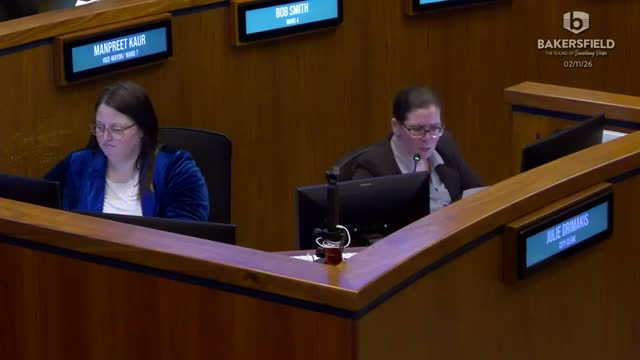
City of Bakersfield officials on Feb. 11 directed staff to begin the Proposition 218 notice process for a multiyear sewer-rate and capital plan designed to repair aging treatment plants and expand capacity.
Staff presented options developed with HF&H and AECOM consultants and recommended a five-year rate sequence that would start at $475 per year in year one ($39.60 per month) and increase by $100 per year until it reaches $875 annually in year five ($72.90 per month). The recommendation also anticipates issuing a bond of about $150 million around year six to cover larger capital projects. "The recommended rate is to increase the year 1 to $475, and then over the next 4 years, increase $100 a year until the end of the Prop 218 five-year period," a staff presenter said during the presentation.
Staff and consultants said the recommendation was shaped by an alternatives analysis that evaluated upgrading Plant 2 and expanding Plant 3, building a new Plant 4 in phases, and a hybrid approach. AECOM’s engineering work identified near-term repairs at Plant 3 ("Plant 3 Phase 0") and replacement or upgrade needs at Plant 2; staff said a combination of alternative 1 (upgrade Plant 2 and expand Plant 3) and alternative 3 (a new Plant 4 in certain phases) appeared to be most cost-effective to meet projected 2050 flows.
Kern County Supervisor Philip Peters and county and district engineers asked staff to provide the AECOM engineer report with sufficient time for interagency review before the Prop 218 process proceeds. "When significant rate increases are proposed, we want to ensure the process is as transparent as possible," Peters said during public comment, asking that the engineering report be published for county review.
Staff acknowledged AECOM’s report was completed in January and said cost-of-service materials had been public since October. City staff described the Prop 218 timeline: mail the notice by the end of February, allow a 45-day public review and protest period, and return for a public hearing in April (the staff presentation identified April dates for the hearing). City staff also said they would update the sewer rate and fee report and include links or QR codes to the engineer and cost-of-service reports in the mailed Prop 218 package.
Council members expressed repeated concern for affordability and directed staff to return with options for a rate-assistance program for low-income and fixed-income residents. Vice Mayor asked staff to research programs that could mitigate the monthly cost increases for seniors, veterans and disabled residents; staff said the assistance program itself would not be part of the Prop 218 rate notice but could be referred back for budget consideration.
Finance Director Randy McKean outlined how bonding capacity is tied to rate-setting and reserves: larger bonds require higher debt-service coverage and reserve build-up. Staff said the recommended approach aims to modestly phase rate increases, build reserves to support a staged bond (staff cited $100 million–$150 million as a likely range for initial bonding), and return to council for any later bonding decisions when construction designs and costs are better defined.
Councilmember Smith moved to direct staff to start the Prop 218 notice using the recommended rate sequence; the motion passed with Councilmember Weir recorded as voting no. Staff will mail the Prop 218 notices, make supporting reports available online, accept public protests during the 45-day window and hold a public hearing in April where the council may adopt, modify, or reject the proposed rate schedule.
What happens next: the Prop 218 notice and updated cost-of-service materials will be mailed and posted for public review; the council will take public testimony at the scheduled hearing in April and may act afterward to adopt rates or amend the plan.
Staff presented options developed with HF&H and AECOM consultants and recommended a five-year rate sequence that would start at $475 per year in year one ($39.60 per month) and increase by $100 per year until it reaches $875 annually in year five ($72.90 per month). The recommendation also anticipates issuing a bond of about $150 million around year six to cover larger capital projects. "The recommended rate is to increase the year 1 to $475, and then over the next 4 years, increase $100 a year until the end of the Prop 218 five-year period," a staff presenter said during the presentation.
Staff and consultants said the recommendation was shaped by an alternatives analysis that evaluated upgrading Plant 2 and expanding Plant 3, building a new Plant 4 in phases, and a hybrid approach. AECOM’s engineering work identified near-term repairs at Plant 3 ("Plant 3 Phase 0") and replacement or upgrade needs at Plant 2; staff said a combination of alternative 1 (upgrade Plant 2 and expand Plant 3) and alternative 3 (a new Plant 4 in certain phases) appeared to be most cost-effective to meet projected 2050 flows.
Kern County Supervisor Philip Peters and county and district engineers asked staff to provide the AECOM engineer report with sufficient time for interagency review before the Prop 218 process proceeds. "When significant rate increases are proposed, we want to ensure the process is as transparent as possible," Peters said during public comment, asking that the engineering report be published for county review.
Staff acknowledged AECOM’s report was completed in January and said cost-of-service materials had been public since October. City staff described the Prop 218 timeline: mail the notice by the end of February, allow a 45-day public review and protest period, and return for a public hearing in April (the staff presentation identified April dates for the hearing). City staff also said they would update the sewer rate and fee report and include links or QR codes to the engineer and cost-of-service reports in the mailed Prop 218 package.
Council members expressed repeated concern for affordability and directed staff to return with options for a rate-assistance program for low-income and fixed-income residents. Vice Mayor asked staff to research programs that could mitigate the monthly cost increases for seniors, veterans and disabled residents; staff said the assistance program itself would not be part of the Prop 218 rate notice but could be referred back for budget consideration.
Finance Director Randy McKean outlined how bonding capacity is tied to rate-setting and reserves: larger bonds require higher debt-service coverage and reserve build-up. Staff said the recommended approach aims to modestly phase rate increases, build reserves to support a staged bond (staff cited $100 million–$150 million as a likely range for initial bonding), and return to council for any later bonding decisions when construction designs and costs are better defined.
Councilmember Smith moved to direct staff to start the Prop 218 notice using the recommended rate sequence; the motion passed with Councilmember Weir recorded as voting no. Staff will mail the Prop 218 notices, make supporting reports available online, accept public protests during the 45-day window and hold a public hearing in April where the council may adopt, modify, or reject the proposed rate schedule.
What happens next: the Prop 218 notice and updated cost-of-service materials will be mailed and posted for public review; the council will take public testimony at the scheduled hearing in April and may act afterward to adopt rates or amend the plan.
View the Full Meeting & All Its Details
This article offers just a summary. Unlock complete video, transcripts, and insights as a Founder Member.
✓
Watch full, unedited meeting videos
✓
Search every word spoken in unlimited transcripts
✓
AI summaries & real-time alerts (all government levels)
✓
Permanent access to expanding government content
30-day money-back guarantee
