Montana high court hears challenge to SB 109, plaintiffs say PSC map dilutes non‑Republican votes
February 12, 2026 | Montana Courts, Montana
This article was created by AI summarizing key points discussed. AI makes mistakes, so for full details and context, please refer to the video of the full meeting. Please report any errors so we can fix them. Report an error »
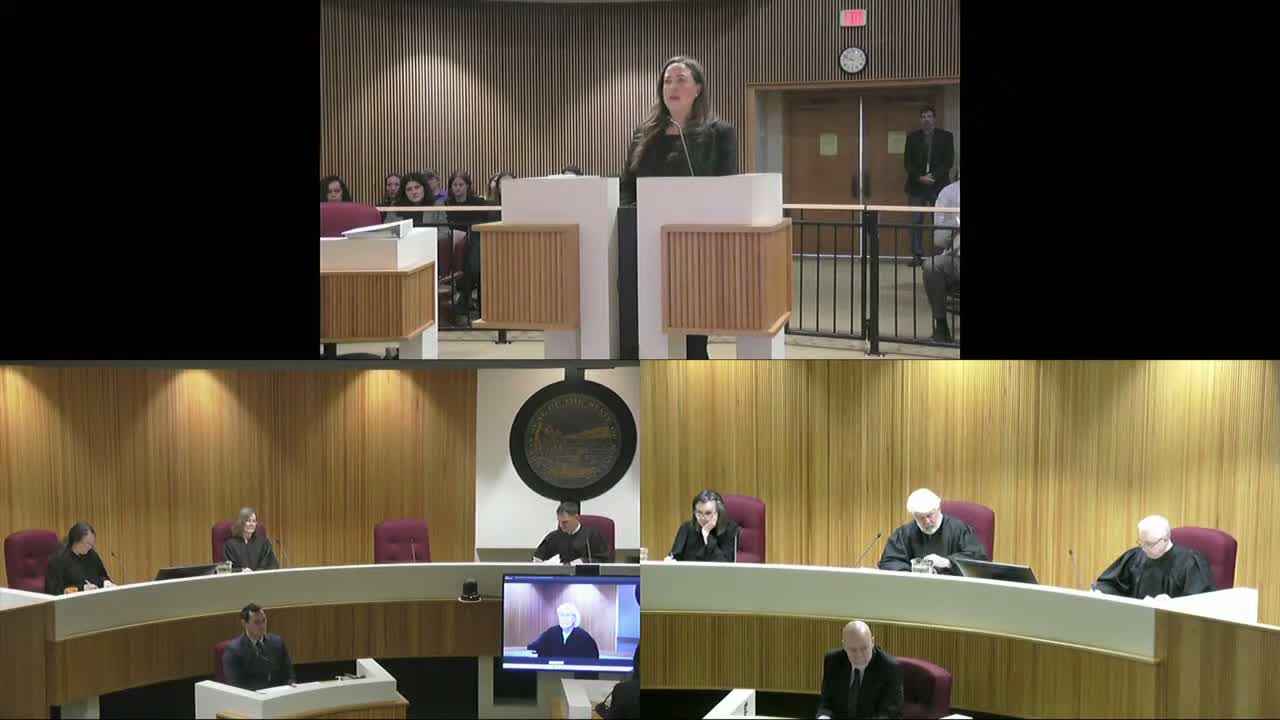
The Montana Supreme Court on oral argument considered whether Senate Bill 109, which redraws Public Service Commission districts, unlawfully dilutes the voting power of Montana residents who typically support non‑Republican candidates.
"The Montana constitution prohibits the state from discriminating against its citizens' exercise of their political and civil rights on the basis of political ideology," Molly Danahy, counsel for Montana Conservation Voters and eight individual plaintiffs, told the court. Danahy urged the justices to decide the case under Article 13 (the right to suffrage) using an effects‑based test for vote dilution, saying the record shows SB 109 "ensures only Republicans will be elected to the Public Service Commission" unless non‑Republican statewide support exceeds 50 percent.
Danahy argued plaintiffs do not need to prove partisan intent to prevail on the right‑to‑suffrage theory. She said the district court erred by treating intent as a prerequisite and that, under Montana precedent, an effects‑based showing of disparate impact is sufficient. Danahy pointed to expert ensemble simulations in the record that, she said, show maps with similar neutral criteria would allow non‑Republican voters to elect PSC candidates starting near a 38 percent statewide vote share, whereas SB 109 does not permit such opportunity until the non‑Republican share exceeds 50 percent.
Intervenor counsel Christian Corrigan, Solicitor General for the intervener Senator Keith Regier, countered that the court should uphold the district court's decision to quash a subpoena seeking the senator's motives. "This court should affirm the district court's decision quashing the subpoena to Senator Regier for three reasons," Corrigan said, arguing that Article 5, Section 8's legislative privilege and separation‑of‑powers principles protect legislators' internal deliberations and that post‑session inquiries into private forethought are governed by longstanding privilege doctrine.
Michael Russell, representing Secretary of State Christy Jacobson, urged the justices to avoid adopting standards that would draw the court into partisan disputes. He argued for deference to the district court's findings and the jury's verdict, contending plaintiffs failed to meet their burden and that remedies are practically constrained by upcoming elections and filing deadlines.
Justices pursued detailed questioning of counsel on several recurring issues: whether Montana's constitutional nondiscrimination language (Article 4) links to the suffrage guarantee in Article 13; whether an effects‑based test is a manageable judicial standard; whether proving discriminatory intent remains necessary under equal‑protection principles; and how legislative privilege, waiver doctrine, and the state's "right to know" interact when ballots and maps are drawn.
Counsel debated whether adopting an effects‑based standard would invite courts to act as permanent referees in redistricting. Danahy emphasized a narrow, limited test she described as applying only where a map "imposes an extreme and durable dilutive effect that systematically prevents a substantial minority from the opportunity to elect candidates of choice," arguing that such maps are rare and identifiable with expert simulations. Russell and Corrigan warned that removing an intent requirement or broadly permitting depositions into legislators' motives would create hard‑to‑manage litigation and could conflict with separation‑of‑powers protections.
The oral argument also addressed practical and procedural questions: whether legislative documents prepared with the assistance of legislative services are confidential, whether third‑party involvement can waive privilege, and what remedies the court could fashion on the eve of imminent elections. Counsel suggested narrower discovery tools (Apex doctrine, burden analysis) to limit harassment while permitting necessary scrutiny.
The court took the matter under advisement after extended questioning. The justices asked counsel to propose manageable lines for when a court should intervene and to clarify the relationship between different constitutional provisions and privilege doctrines. The case record and jury findings, the parties noted, will factor into any ultimate ruling.
If the court were to adopt an effects‑based right‑to‑suffrage test and find SB 109 unconstitutional, the practical consequences could include remand for map redrawing or declaratory relief directing a later legislative or remedial process; the justices noted timelines for upcoming PSC elections and candidate filing deadlines as constraints on immediate remedies.
The court has taken the question under submission; no decision was announced at the hearing.
"The Montana constitution prohibits the state from discriminating against its citizens' exercise of their political and civil rights on the basis of political ideology," Molly Danahy, counsel for Montana Conservation Voters and eight individual plaintiffs, told the court. Danahy urged the justices to decide the case under Article 13 (the right to suffrage) using an effects‑based test for vote dilution, saying the record shows SB 109 "ensures only Republicans will be elected to the Public Service Commission" unless non‑Republican statewide support exceeds 50 percent.
Danahy argued plaintiffs do not need to prove partisan intent to prevail on the right‑to‑suffrage theory. She said the district court erred by treating intent as a prerequisite and that, under Montana precedent, an effects‑based showing of disparate impact is sufficient. Danahy pointed to expert ensemble simulations in the record that, she said, show maps with similar neutral criteria would allow non‑Republican voters to elect PSC candidates starting near a 38 percent statewide vote share, whereas SB 109 does not permit such opportunity until the non‑Republican share exceeds 50 percent.
Intervenor counsel Christian Corrigan, Solicitor General for the intervener Senator Keith Regier, countered that the court should uphold the district court's decision to quash a subpoena seeking the senator's motives. "This court should affirm the district court's decision quashing the subpoena to Senator Regier for three reasons," Corrigan said, arguing that Article 5, Section 8's legislative privilege and separation‑of‑powers principles protect legislators' internal deliberations and that post‑session inquiries into private forethought are governed by longstanding privilege doctrine.
Michael Russell, representing Secretary of State Christy Jacobson, urged the justices to avoid adopting standards that would draw the court into partisan disputes. He argued for deference to the district court's findings and the jury's verdict, contending plaintiffs failed to meet their burden and that remedies are practically constrained by upcoming elections and filing deadlines.
Justices pursued detailed questioning of counsel on several recurring issues: whether Montana's constitutional nondiscrimination language (Article 4) links to the suffrage guarantee in Article 13; whether an effects‑based test is a manageable judicial standard; whether proving discriminatory intent remains necessary under equal‑protection principles; and how legislative privilege, waiver doctrine, and the state's "right to know" interact when ballots and maps are drawn.
Counsel debated whether adopting an effects‑based standard would invite courts to act as permanent referees in redistricting. Danahy emphasized a narrow, limited test she described as applying only where a map "imposes an extreme and durable dilutive effect that systematically prevents a substantial minority from the opportunity to elect candidates of choice," arguing that such maps are rare and identifiable with expert simulations. Russell and Corrigan warned that removing an intent requirement or broadly permitting depositions into legislators' motives would create hard‑to‑manage litigation and could conflict with separation‑of‑powers protections.
The oral argument also addressed practical and procedural questions: whether legislative documents prepared with the assistance of legislative services are confidential, whether third‑party involvement can waive privilege, and what remedies the court could fashion on the eve of imminent elections. Counsel suggested narrower discovery tools (Apex doctrine, burden analysis) to limit harassment while permitting necessary scrutiny.
The court took the matter under advisement after extended questioning. The justices asked counsel to propose manageable lines for when a court should intervene and to clarify the relationship between different constitutional provisions and privilege doctrines. The case record and jury findings, the parties noted, will factor into any ultimate ruling.
If the court were to adopt an effects‑based right‑to‑suffrage test and find SB 109 unconstitutional, the practical consequences could include remand for map redrawing or declaratory relief directing a later legislative or remedial process; the justices noted timelines for upcoming PSC elections and candidate filing deadlines as constraints on immediate remedies.
The court has taken the question under submission; no decision was announced at the hearing.
Don't Miss a Word: See the Full Meeting!
Go beyond summaries. Unlock every video, transcript, and key insight with a Founder Membership.
✓
Get instant access to full meeting videos
✓
Search and clip any phrase from complete transcripts
✓
Receive AI-powered summaries & custom alerts
✓
Enjoy lifetime, unrestricted access to government data
30-day money-back guarantee
