Senators hear industry support to raise tobacco tax-stamp discount to 3.75% to cover compliance costs
February 12, 2026 | General Government Operations and Appropriations , Legislative, Guam, International
This article was created by AI summarizing key points discussed. AI makes mistakes, so for full details and context, please refer to the video of the full meeting. Please report any errors so we can fix them. Report an error »
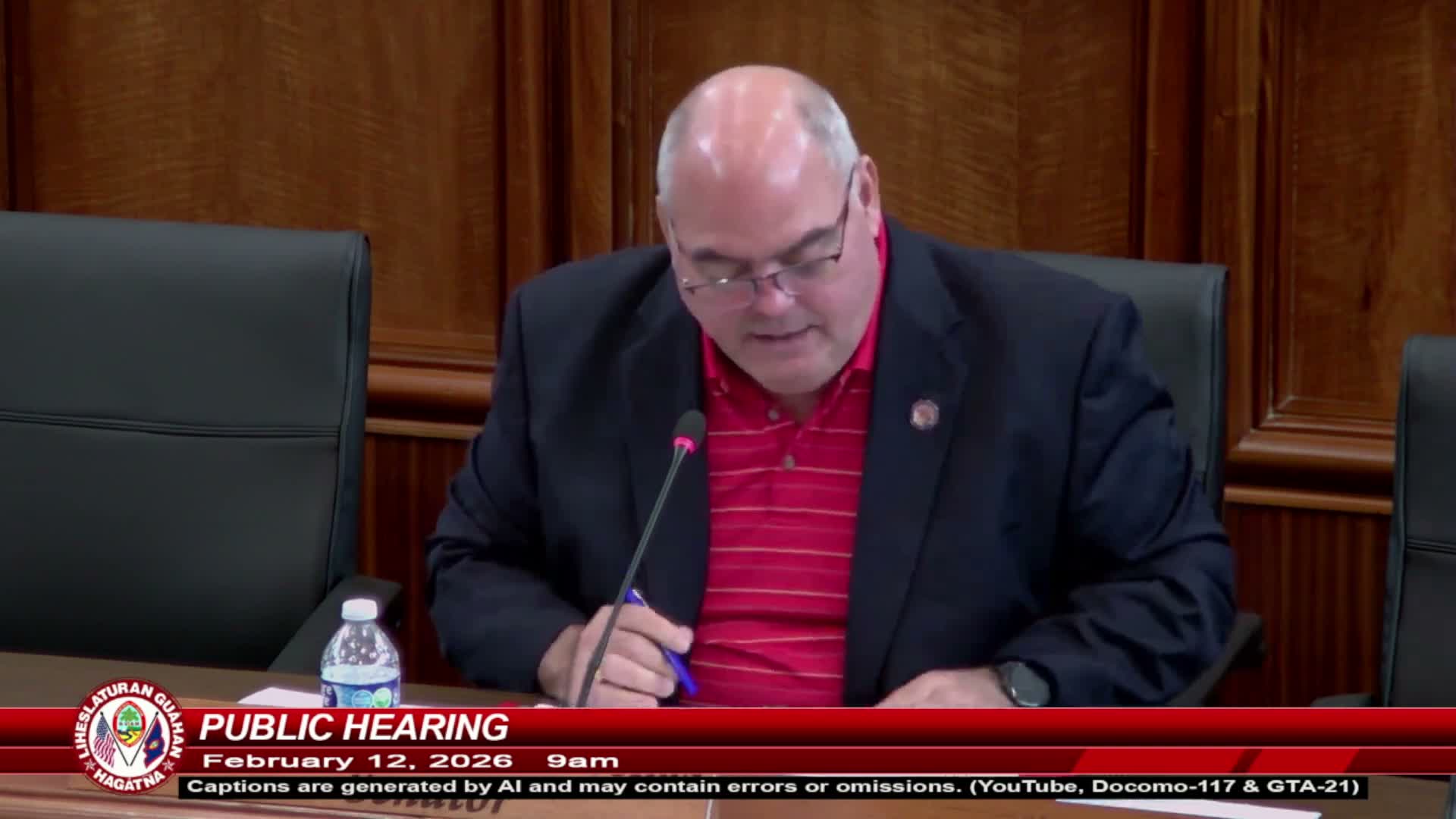
The Committee on Finance and Government Operations heard public testimony on Bill 205-38 on Feb. 4, a measure to amend section 6802(e) of article 8, chapter 6, title 11 of the Guam Code Annotated to raise the licensee discount for purchasing tobacco tax stamps from 0.4% (four-tenths of one percent) to 3.75% (three and three-quarters percent).
Senator St. Augustine, the bill's sponsor, said the original discount was set in 2017, before implementation, and no one at the time knew the full cost of complying with a stamping program. A Department of Revenue and Taxation (DRT) letter dated Oct. 8, 2025, from Director Maria Lazama was read into the record; the letter recommended that the discount be set at no more than 3.75% (equivalent to 15 cents per stamp) and advised correcting a statutory citation in the bill to Title 11.
Ricardo C. Duenas, chief financial officer of WESCO Trading Company, testified in support of the increase. He described the operational costs distributors have assumed since implementation: purchase of stamp machines that he said cost roughly $150,000'$200,000 each, hiring six to 10 staff to operate stamping lines, installing climate-control equipment to protect machines and product, bringing in vendor technicians for installation and maintenance (testimony cited a vendor visit fee of about $15,000), and training costs. "The 0.4% just didn't cut it," Duenas said, and he supported the 3.75% discount as a reimbursement to keep the program viable for private distributors.
Senators questioned the procurement timeline for the print and distribution of stamps (citing Office of Public Accountability report 23-02) and asked BBMR and DRT to provide revenue and collection data so the bill's fiscal impact can be assessed. One senator noted the Healthy Futures Fund averages about $33 million over the last five years and asked for a summary of revenues attributable to tobacco-stamp activity to help evaluate any change to the discount.
Cosponsors and committee members praised the private sector for underwriting implementation and said further oversight and audits (including possible public auditor review) should follow to verify whether the private-sector approach is working as intended. Senator St. Augustine closed by urging committee support; the hearing concluded with no final vote and a short recess.
Next steps identified by the committee included: DRT to provide revenue/collection data for BBMR to update the fiscal note and continued oversight hearings to monitor collections and the stamping program's operational impact.
Senator St. Augustine, the bill's sponsor, said the original discount was set in 2017, before implementation, and no one at the time knew the full cost of complying with a stamping program. A Department of Revenue and Taxation (DRT) letter dated Oct. 8, 2025, from Director Maria Lazama was read into the record; the letter recommended that the discount be set at no more than 3.75% (equivalent to 15 cents per stamp) and advised correcting a statutory citation in the bill to Title 11.
Ricardo C. Duenas, chief financial officer of WESCO Trading Company, testified in support of the increase. He described the operational costs distributors have assumed since implementation: purchase of stamp machines that he said cost roughly $150,000'$200,000 each, hiring six to 10 staff to operate stamping lines, installing climate-control equipment to protect machines and product, bringing in vendor technicians for installation and maintenance (testimony cited a vendor visit fee of about $15,000), and training costs. "The 0.4% just didn't cut it," Duenas said, and he supported the 3.75% discount as a reimbursement to keep the program viable for private distributors.
Senators questioned the procurement timeline for the print and distribution of stamps (citing Office of Public Accountability report 23-02) and asked BBMR and DRT to provide revenue and collection data so the bill's fiscal impact can be assessed. One senator noted the Healthy Futures Fund averages about $33 million over the last five years and asked for a summary of revenues attributable to tobacco-stamp activity to help evaluate any change to the discount.
Cosponsors and committee members praised the private sector for underwriting implementation and said further oversight and audits (including possible public auditor review) should follow to verify whether the private-sector approach is working as intended. Senator St. Augustine closed by urging committee support; the hearing concluded with no final vote and a short recess.
Next steps identified by the committee included: DRT to provide revenue/collection data for BBMR to update the fiscal note and continued oversight hearings to monitor collections and the stamping program's operational impact.
Don't Miss a Word: See the Full Meeting!
Go beyond summaries. Unlock every video, transcript, and key insight with a Founder Membership.
✓
Get instant access to full meeting videos
✓
Search and clip any phrase from complete transcripts
✓
Receive AI-powered summaries & custom alerts
✓
Enjoy lifetime, unrestricted access to government data
30-day money-back guarantee
