Planning commission workshop narrows Recreation Benefit Program choices; stakeholders press for setbacks and strong AEO safeguards
February 12, 2026 | Santa Barbara County, California
This article was created by AI summarizing key points discussed. AI makes mistakes, so for full details and context, please refer to the video of the full meeting. Please report any errors so we can fix them. Report an error »
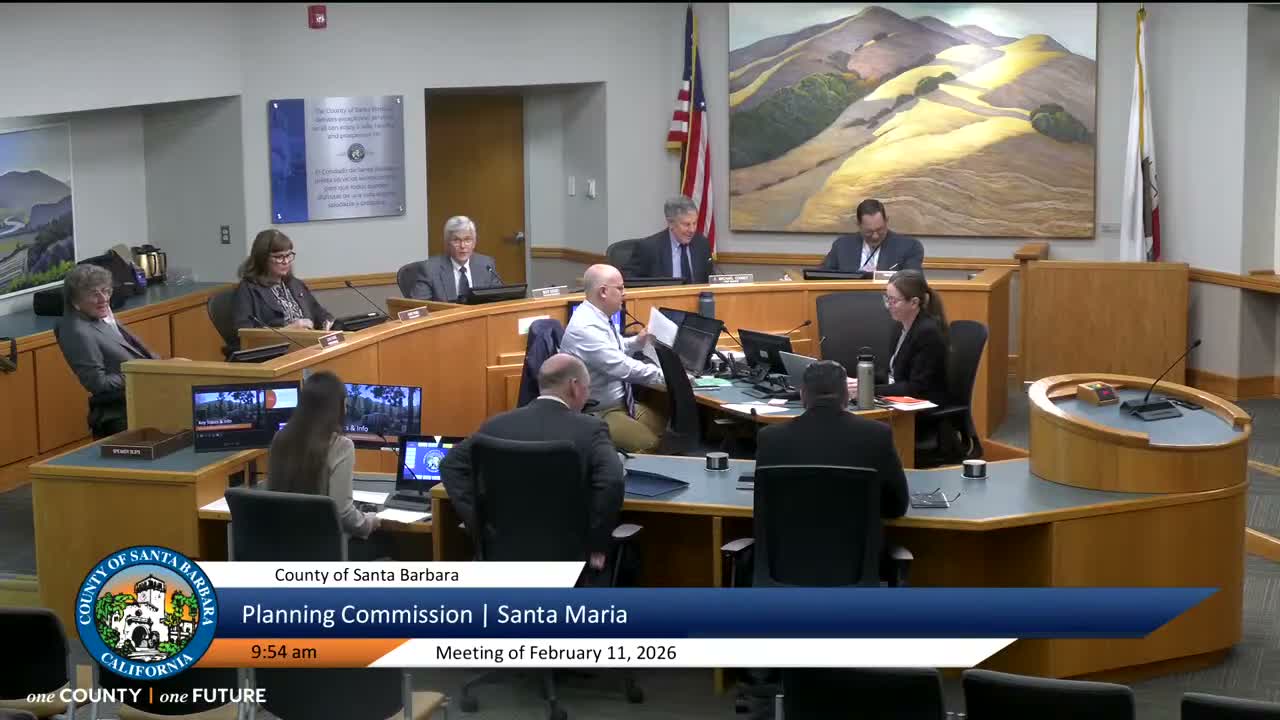
The Santa Barbara County Planning Commission used a Feb. 11 workshop to narrow policy choices that will define the Recreation Benefit Program (RBP) and related Land Use and Development Code amendments and to shape assumptions for the programmatic environmental impact report.
Staff from the Planning and Development Department and the Community Services Department summarized months of public input and asked the commission for direction on four core topics: the range of incentives to entice private partners (examples include country inns, trailside cafes, day‑use wellness facilities and overnight camps), the zoning eligibility and minimum parcel sizes for incentive uses, setbacks from active agricultural uses, and the permitting path (use of land use permits vs conditional use permits and possible waivers of development plan requirements).
Staff said the RBP is a separate program from the Agricultural Enterprise Ordinance (AEO) though it borrows some ideas; eligibility will be determined by staff with a director‑level decision in Community Services and an appeal process is being considered. Proposed incentives are intended to be narrow and tied to in‑kind recreational contributions that provide public benefit; staff emphasized that existing development standards (infrastructure, building codes, environmental health) would still apply to projects that access incentives.
A central policy dispute at the workshop concerned setbacks from active row‑crop agriculture. Commissioners and public commenters discussed a range of options: staff initially proposed a 200‑foot standard in some contexts and identified 300 feet as another option; the Grower‑Shipper Association and some commissioners urged a 1,000‑foot setback from row crops inside the AEO overlay to protect food safety and reduce conflicts. Commissioner Park proposed a framework that would apply a 1,000‑foot setback where both project and adjacent row‑crop are in the AEO overlay, a 300‑foot setback outside the overlay, and allow setbacks to be reduced by written agreement between adjoining landowners. Staff said these alternatives will be analyzed in the EIR.
Commissioners debated minimum parcel or premise sizes for incentive uses. Commissioner Park repeatedly recommended preserving a 40‑acre minimum for larger incentive uses (country inns, campgrounds) to avoid incremental commercialization of small parcels; staff noted some potential projects may involve parcels smaller than 40 acres (or combined parcels) and recommended flexible approaches for certain trail or park projects.
On incentives and numeric assumptions, staff presented draft CEQA‑level numbers to inform analysis: a 20,000 sq ft maximum floor area for a new country inn (illustrative maximum, or aggregate for clustered cottages), a larger interior size for trailside cafes (staff and some commissioners discussed 1,200–3,000 sq ft), and campground thresholds for permitting (LUP up to 70 sites; minor CUP up to 120 sites; full CUP 121+ sites). Staff also proposed allowing some conversions of existing structures without invoking size caps.
Process and appeals became another focal point. Commissioner Park urged an expanded consultation step that would include technical departments and advisory groups (fire, flood control, CREATAC, AAC) early in the eligibility review so applicants understand requirements before investing in proposals. Park also proposed an eligibility‑stage appeal (to an appellate review board or similar body) for applicants denied RBP eligibility, and limited public appeal availability in some CUP‑scale cases if compatibility findings were removed at later stages. Staff and other commissioners said most RBP projects are expected to use a land use permit pathway and only larger projects will require CUPs; appeals and public noticing options will be designed accordingly and analyzed for legal constraints.
Public commenters reflected broad but divergent interests. Grower and shipper representatives urged robust setbacks and adequate fencing options to protect crops and food safety; WeWatch asked that RBP participation require demonstrable recreational need and recommended strict alignment with AEO standards where RBP incentives are applied to ag land; equestrian advocates asked for explicit protections for trails with long‑standing equestrian use (noting habitat and safety concerns on the North Shore/Live Oak Trail); conservation and trails advisors asked for precise policy language rather than aspirational 'shoulds' so protection and maintenance obligations are enforceable. Several ranchers urged the county to include lower‑capital incentives such as periodic events and outdoor activities that do not require permanent structures.
After public comment, Commissioner Park moved and Commissioner Ford seconded a motion to receive and file the workshop materials and the narrow recommended actions for purposes of preparing the programmatic EIR; Commissioner Cooney recused from that vote. The motion passed 4–0. Staff said the public draft EIR is expected in coming months and that further commission hearings and committee consultations will follow as the EIR and ordinance amendments are prepared.
Next steps: staff will incorporate feedback into the project description for the programmatic EIR and will continue stakeholder outreach and committee reviews before publishing the public draft document.
Staff from the Planning and Development Department and the Community Services Department summarized months of public input and asked the commission for direction on four core topics: the range of incentives to entice private partners (examples include country inns, trailside cafes, day‑use wellness facilities and overnight camps), the zoning eligibility and minimum parcel sizes for incentive uses, setbacks from active agricultural uses, and the permitting path (use of land use permits vs conditional use permits and possible waivers of development plan requirements).
Staff said the RBP is a separate program from the Agricultural Enterprise Ordinance (AEO) though it borrows some ideas; eligibility will be determined by staff with a director‑level decision in Community Services and an appeal process is being considered. Proposed incentives are intended to be narrow and tied to in‑kind recreational contributions that provide public benefit; staff emphasized that existing development standards (infrastructure, building codes, environmental health) would still apply to projects that access incentives.
A central policy dispute at the workshop concerned setbacks from active row‑crop agriculture. Commissioners and public commenters discussed a range of options: staff initially proposed a 200‑foot standard in some contexts and identified 300 feet as another option; the Grower‑Shipper Association and some commissioners urged a 1,000‑foot setback from row crops inside the AEO overlay to protect food safety and reduce conflicts. Commissioner Park proposed a framework that would apply a 1,000‑foot setback where both project and adjacent row‑crop are in the AEO overlay, a 300‑foot setback outside the overlay, and allow setbacks to be reduced by written agreement between adjoining landowners. Staff said these alternatives will be analyzed in the EIR.
Commissioners debated minimum parcel or premise sizes for incentive uses. Commissioner Park repeatedly recommended preserving a 40‑acre minimum for larger incentive uses (country inns, campgrounds) to avoid incremental commercialization of small parcels; staff noted some potential projects may involve parcels smaller than 40 acres (or combined parcels) and recommended flexible approaches for certain trail or park projects.
On incentives and numeric assumptions, staff presented draft CEQA‑level numbers to inform analysis: a 20,000 sq ft maximum floor area for a new country inn (illustrative maximum, or aggregate for clustered cottages), a larger interior size for trailside cafes (staff and some commissioners discussed 1,200–3,000 sq ft), and campground thresholds for permitting (LUP up to 70 sites; minor CUP up to 120 sites; full CUP 121+ sites). Staff also proposed allowing some conversions of existing structures without invoking size caps.
Process and appeals became another focal point. Commissioner Park urged an expanded consultation step that would include technical departments and advisory groups (fire, flood control, CREATAC, AAC) early in the eligibility review so applicants understand requirements before investing in proposals. Park also proposed an eligibility‑stage appeal (to an appellate review board or similar body) for applicants denied RBP eligibility, and limited public appeal availability in some CUP‑scale cases if compatibility findings were removed at later stages. Staff and other commissioners said most RBP projects are expected to use a land use permit pathway and only larger projects will require CUPs; appeals and public noticing options will be designed accordingly and analyzed for legal constraints.
Public commenters reflected broad but divergent interests. Grower and shipper representatives urged robust setbacks and adequate fencing options to protect crops and food safety; WeWatch asked that RBP participation require demonstrable recreational need and recommended strict alignment with AEO standards where RBP incentives are applied to ag land; equestrian advocates asked for explicit protections for trails with long‑standing equestrian use (noting habitat and safety concerns on the North Shore/Live Oak Trail); conservation and trails advisors asked for precise policy language rather than aspirational 'shoulds' so protection and maintenance obligations are enforceable. Several ranchers urged the county to include lower‑capital incentives such as periodic events and outdoor activities that do not require permanent structures.
After public comment, Commissioner Park moved and Commissioner Ford seconded a motion to receive and file the workshop materials and the narrow recommended actions for purposes of preparing the programmatic EIR; Commissioner Cooney recused from that vote. The motion passed 4–0. Staff said the public draft EIR is expected in coming months and that further commission hearings and committee consultations will follow as the EIR and ordinance amendments are prepared.
Next steps: staff will incorporate feedback into the project description for the programmatic EIR and will continue stakeholder outreach and committee reviews before publishing the public draft document.
View the Full Meeting & All Its Details
This article offers just a summary. Unlock complete video, transcripts, and insights as a Founder Member.
✓
Watch full, unedited meeting videos
✓
Search every word spoken in unlimited transcripts
✓
AI summaries & real-time alerts (all government levels)
✓
Permanent access to expanding government content
30-day money-back guarantee
