Developers and county clash over telecom and landscaping requirements as code lags behind technology and water policy
December 22, 2025 | Teton County, Idaho
This article was created by AI summarizing key points discussed. AI makes mistakes, so for full details and context, please refer to the video of the full meeting. Please report any errors so we can fix them. Report an error »
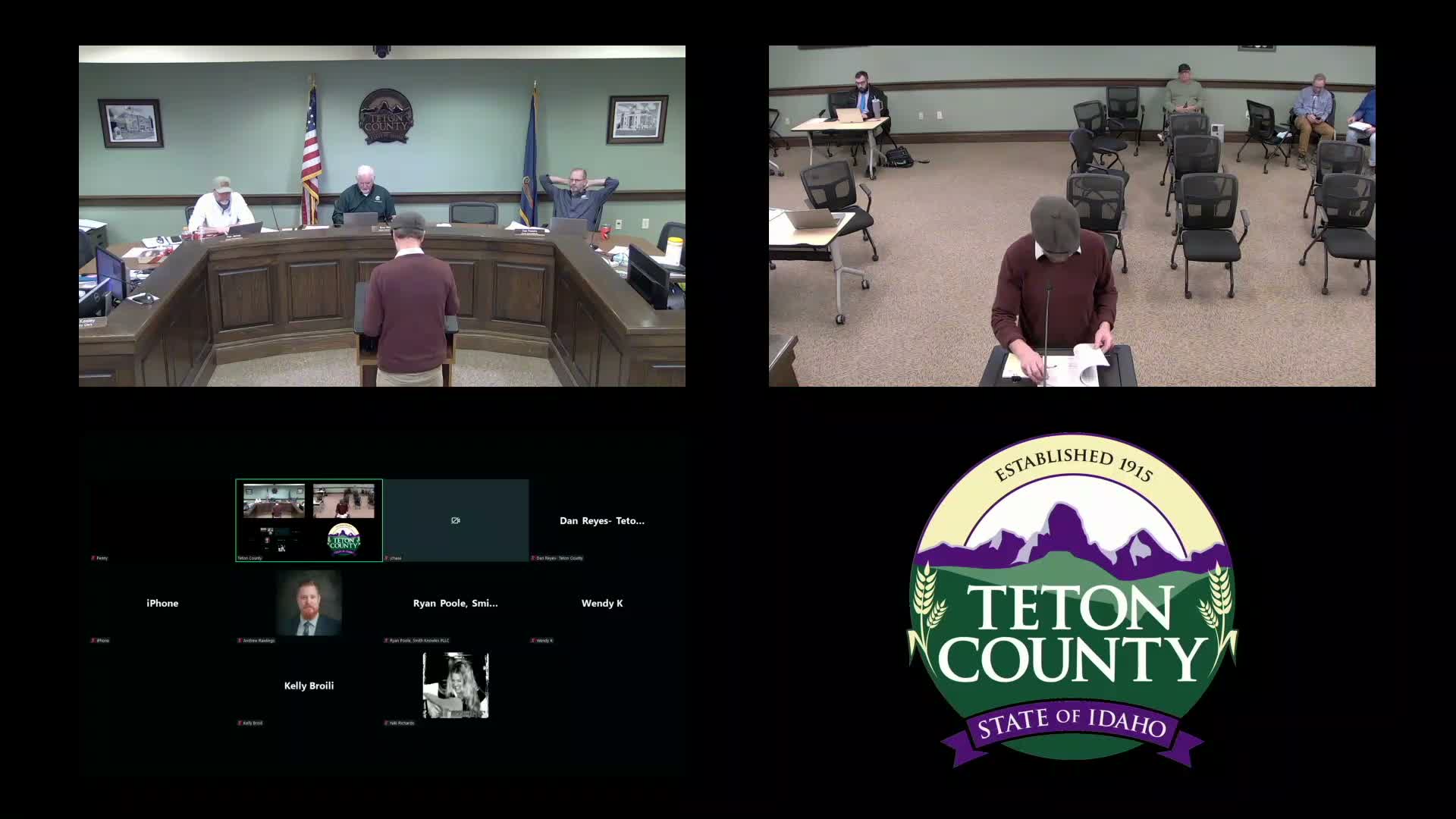
TETON COUNTY — Growing tension between subdivision applicants and county planners over two long‑standing final‑plat requirements — street‑front landscaping and underground telecommunications conduit — surfaced at the Dec. 22 meeting, highlighting a gap between the county’s older land‑development code and modern broadband options and new state water rules.
Developers for Rolling Stone Acres and Burton Ranch told commissioners the county’s landscaping expectation (trees and plantings along roads) is impractical where new well rules restrict irrigation of common areas and where no irrigation water is available. Applicant Kurt Bailey said crews were instructed in earlier reviews to add trees even when a site had no water source; he described examples where planted trees later died because irrigation was not feasible.
On telecommunications, commissioners heard developers object to a narrow interpretation that would require costly trenching to extend private fiber (or other wired service) for small, remote subdivisions. Developers argued many buyers rely on satellite or cellular options (for example, Starlink) and that forcing a private trench for a single provider could be prohibitively expensive and lock in a specific private vendor.
County staff and the county attorney urged caution: approved plats and improvement plans carry legal commitments, and departmental staff said changes to those commitments normally require a plat amendment or a formal variance process. The county attorney advised that the board should not administratively override the code or prior approvals; instead, the county should move quickly to clarify the code in a transparent, county‑wide amendment to account for modern telecom choices and the new state water landscape.
Commissioners directed planning staff to prepare options and a recommended path forward — including a possible code amendment, variance pathway, or formal plat amendment process — and to return at the next meeting with draft language so decisions apply uniformly rather than ad‑hoc.
Why it matters: The dispute reflects broader shifts — rapidly evolving broadband technology, private‑sector deployment models, and state changes to domestic well/use rights — that affect affordability and developer costs, and ultimately buyers. Commissioners said they want county‑wide rules that balance infrastructure expectations, fairness and technical realities.
Developers for Rolling Stone Acres and Burton Ranch told commissioners the county’s landscaping expectation (trees and plantings along roads) is impractical where new well rules restrict irrigation of common areas and where no irrigation water is available. Applicant Kurt Bailey said crews were instructed in earlier reviews to add trees even when a site had no water source; he described examples where planted trees later died because irrigation was not feasible.
On telecommunications, commissioners heard developers object to a narrow interpretation that would require costly trenching to extend private fiber (or other wired service) for small, remote subdivisions. Developers argued many buyers rely on satellite or cellular options (for example, Starlink) and that forcing a private trench for a single provider could be prohibitively expensive and lock in a specific private vendor.
County staff and the county attorney urged caution: approved plats and improvement plans carry legal commitments, and departmental staff said changes to those commitments normally require a plat amendment or a formal variance process. The county attorney advised that the board should not administratively override the code or prior approvals; instead, the county should move quickly to clarify the code in a transparent, county‑wide amendment to account for modern telecom choices and the new state water landscape.
Commissioners directed planning staff to prepare options and a recommended path forward — including a possible code amendment, variance pathway, or formal plat amendment process — and to return at the next meeting with draft language so decisions apply uniformly rather than ad‑hoc.
Why it matters: The dispute reflects broader shifts — rapidly evolving broadband technology, private‑sector deployment models, and state changes to domestic well/use rights — that affect affordability and developer costs, and ultimately buyers. Commissioners said they want county‑wide rules that balance infrastructure expectations, fairness and technical realities.
View the Full Meeting & All Its Details
This article offers just a summary. Unlock complete video, transcripts, and insights as a Founder Member.
✓
Watch full, unedited meeting videos
✓
Search every word spoken in unlimited transcripts
✓
AI summaries & real-time alerts (all government levels)
✓
Permanent access to expanding government content
30-day money-back guarantee
