GMP engineers tell House committee Vermont can host data centers but size and location matter
February 12, 2026 | Environment & Energy, HOUSE OF REPRESENTATIVES, Committees, Legislative , Vermont
This article was created by AI summarizing key points discussed. AI makes mistakes, so for full details and context, please refer to the video of the full meeting. Please report any errors so we can fix them. Report an error »
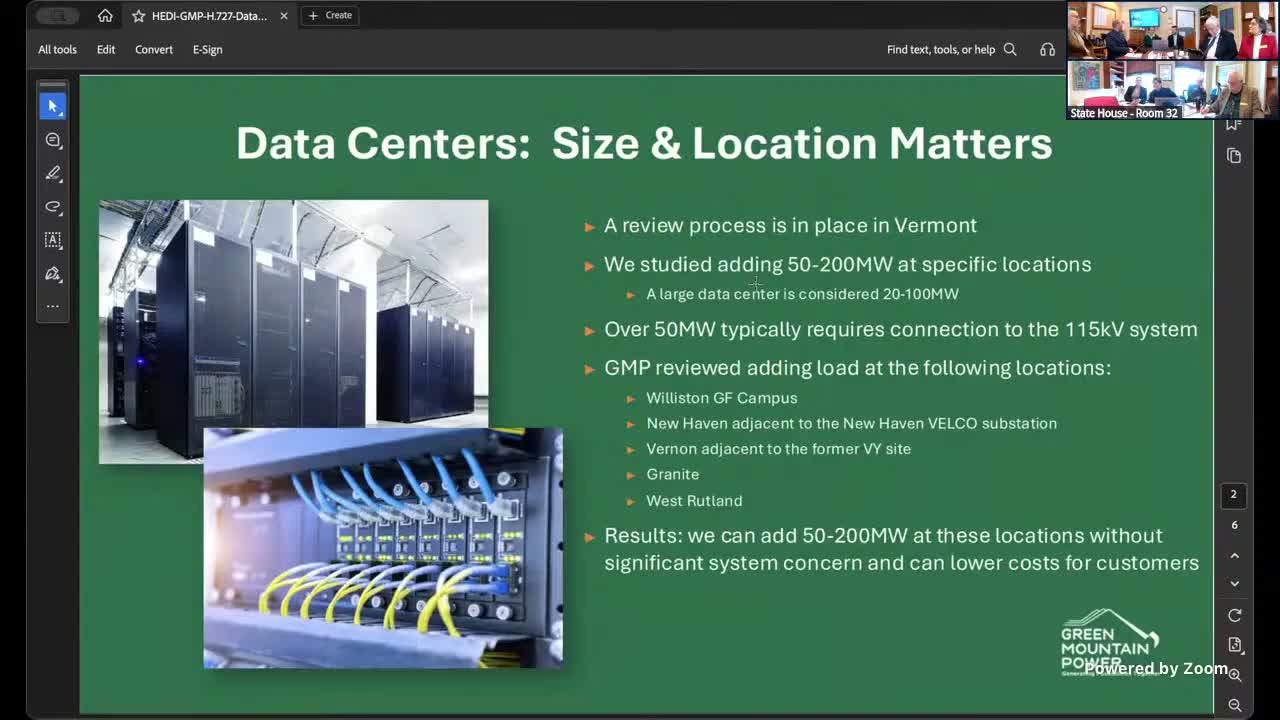
Green Mountain Power engineers told the House Energy Digital Infrastructure Committee on Feb. 11 that Vermont could accommodate data-center electricity demands at certain southern transmission nodes — but size and location are decisive.
Cam Toro, a system planning engineer at Green Mountain Power, said GMP ran incremental tests, adding load in 10‑megawatt steps at five statewide sites using ISO-New England transmission modeling. "With the correct size and the correct location, these data centers can be kind of a net benefit for costs on the electric system," Toro said, describing a tested envelope of roughly 50 to 200 megawatts where connections to the 115 kV bulk system remain feasible before major upgrades are required.
Why it matters: GMP and the committee are assessing H.727, a bill about data-center deployment, amid national attention on large computing facilities and their local rate and reliability impacts. GMP argued Vermont’s fully regulated utility structure and existing rate design can limit cost shifts when a large customer pays required interconnection upgrades.
GMP said interconnection costs (poles, breakers, transformers and other upgrades) are typically borne by the connecting customer. Candice Morgan of GMP noted the utility currently uses a tariff (cited in testimony as "GMP Rate 70") designed for large industrial customers that seeks to charge a class according to peak-demand and other characteristics.
Committee members asked whether Vermont’s statutory threshold (a 20 MW reference was discussed) aligns with the sizes GMP simulated. Toro said he began at 10 MW and incrementally scaled tests to observe when the grid showed constraints; he highlighted that southern Vermont has greater bulk-transmission capacity, while northern locations would require upgrades at lower sizes. He added that larger interconnections trigger ISO and regional studies and that ISO-New England and neighboring utilities (Belco referenced) would follow more stringent regional processes.
GMP outlined the regulatory path for large projects: an ability-to-serve letter is tied to Act 250 reviews for some projects, subtransmission modifications can require Act 248 and a Certificate of Public Good, and bulk-transmission connections generally require ISO system-impact and generation-adequacy studies. Witnesses also noted federal interconnection rules are under review and may change regional procedures for large bulk connections.
Next steps and context: GMP said its next integrated resource plan (IRP) — directed by the Public Utility Commission to include large-load analysis — will further detail how projected large loads are reflected in procurement and reliability planning. GMP offered to provide follow-up information on rate calculations and on the specific customer charges used in its modeling.
The committee’s H.727 hearing continues as ISO and other utilities are scheduled to testify and the committee evaluates whether statutory thresholds or permitting steps should be adjusted for new large loads.
Cam Toro, a system planning engineer at Green Mountain Power, said GMP ran incremental tests, adding load in 10‑megawatt steps at five statewide sites using ISO-New England transmission modeling. "With the correct size and the correct location, these data centers can be kind of a net benefit for costs on the electric system," Toro said, describing a tested envelope of roughly 50 to 200 megawatts where connections to the 115 kV bulk system remain feasible before major upgrades are required.
Why it matters: GMP and the committee are assessing H.727, a bill about data-center deployment, amid national attention on large computing facilities and their local rate and reliability impacts. GMP argued Vermont’s fully regulated utility structure and existing rate design can limit cost shifts when a large customer pays required interconnection upgrades.
GMP said interconnection costs (poles, breakers, transformers and other upgrades) are typically borne by the connecting customer. Candice Morgan of GMP noted the utility currently uses a tariff (cited in testimony as "GMP Rate 70") designed for large industrial customers that seeks to charge a class according to peak-demand and other characteristics.
Committee members asked whether Vermont’s statutory threshold (a 20 MW reference was discussed) aligns with the sizes GMP simulated. Toro said he began at 10 MW and incrementally scaled tests to observe when the grid showed constraints; he highlighted that southern Vermont has greater bulk-transmission capacity, while northern locations would require upgrades at lower sizes. He added that larger interconnections trigger ISO and regional studies and that ISO-New England and neighboring utilities (Belco referenced) would follow more stringent regional processes.
GMP outlined the regulatory path for large projects: an ability-to-serve letter is tied to Act 250 reviews for some projects, subtransmission modifications can require Act 248 and a Certificate of Public Good, and bulk-transmission connections generally require ISO system-impact and generation-adequacy studies. Witnesses also noted federal interconnection rules are under review and may change regional procedures for large bulk connections.
Next steps and context: GMP said its next integrated resource plan (IRP) — directed by the Public Utility Commission to include large-load analysis — will further detail how projected large loads are reflected in procurement and reliability planning. GMP offered to provide follow-up information on rate calculations and on the specific customer charges used in its modeling.
The committee’s H.727 hearing continues as ISO and other utilities are scheduled to testify and the committee evaluates whether statutory thresholds or permitting steps should be adjusted for new large loads.
View the Full Meeting & All Its Details
This article offers just a summary. Unlock complete video, transcripts, and insights as a Founder Member.
✓
Watch full, unedited meeting videos
✓
Search every word spoken in unlimited transcripts
✓
AI summaries & real-time alerts (all government levels)
✓
Permanent access to expanding government content
30-day money-back guarantee
