OCA’s first HPD analysis: utilization fell while commercial medical spending rose; staff to probe prices and intensity
February 12, 2026 | Department of Health Care Access and Information, Agencies under Office of the Governor, Executive, California
This article was created by AI summarizing key points discussed. AI makes mistakes, so for full details and context, please refer to the video of the full meeting. Please report any errors so we can fix them. Report an error »
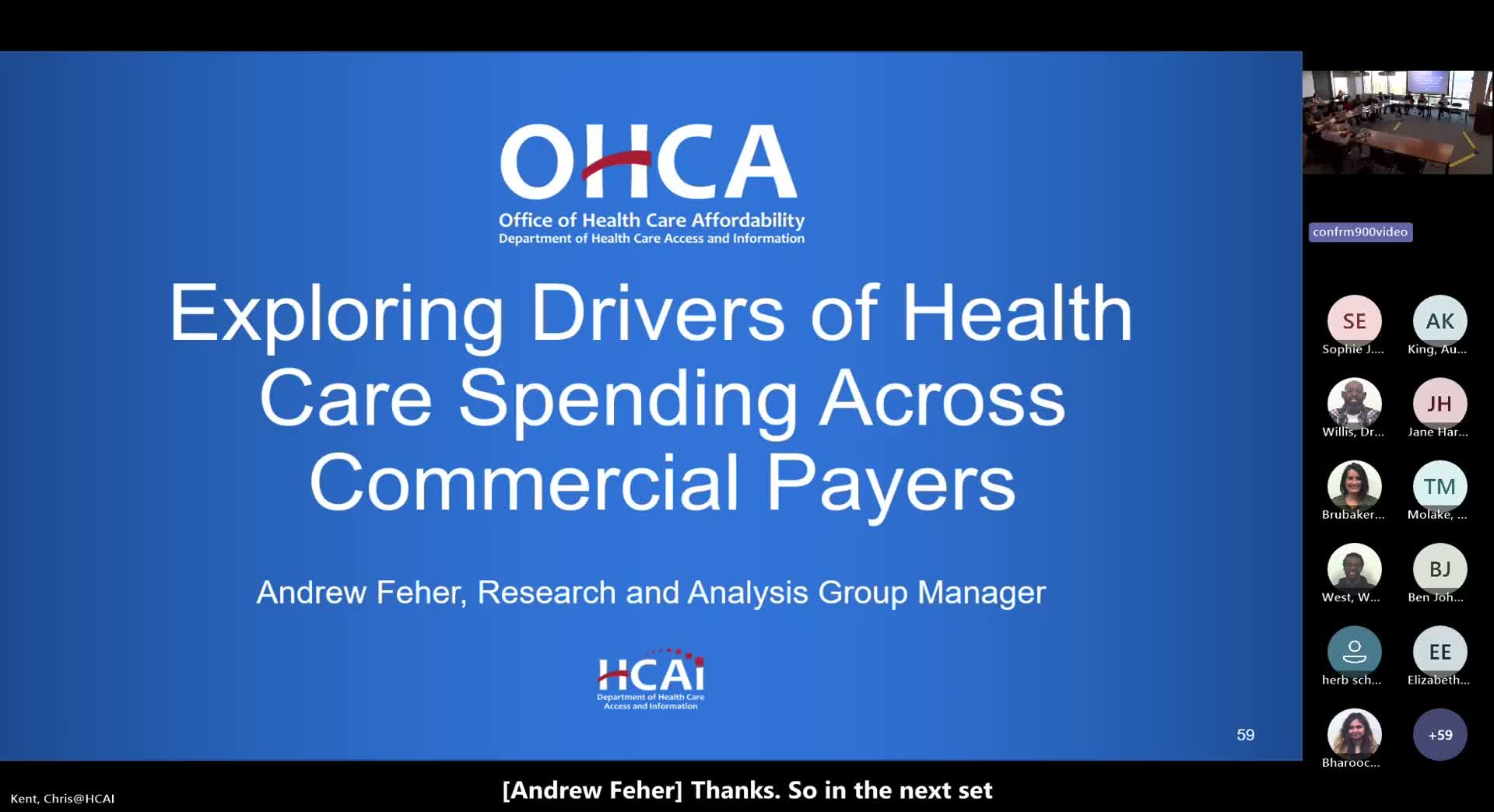
OCA researchers presented an initial analysis using the Health Plan Data (HPD) to probe why commercial market medical expense per member rose in 2023 despite falling utilization.
Andrew Fair, research and analysis group manager, summarized a crosswalk between OCA’s aggregated submissions and the HPD and explained the analytic approach: converting HPD claims into a collapsed member‑payer‑year view and measuring three candidate drivers — average age, utilization (the share of members with at least one medical claim), and chronic‑condition prevalence (members with a condition recorded that year). The analysis excluded a small share of records with conflicting demographic fields and focused on 2022–23 to align with OCA’s baseline reporting.
Key findings: across the commercial market TME (total medical expense) per member per year rose about 5% from 2022 to 2023 while the share of members with any medical claim fell roughly 5 percentage points on average (from about 76.7% to 72.6% in OCA’s collapsed HPD sample). Average age showed no meaningful change. Chronic‑condition flags rose modestly in aggregate (about a 3% relative increase) but varied widely by plan. Fair emphasized that these measures capture the extensive margin (whether members used services) and that further work is needed on intensive margin measures (how much care per user), pharmacy claims, and price variation.
Board response and next steps: members and stakeholders flagged data‑quality anomalies for some submitters (large plan‑level swings that likely reflect reporting or coding changes), asked for clarity on chronic‑condition operationalization, and urged follow‑up analyses on intensity of utilization, shoppable services pricing, and Medicare Advantage inclusion. Staff said they plan follow‑up HPD analyses in Q2 and Q4 to explore intensity, price variation for select shoppable services, and integration of pharmacy and MA data where quality permits.
Public commenters provided local examples (Monterey County market research) and urged attention to market consolidation and provider ownership as drivers of spending.
Andrew Fair, research and analysis group manager, summarized a crosswalk between OCA’s aggregated submissions and the HPD and explained the analytic approach: converting HPD claims into a collapsed member‑payer‑year view and measuring three candidate drivers — average age, utilization (the share of members with at least one medical claim), and chronic‑condition prevalence (members with a condition recorded that year). The analysis excluded a small share of records with conflicting demographic fields and focused on 2022–23 to align with OCA’s baseline reporting.
Key findings: across the commercial market TME (total medical expense) per member per year rose about 5% from 2022 to 2023 while the share of members with any medical claim fell roughly 5 percentage points on average (from about 76.7% to 72.6% in OCA’s collapsed HPD sample). Average age showed no meaningful change. Chronic‑condition flags rose modestly in aggregate (about a 3% relative increase) but varied widely by plan. Fair emphasized that these measures capture the extensive margin (whether members used services) and that further work is needed on intensive margin measures (how much care per user), pharmacy claims, and price variation.
Board response and next steps: members and stakeholders flagged data‑quality anomalies for some submitters (large plan‑level swings that likely reflect reporting or coding changes), asked for clarity on chronic‑condition operationalization, and urged follow‑up analyses on intensity of utilization, shoppable services pricing, and Medicare Advantage inclusion. Staff said they plan follow‑up HPD analyses in Q2 and Q4 to explore intensity, price variation for select shoppable services, and integration of pharmacy and MA data where quality permits.
Public commenters provided local examples (Monterey County market research) and urged attention to market consolidation and provider ownership as drivers of spending.
View the Full Meeting & All Its Details
This article offers just a summary. Unlock complete video, transcripts, and insights as a Founder Member.
✓
Watch full, unedited meeting videos
✓
Search every word spoken in unlimited transcripts
✓
AI summaries & real-time alerts (all government levels)
✓
Permanent access to expanding government content
30-day money-back guarantee
