Nebraska State Colleges outline shorter pathways to address teacher shortage
February 07, 2026 | Board of Education, Elected Officials, Organizations, Executive, Nebraska
This article was created by AI summarizing key points discussed. AI makes mistakes, so for full details and context, please refer to the video of the full meeting. Please report any errors so we can fix them. Report an error »
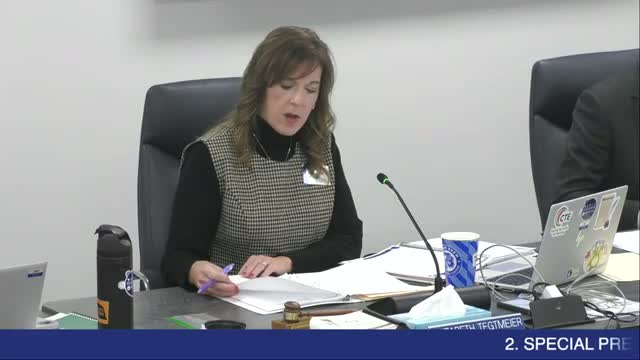
Chancellor Paul Turman of the Nebraska State College System presented to the State Board of Education on Feb. 6 an overview of efforts to expand and accelerate pathways into K'12 teaching.
Turman said roughly 1,600 undergraduates in the state college system—about 29% of current enrollees—are working toward teaching credentials. He described three major innovations: reduced'credit bachelor'degree pilots that keep state licensure requirements while trimming total credit hours, dual'credit "routes to teaching" for high school students, and apprenticeship-style programs that allow paraprofessionals to earn licensure while remaining employed in their districts.
The chancellor said his board recently approved two reduced'credit bachelor programs at Chadron State College—a 96'credit special education degree and a 95'credit elementary program—that were sent to the Higher Learning Commission for review and anticipated site visits. He said Peru and Wayne have similar programs in the pipeline for upcoming meetings.
Turman also described a Master of Arts in Teaching (M.A.T.) pathway that bundles 12 graduate credits and a supervised clinical student'teaching component. That route, he said, permits individuals with prior professional degrees and experience to move into teaching with graduate'level coursework aligned to state standards and a two'year completion timeline that includes temporary authorization to teach while finishing requirements.
On K'12 practice and recruitment, Turman highlighted "Nebraska Smart," an online tutoring program that began in rural districts and expanded statewide. He said Nebraska Smart grew from about 700 sessions during an earlier pilot to roughly 2,300 sessions after statewide rollout, and that teacher education candidates frequently serve as tutors—a practice Turman said both supports K'12 students and gives early clinical experience to future teachers.
Board members asked how the department and colleges will measure whether the new pathways keep teachers in Nebraska and meet classroom needs. Turman said licensure data will be integrated with the Nebraska statewide education reporting system so the state can track where newly licensed candidates teach and whether they remain in-state. He added that CAEP accreditation and program reporting will continue to provide programmatic evaluation and that the board expects the pilot programs to report outcomes back to the State Board.
No formal action on the college programs was required at the meeting; Turman said the colleges have submitted program modifications to accreditors and will continue customary program review steps.
Turman said roughly 1,600 undergraduates in the state college system—about 29% of current enrollees—are working toward teaching credentials. He described three major innovations: reduced'credit bachelor'degree pilots that keep state licensure requirements while trimming total credit hours, dual'credit "routes to teaching" for high school students, and apprenticeship-style programs that allow paraprofessionals to earn licensure while remaining employed in their districts.
The chancellor said his board recently approved two reduced'credit bachelor programs at Chadron State College—a 96'credit special education degree and a 95'credit elementary program—that were sent to the Higher Learning Commission for review and anticipated site visits. He said Peru and Wayne have similar programs in the pipeline for upcoming meetings.
Turman also described a Master of Arts in Teaching (M.A.T.) pathway that bundles 12 graduate credits and a supervised clinical student'teaching component. That route, he said, permits individuals with prior professional degrees and experience to move into teaching with graduate'level coursework aligned to state standards and a two'year completion timeline that includes temporary authorization to teach while finishing requirements.
On K'12 practice and recruitment, Turman highlighted "Nebraska Smart," an online tutoring program that began in rural districts and expanded statewide. He said Nebraska Smart grew from about 700 sessions during an earlier pilot to roughly 2,300 sessions after statewide rollout, and that teacher education candidates frequently serve as tutors—a practice Turman said both supports K'12 students and gives early clinical experience to future teachers.
Board members asked how the department and colleges will measure whether the new pathways keep teachers in Nebraska and meet classroom needs. Turman said licensure data will be integrated with the Nebraska statewide education reporting system so the state can track where newly licensed candidates teach and whether they remain in-state. He added that CAEP accreditation and program reporting will continue to provide programmatic evaluation and that the board expects the pilot programs to report outcomes back to the State Board.
No formal action on the college programs was required at the meeting; Turman said the colleges have submitted program modifications to accreditors and will continue customary program review steps.
Don't Miss a Word: See the Full Meeting!
Go beyond summaries. Unlock every video, transcript, and key insight with a Founder Membership.
✓
Get instant access to full meeting videos
✓
Search and clip any phrase from complete transcripts
✓
Receive AI-powered summaries & custom alerts
✓
Enjoy lifetime, unrestricted access to government data
30-day money-back guarantee
