Wilkett School Street bridge replacement tied to wastewater and flood mitigation
February 12, 2026 | Transportation, HOUSE OF REPRESENTATIVES, Committees, Legislative , Vermont
This article was created by AI summarizing key points discussed. AI makes mistakes, so for full details and context, please refer to the video of the full meeting. Please report any errors so we can fix them. Report an error »
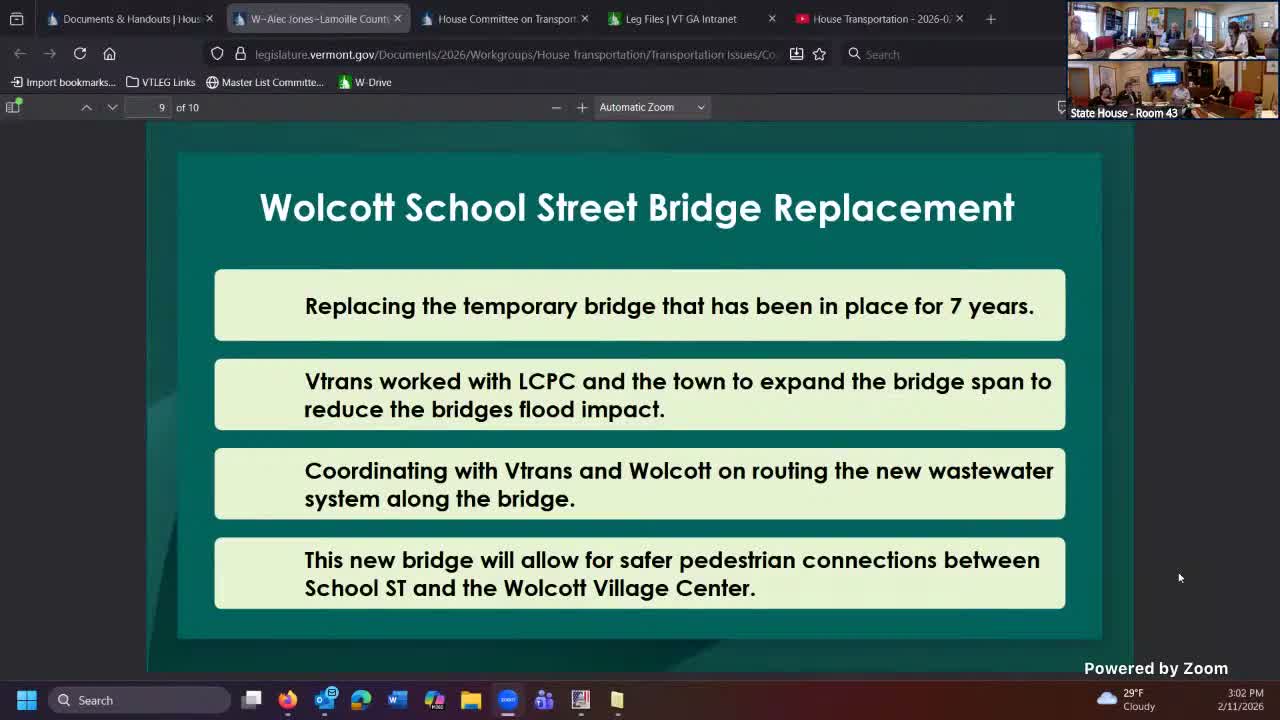
House Transportation Committee — Presenters highlighted a multiagency effort to replace a temporary bridge on Wilkett (School Street) that uses modeling to reduce flood risk, improves pedestrian connectivity and coordinates design with a village wastewater project.
Alec Jones, transportation planner at the Memorial County Planning Commission, told the committee the Wilkett School Street bridge — which had a temporary span in place for seven years — is being replaced with a new span that was adjusted after RPC hydraulic modeling to reduce flooding on School Street. Jones said the revised span "will have measurable reductions in the flood risk to the remaining homes" on that street.
The bridge project includes a widened shoulder to accommodate pedestrian connectivity between School Street and Wolcott Main Street, addressing a persistent resident concern. Jones said VTrans worked with local planners to modify the bridge span after reviewing the RPC's modeling data.
Crucially for project delivery, the bridge design was coordinated with a village wastewater system that is expected to be constructed this year pending permitting. Presenters said funding sources for the two pieces are distinct — Federal Highway funds for the bridge and Clean Water State Revolving Fund support for wastewater — and that the RPC and VTrans aligned permitting and design to allow force mains to cross the new bridge.
Why it matters: Presenters framed the project as a model of multi-level coordination: leveraging federal and state grant programs, local planning, and hydraulic modeling to address flood risk and restore pedestrian access while allowing a separate wastewater project to proceed without redesign.
What comes next: Construction was described as scheduled for the upcoming building season, pending permitting for the wastewater system. The presenters asked legislators to note the importance of aligning funding streams and permitting windows to complete such coordinated projects efficiently.
Alec Jones, transportation planner at the Memorial County Planning Commission, told the committee the Wilkett School Street bridge — which had a temporary span in place for seven years — is being replaced with a new span that was adjusted after RPC hydraulic modeling to reduce flooding on School Street. Jones said the revised span "will have measurable reductions in the flood risk to the remaining homes" on that street.
The bridge project includes a widened shoulder to accommodate pedestrian connectivity between School Street and Wolcott Main Street, addressing a persistent resident concern. Jones said VTrans worked with local planners to modify the bridge span after reviewing the RPC's modeling data.
Crucially for project delivery, the bridge design was coordinated with a village wastewater system that is expected to be constructed this year pending permitting. Presenters said funding sources for the two pieces are distinct — Federal Highway funds for the bridge and Clean Water State Revolving Fund support for wastewater — and that the RPC and VTrans aligned permitting and design to allow force mains to cross the new bridge.
Why it matters: Presenters framed the project as a model of multi-level coordination: leveraging federal and state grant programs, local planning, and hydraulic modeling to address flood risk and restore pedestrian access while allowing a separate wastewater project to proceed without redesign.
What comes next: Construction was described as scheduled for the upcoming building season, pending permitting for the wastewater system. The presenters asked legislators to note the importance of aligning funding streams and permitting windows to complete such coordinated projects efficiently.
View the Full Meeting & All Its Details
This article offers just a summary. Unlock complete video, transcripts, and insights as a Founder Member.
✓
Watch full, unedited meeting videos
✓
Search every word spoken in unlimited transcripts
✓
AI summaries & real-time alerts (all government levels)
✓
Permanent access to expanding government content
30-day money-back guarantee
