SWA awards Cross State landfill parcel lease to Coastal Waste amid push to prioritize equine waste and biochar
February 12, 2026 | Palm Beach County, Florida
This article was created by AI summarizing key points discussed. AI makes mistakes, so for full details and context, please refer to the video of the full meeting. Please report any errors so we can fix them. Report an error »
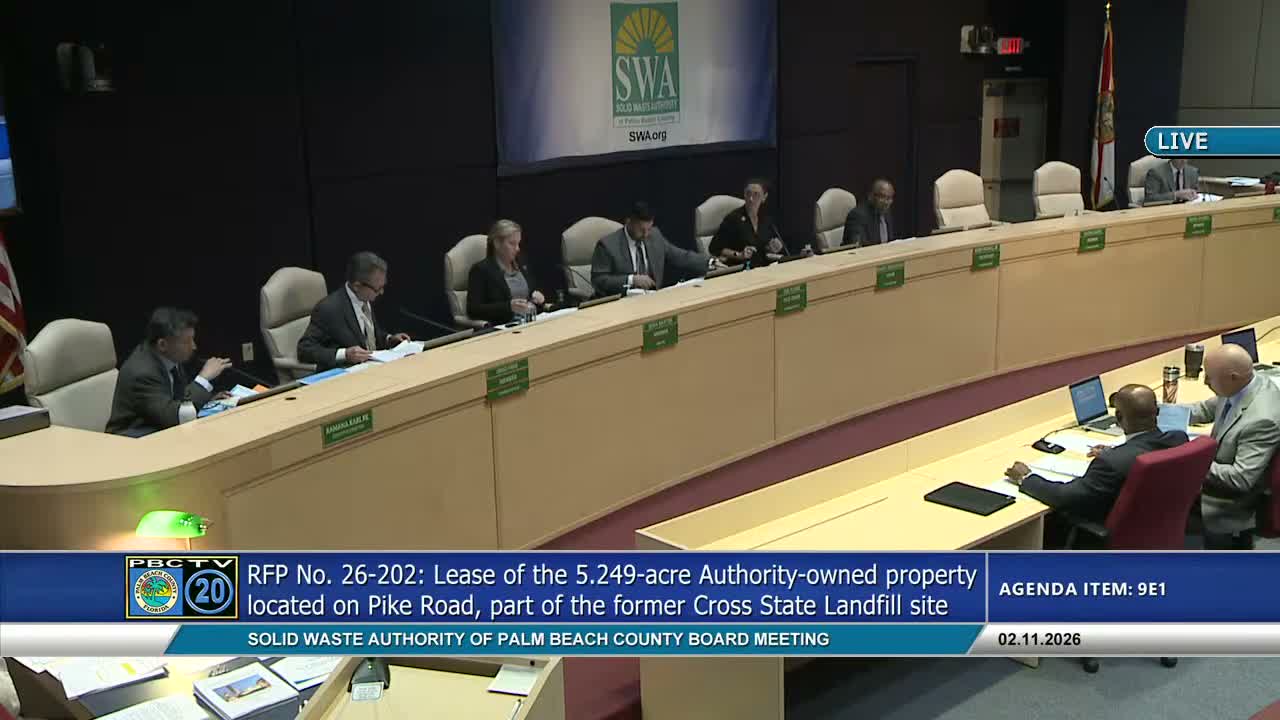
The Solid Waste Authority authorized a 20‑year lease (with two 5‑year extension options) for a parcel at the former Cross State Landfill to Coastal Waste and Recycling, awarding the county parcel based on a competitive RFP process and an evaluation committee recommendation.
Nate Mayer, the authority’s engineer, told the board the RFP (26202) received four proposals. Coastal’s bid proposed yard‑trash processing on the site, an enclosed equine residual waste transfer facility and the possibility of future biochar production; staff recommended Coastal based on the committee’s evaluation and the company’s existing local operations. Coastal proposed a $300,000 annual lease payment and a 20‑year term; staff said the appraisal had been adjusted to reflect an unusable easement area, reducing leasable acreage to about 3.85 acres.
Several commissioners pushed staff to prioritize equine waste processing and biochar as public‑interest uses. Commissioners noted the equestrian community’s needs in parts of the county (Wellington and surrounding areas) and asked whether the lease obligates Coastal to develop equine or biochar operations. Coastal representative Trevor Black and staff said yard‑trash processing is the assured use in the proposal while equine transfer and biochar would proceed only if economically feasible; the lease identifies permitted uses but does not compel construction of all proposed facilities. Staff confirmed lease payments include a CPI adjustment.
Public commenters included TreeCycle Land Clearing (Sean Casey), which proposed a revenue‑share model ($3/ton to the authority) and an incentive‑based approach; TreeCycle estimated up to $750,000 annually at scale and emphasized local SBE status. Post Waste and Coastal representatives noted Coastal currently processes about 150,000 tons annually for the authority at another site, which supports feasibility for additional processing capacity.
The board voted unanimously to approve the lease to Coastal Waste and directed staff to work with Coastal to explore ways to make equine residual processing and biochar development feasible — including aligning biomass processing contract terms to secure feedstock — while noting permitting, capital investment and CPI indexing affect project timelines. Staff said permitting can take years; commissioners asked for continued engagement to move equine processing forward if commercially viable.
Nate Mayer, the authority’s engineer, told the board the RFP (26202) received four proposals. Coastal’s bid proposed yard‑trash processing on the site, an enclosed equine residual waste transfer facility and the possibility of future biochar production; staff recommended Coastal based on the committee’s evaluation and the company’s existing local operations. Coastal proposed a $300,000 annual lease payment and a 20‑year term; staff said the appraisal had been adjusted to reflect an unusable easement area, reducing leasable acreage to about 3.85 acres.
Several commissioners pushed staff to prioritize equine waste processing and biochar as public‑interest uses. Commissioners noted the equestrian community’s needs in parts of the county (Wellington and surrounding areas) and asked whether the lease obligates Coastal to develop equine or biochar operations. Coastal representative Trevor Black and staff said yard‑trash processing is the assured use in the proposal while equine transfer and biochar would proceed only if economically feasible; the lease identifies permitted uses but does not compel construction of all proposed facilities. Staff confirmed lease payments include a CPI adjustment.
Public commenters included TreeCycle Land Clearing (Sean Casey), which proposed a revenue‑share model ($3/ton to the authority) and an incentive‑based approach; TreeCycle estimated up to $750,000 annually at scale and emphasized local SBE status. Post Waste and Coastal representatives noted Coastal currently processes about 150,000 tons annually for the authority at another site, which supports feasibility for additional processing capacity.
The board voted unanimously to approve the lease to Coastal Waste and directed staff to work with Coastal to explore ways to make equine residual processing and biochar development feasible — including aligning biomass processing contract terms to secure feedstock — while noting permitting, capital investment and CPI indexing affect project timelines. Staff said permitting can take years; commissioners asked for continued engagement to move equine processing forward if commercially viable.
Don't Miss a Word: See the Full Meeting!
Go beyond summaries. Unlock every video, transcript, and key insight with a Founder Membership.
✓
Get instant access to full meeting videos
✓
Search and clip any phrase from complete transcripts
✓
Receive AI-powered summaries & custom alerts
✓
Enjoy lifetime, unrestricted access to government data
30-day money-back guarantee
