Delegate McQuinn’s HB 193 advances after testimony urging Fishback remedy for juries not told parole was abolished
February 11, 2026 | 2026 Legislature VA, Virginia
This article was created by AI summarizing key points discussed. AI makes mistakes, so for full details and context, please refer to the video of the full meeting. Please report any errors so we can fix them. Report an error »
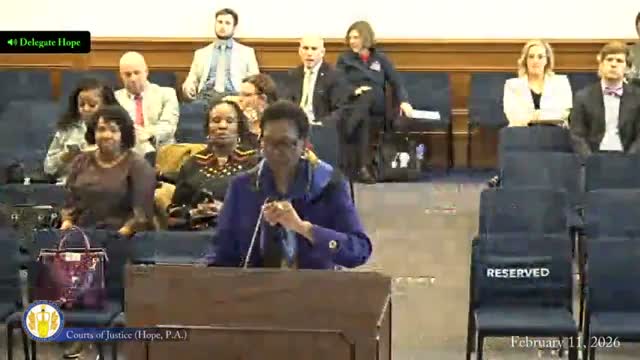
Delegate K. McQuinn introduced House Bill 193 on the Justice Committee floor, saying the measure implements a Fishback remedy following the Virginia Supreme Court’s decision in Fishback v. Commonwealth (2000).
McQuinn told the committee HB 193 would "make a person eligible to be considered for parole, not released but considered if all of the statutory criterias are met," and said the bill applies to individuals sentenced by a jury after the Fishback decision who can prove the jury was not instructed that parole had been abolished.
The bill narrowly defines eligibility. McQuinn said HB 193 applies only to felonies committed on or after Jan. 1, 1995 (the date parole was abolished), requires proof by a preponderance of the evidence that jurors were not told parole had been abolished, and applies only to people still incarcerated for the offense as of July 1, 2026. He said the measure expressly excludes Class 1 felonies and a set of serious sex- and violence-related offenses involving minors.
Proponents told the committee the bill is corrective, not automatic clemency. Lily Branch Kennedy, founder of Resource Information Health for the Disadvantaged and the Disenfranchised (RIHD), asked members to "vote in favor of House Bill HB193, which would expand parole eligibility to certain individuals," describing HB 193 as intended to remedy inequities left by inconsistent jury instructions. Brenda Coles, citing four decades in civil-rights work, told the panel HB 193 "does not guarantee freedom for anyone. It simply allows eligible individuals to be reviewed by the Virginia Parole Board."
Family members and advocacy groups also spoke. Carla Johnson described a brother sentenced in 1996 who has been incarcerated about 30 years and urged the committee to advance the bill. Representatives from RISE for Youth and the Virginia Justice Alliance also expressed support, and callers from Lynchburg and elsewhere offered remote testimony in favor.
Committee members asked no formal policy amendments on the floor. After public testimony closed, the committee voted to report HB 193 and refer it to the Appropriations Committee by roll call, 14–7.
What’s next: HB 193 will be considered by Appropriations. The bill, as described to the committee, allows parole consideration under statutory criteria but does not guarantee release; detailed implementation (including review procedures and which convictions qualify) would depend on the statutory substitute and any further amendments in later committee action.
McQuinn told the committee HB 193 would "make a person eligible to be considered for parole, not released but considered if all of the statutory criterias are met," and said the bill applies to individuals sentenced by a jury after the Fishback decision who can prove the jury was not instructed that parole had been abolished.
The bill narrowly defines eligibility. McQuinn said HB 193 applies only to felonies committed on or after Jan. 1, 1995 (the date parole was abolished), requires proof by a preponderance of the evidence that jurors were not told parole had been abolished, and applies only to people still incarcerated for the offense as of July 1, 2026. He said the measure expressly excludes Class 1 felonies and a set of serious sex- and violence-related offenses involving minors.
Proponents told the committee the bill is corrective, not automatic clemency. Lily Branch Kennedy, founder of Resource Information Health for the Disadvantaged and the Disenfranchised (RIHD), asked members to "vote in favor of House Bill HB193, which would expand parole eligibility to certain individuals," describing HB 193 as intended to remedy inequities left by inconsistent jury instructions. Brenda Coles, citing four decades in civil-rights work, told the panel HB 193 "does not guarantee freedom for anyone. It simply allows eligible individuals to be reviewed by the Virginia Parole Board."
Family members and advocacy groups also spoke. Carla Johnson described a brother sentenced in 1996 who has been incarcerated about 30 years and urged the committee to advance the bill. Representatives from RISE for Youth and the Virginia Justice Alliance also expressed support, and callers from Lynchburg and elsewhere offered remote testimony in favor.
Committee members asked no formal policy amendments on the floor. After public testimony closed, the committee voted to report HB 193 and refer it to the Appropriations Committee by roll call, 14–7.
What’s next: HB 193 will be considered by Appropriations. The bill, as described to the committee, allows parole consideration under statutory criteria but does not guarantee release; detailed implementation (including review procedures and which convictions qualify) would depend on the statutory substitute and any further amendments in later committee action.
View the Full Meeting & All Its Details
This article offers just a summary. Unlock complete video, transcripts, and insights as a Founder Member.
✓
Watch full, unedited meeting videos
✓
Search every word spoken in unlimited transcripts
✓
AI summaries & real-time alerts (all government levels)
✓
Permanent access to expanding government content
30-day money-back guarantee
