Sarpy County hearing examines termination of corrections sergeant after October takedown
February 12, 2026 | Sarpy County, Nebraska
This article was created by AI summarizing key points discussed. AI makes mistakes, so for full details and context, please refer to the video of the full meeting. Please report any errors so we can fix them. Report an error »
A Sarpy County Personal Policy Board hearing on Feb. 11, 2026, took evidence on the December 2024 termination of Sergeant Ramon Leonardo Estevez after a takedown on Oct. 9 that left an inmate with a broken nose and facial lacerations.
The county, represented by Sarpy County attorney Ryan Coonhardt, told the board the corrections director’s decision to fire Estevez was justified because the department’s use-of-force policy prohibits techniques that create foreseeable head injuries when safer alternatives exist. "The evidence tonight will show the force used by Sergeant Estevez was objectively unreasonable," Coonhardt said in his opening statement, citing investigator reports, still images and witness testimony.
Estevez’s counsel, Courtney Faller, argued the termination lacked just cause under the labor contract and warned against 20/20 hindsight. "The legal standard is objective reasonableness without hindsight," Faller said, and urged the board to consider what the officer perceived in the split seconds before the takedown.
Evidence and testimony
The hearing admitted multiple exhibits and heard testimony from county trainers, investigators and an external use-of-force expert.
- Deputy Kevin Jones, a Sarpy County Sheriff's Office TAP instructor, testified he reviewed video stills and staff reports and concluded the takedown was "unreasonable" because the inmate was handcuffed behind his back and the maneuver risked head-first impact on a metal catwalk. Jones recommended that other, lower-risk control options—two- to four-person escorts, compression wrist-locks or pinning to a wall—were available.
- Assistant Director Jake Burst, who authored a memorandum recommending termination, told the board the technique used was not taught in the department’s TAP-based training and that the combination of a non‑authorized maneuver, the restrained status of the inmate, and resulting injury made termination appropriate.
- Director Joe Martin said he reviewed Lieutenant Vanden Bogard’s findings, Burst’s memorandum and Deputy Jones’s analysis before deciding termination was warranted; he said the inmate sustained a broken nose and three lacerations that factored into the assessment.
- Lieutenant Matthew Vanden Bogard, the lead internal investigator, described interviewing roughly 10 officers and 10 inmates and concluded that, by the letter of department policy, a takedown can be permissible for defensive resistance but that the particular technique used "should not have been attempted" in this setting; he recommended an eight‑hour suspension in his report but recorded policy concerns about an untrained maneuver.
- Sergeant Ramon Leonardo Estevez testified that the inmate had been verbally aggressive and attempted to throw an unknown liquid; he said he gave commands and that the inmate repeatedly pulled away. Estevez said his intent was to guide the inmate to the floor—not to cause injury—and that the inmate’s momentum and resistance caused the face-first impact. "My intent was never to hurt him," Estevez said, and he described rendering aid immediately after the incident.
- Two department TAP master instructors who testified in support of Estevez said TAP is a guiding curriculum and allows for modifications depending on context; one instructor, Alexander Gore, said a takedown can fall within "soft empty-hand control" and be appropriate for passive or defensive resistance if the officer can explain the modification.
- Jason Cividano, a retained use-of-force expert and cofounder of the TAP program, reviewed reports, policies and video and testified that, under the objective-reasonableness standard, he found Estevez’s actions reasonable "based on what he knew at the time" given the narrow top-tier walkway, the inmate’s resistance, and the department practice of moving combative inmates to lockdown. Cividano cautioned against overreliance on single-angle video and stressed that expert review must weigh reports, interviews and context together.
Conflicting perspectives and evidence
Witnesses disagreed on whether the takedown was a prohibited "untrained" move or an allowable, modified takedown. Lieutenant Vanden Bogard’s report described the maneuver as not taught by TAP and recommended an eight‑hour suspension; assistant director Burst and Director Martin contended the severity warranted termination. By contrast, most of the on‑scene officers interviewed (7 of 10, per the investigator’s report) said they did not believe the force was excessive, and the union (FOP 90) held a vote reported in the hearing as strongly supporting the officer.
Procedural and factual notes
- The board admitted exhibits A–Z (excluding W) and AA–AC for consideration during the hearing.
- The county cited department policy SOP 80‑90 (use-of-force policy) and SOP 5,100 (discipline procedures) in its rationale; legal standards cited at the hearing included Kingsley v. Hendrickson and Graham v. Connor.
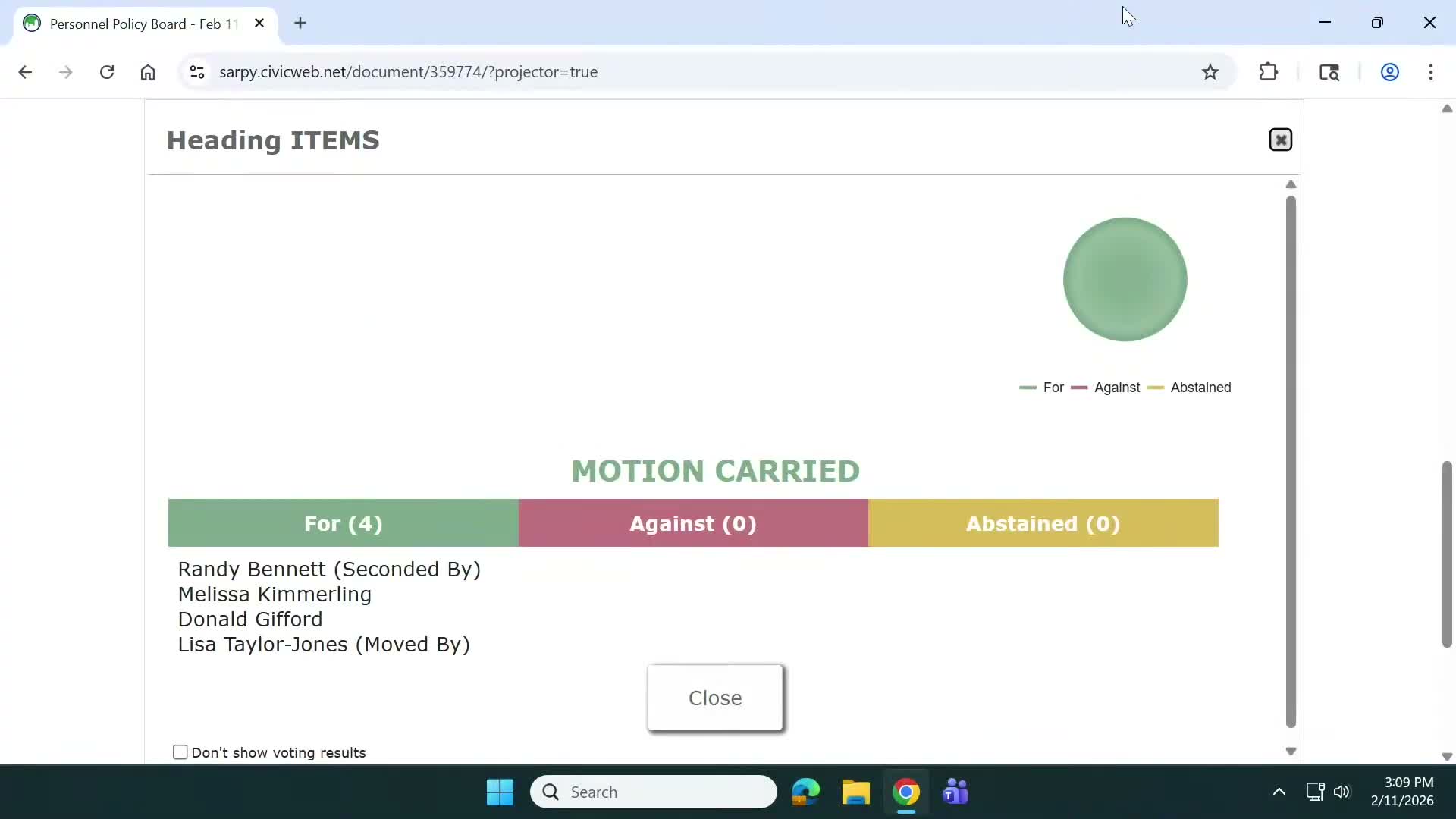
- A motion to move into the grievance hearing passed with a recorded tally of 4 in favor and 1 absent.
What happens next
After hearing testimony and admitting evidence, the Personal Policy Board went into executive session and later recessed the hearing because a board member became ill; the board announced it will reconvene to complete the hearing and deliberate further. No final board decision on the termination was reached at the Feb. 11 session.
Reporting note: Quotations and attributions in this report are drawn from the hearing transcript and statements given in the Feb. 11, 2026, Sarpy County Personal Policy Board proceeding.
The county, represented by Sarpy County attorney Ryan Coonhardt, told the board the corrections director’s decision to fire Estevez was justified because the department’s use-of-force policy prohibits techniques that create foreseeable head injuries when safer alternatives exist. "The evidence tonight will show the force used by Sergeant Estevez was objectively unreasonable," Coonhardt said in his opening statement, citing investigator reports, still images and witness testimony.
Estevez’s counsel, Courtney Faller, argued the termination lacked just cause under the labor contract and warned against 20/20 hindsight. "The legal standard is objective reasonableness without hindsight," Faller said, and urged the board to consider what the officer perceived in the split seconds before the takedown.
Evidence and testimony
The hearing admitted multiple exhibits and heard testimony from county trainers, investigators and an external use-of-force expert.
- Deputy Kevin Jones, a Sarpy County Sheriff's Office TAP instructor, testified he reviewed video stills and staff reports and concluded the takedown was "unreasonable" because the inmate was handcuffed behind his back and the maneuver risked head-first impact on a metal catwalk. Jones recommended that other, lower-risk control options—two- to four-person escorts, compression wrist-locks or pinning to a wall—were available.
- Assistant Director Jake Burst, who authored a memorandum recommending termination, told the board the technique used was not taught in the department’s TAP-based training and that the combination of a non‑authorized maneuver, the restrained status of the inmate, and resulting injury made termination appropriate.
- Director Joe Martin said he reviewed Lieutenant Vanden Bogard’s findings, Burst’s memorandum and Deputy Jones’s analysis before deciding termination was warranted; he said the inmate sustained a broken nose and three lacerations that factored into the assessment.
- Lieutenant Matthew Vanden Bogard, the lead internal investigator, described interviewing roughly 10 officers and 10 inmates and concluded that, by the letter of department policy, a takedown can be permissible for defensive resistance but that the particular technique used "should not have been attempted" in this setting; he recommended an eight‑hour suspension in his report but recorded policy concerns about an untrained maneuver.
- Sergeant Ramon Leonardo Estevez testified that the inmate had been verbally aggressive and attempted to throw an unknown liquid; he said he gave commands and that the inmate repeatedly pulled away. Estevez said his intent was to guide the inmate to the floor—not to cause injury—and that the inmate’s momentum and resistance caused the face-first impact. "My intent was never to hurt him," Estevez said, and he described rendering aid immediately after the incident.
- Two department TAP master instructors who testified in support of Estevez said TAP is a guiding curriculum and allows for modifications depending on context; one instructor, Alexander Gore, said a takedown can fall within "soft empty-hand control" and be appropriate for passive or defensive resistance if the officer can explain the modification.
- Jason Cividano, a retained use-of-force expert and cofounder of the TAP program, reviewed reports, policies and video and testified that, under the objective-reasonableness standard, he found Estevez’s actions reasonable "based on what he knew at the time" given the narrow top-tier walkway, the inmate’s resistance, and the department practice of moving combative inmates to lockdown. Cividano cautioned against overreliance on single-angle video and stressed that expert review must weigh reports, interviews and context together.
Conflicting perspectives and evidence
Witnesses disagreed on whether the takedown was a prohibited "untrained" move or an allowable, modified takedown. Lieutenant Vanden Bogard’s report described the maneuver as not taught by TAP and recommended an eight‑hour suspension; assistant director Burst and Director Martin contended the severity warranted termination. By contrast, most of the on‑scene officers interviewed (7 of 10, per the investigator’s report) said they did not believe the force was excessive, and the union (FOP 90) held a vote reported in the hearing as strongly supporting the officer.
Procedural and factual notes
- The board admitted exhibits A–Z (excluding W) and AA–AC for consideration during the hearing.
- The county cited department policy SOP 80‑90 (use-of-force policy) and SOP 5,100 (discipline procedures) in its rationale; legal standards cited at the hearing included Kingsley v. Hendrickson and Graham v. Connor.
- A motion to move into the grievance hearing passed with a recorded tally of 4 in favor and 1 absent.
What happens next
After hearing testimony and admitting evidence, the Personal Policy Board went into executive session and later recessed the hearing because a board member became ill; the board announced it will reconvene to complete the hearing and deliberate further. No final board decision on the termination was reached at the Feb. 11 session.
Reporting note: Quotations and attributions in this report are drawn from the hearing transcript and statements given in the Feb. 11, 2026, Sarpy County Personal Policy Board proceeding.
Don't Miss a Word: See the Full Meeting!
Go beyond summaries. Unlock every video, transcript, and key insight with a Founder Membership.
✓
Get instant access to full meeting videos
✓
Search and clip any phrase from complete transcripts
✓
Receive AI-powered summaries & custom alerts
✓
Enjoy lifetime, unrestricted access to government data
30-day money-back guarantee
