Prairie Sunlight touts 500‑acre solar project’s local revenue as county hears calls for broader review of storage, moratorium
February 11, 2026 | Franklin County, Kansas
This article was created by AI summarizing key points discussed. AI makes mistakes, so for full details and context, please refer to the video of the full meeting. Please report any errors so we can fix them. Report an error »
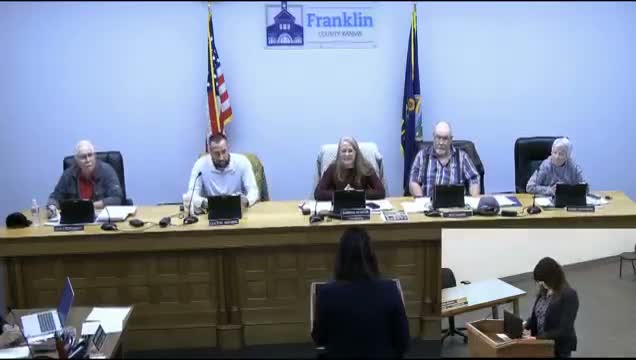
Prairie Sunlight representatives and several residents presented the Franklin County Commission on Feb. 11 a proposal for a roughly 500‑acre solar farm and urged the commission to use existing special‑permit review procedures rather than an extended moratorium.
The presenters said the project would “use about 500 acres of solar panels” and, over an approximately 35‑year life, provide “$230,000,000 local economic value,” including about $153,000,000 in new property tax revenues for county services and targeted community funding and payments to landowners. Proponents asked the commission to require conditions through the county’s existing zoning and special‑use permit authority rather than block projects with a moratorium.
Supporters framed the project as compatible with continued agricultural use, noting planned vegetative buffers, pollinator‑friendly ground cover and possible sheep grazing. Tom Wigan, a former county commissioner and former Ottawa city commissioner who spoke in support, said the site’s proximity to an industrial park and I‑35 makes it a reasonable place for large‑scale solar and that construction activity would boost hotels, restaurants and other local businesses.
Opponents and some speakers raised procedural and safety concerns. Multiple commenters said the county’s recently enacted solar moratorium did not undergo as much advance public notice or hearings as an earlier wind moratorium, and several speakers urged a fuller public process, with some pointing to the county comprehensive‑plan review as the appropriate forum for zoning changes. One commenter said, “The solar moratorium was brought up without further notice,” urging a planning‑commission review and additional public input.
Several commissioners and staff acknowledged specific regulatory gaps. The commission was told battery energy storage — equipment proponents indicated may accompany large solar projects — has not been addressed in county regulations. A speaker cited the project’s technical scale as “185 megawatts and on 500 acres” and said battery storage “is an industrial thing” that may require its own setbacks or rules. Commissioners and staff discussed interconnection scheduling and fees, with project representatives warning that interconnection deposits and fees could come due within roughly six months and that delays could put those funds at risk.
Prairie Sunlight’s representatives said the permanent application materials were in final review and that wildlife and wetland delineation studies were part of the submittal package. They asked the commission to allow the standard special‑use permit process, including site‑specific conditions, hearings and public input, to proceed rather than adopt regulatory limits that would preclude review.
The meeting excerpt provided did not record any vote or formal commission action on the project, the moratorium or rule changes. Commissioners indicated interest in addressing battery storage and in timing a comprehensive‑plan or regulatory review, but staff capacity and scheduling were cited as constraints. The commission moved on to other agenda items after public comment.
The presenters said the project would “use about 500 acres of solar panels” and, over an approximately 35‑year life, provide “$230,000,000 local economic value,” including about $153,000,000 in new property tax revenues for county services and targeted community funding and payments to landowners. Proponents asked the commission to require conditions through the county’s existing zoning and special‑use permit authority rather than block projects with a moratorium.
Supporters framed the project as compatible with continued agricultural use, noting planned vegetative buffers, pollinator‑friendly ground cover and possible sheep grazing. Tom Wigan, a former county commissioner and former Ottawa city commissioner who spoke in support, said the site’s proximity to an industrial park and I‑35 makes it a reasonable place for large‑scale solar and that construction activity would boost hotels, restaurants and other local businesses.
Opponents and some speakers raised procedural and safety concerns. Multiple commenters said the county’s recently enacted solar moratorium did not undergo as much advance public notice or hearings as an earlier wind moratorium, and several speakers urged a fuller public process, with some pointing to the county comprehensive‑plan review as the appropriate forum for zoning changes. One commenter said, “The solar moratorium was brought up without further notice,” urging a planning‑commission review and additional public input.
Several commissioners and staff acknowledged specific regulatory gaps. The commission was told battery energy storage — equipment proponents indicated may accompany large solar projects — has not been addressed in county regulations. A speaker cited the project’s technical scale as “185 megawatts and on 500 acres” and said battery storage “is an industrial thing” that may require its own setbacks or rules. Commissioners and staff discussed interconnection scheduling and fees, with project representatives warning that interconnection deposits and fees could come due within roughly six months and that delays could put those funds at risk.
Prairie Sunlight’s representatives said the permanent application materials were in final review and that wildlife and wetland delineation studies were part of the submittal package. They asked the commission to allow the standard special‑use permit process, including site‑specific conditions, hearings and public input, to proceed rather than adopt regulatory limits that would preclude review.
The meeting excerpt provided did not record any vote or formal commission action on the project, the moratorium or rule changes. Commissioners indicated interest in addressing battery storage and in timing a comprehensive‑plan or regulatory review, but staff capacity and scheduling were cited as constraints. The commission moved on to other agenda items after public comment.
View the Full Meeting & All Its Details
This article offers just a summary. Unlock complete video, transcripts, and insights as a Founder Member.
✓
Watch full, unedited meeting videos
✓
Search every word spoken in unlimited transcripts
✓
AI summaries & real-time alerts (all government levels)
✓
Permanent access to expanding government content
30-day money-back guarantee
