Livingston Parish schools outline Act 479 changes to seclusion, restraint and classroom cameras
February 11, 2026 | Livingston Parish, School Boards, Louisiana
This article was created by AI summarizing key points discussed. AI makes mistakes, so for full details and context, please refer to the video of the full meeting. Please report any errors so we can fix them. Report an error »
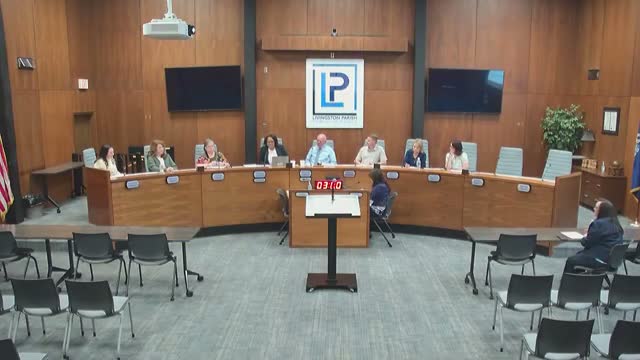
Dr. Joni Walker, Special Education Program Development Coordinator for Livingston Parish Public Schools, briefed the board on Act 479 and said the law strengthens protections for students with disabilities by limiting use of seclusion and physical restraint and expanding camera requirements for certain special-education classrooms.
The new law, Walker said, focuses on three areas—seclusion, restraint and cameras—and aims to promote student safety while preserving staff safety and professional judgment. “Act 479 strengthens these protections,” she said, and adds definitions, prohibitions and compliance steps districts must follow.
Under the law, Walker explained, seclusion is isolating a student in a separate room until they are no longer an immediate danger to themselves or others; sensory rooms that are unlocked and monitored are not seclusion rooms. Physical restraint is defined as bodily force used to limit movement; minimal-contact escorting or calming is not considered restraint. The law strictly prohibits mechanical restraints and techniques that apply excessive pressure to the chest or back or cause asphyxia, and it bars use of seclusion or restraint for punishment or in cases where a student’s medical or psychological condition makes such measures inappropriate.
Walker outlined required documentation and notification steps after an incident: the staff member who used seclusion or restraint must notify the principal; the principal must notify the director of special education electronically; staff must notify the parent or guardian by phone as soon as practicable but no later than the end of the school day; and the school health designee or nurse must visit the student by the end of that same school day to check for injury and document findings. If a student is involved in three incidents in a school year, the special-education teacher must invite the parent to an IEP meeting to review the behavior intervention plan.
Act 479 also expands classroom camera requirements, Walker said, requiring audio and video cameras in designated self-contained special-education classrooms—defined as settings where students receive special-education services for 50% or more of the instructional day—including classrooms for students with significant disabilities, early childhood classrooms and seclusion rooms. Resource rooms or gifted-only classrooms are not designated under the law. The law specifies proper placement (no cameras in bathrooms or changing areas), required signage, staff training and equipment checks.
Recordings must be retained for at least 30 days unless an active investigation is ongoing and are protected under the Family Educational Rights and Privacy Act (FERPA). Walker said access is limited: the superintendent, designated district representatives, the director of special education and eligible parents may request and view recordings; law enforcement may be given access if a violation is suspected. “When it’s suspected outside the home, we report to law enforcement. When it’s suspected inside the home, that’s when we contact DCFS,” Walker said in response to a board question about reporting pathways.
The district has established a video-access workflow tied to an incident-report form: parents submit a detailed incident form (date, time, location, witnesses and description), the SPED director requests superintendent approval to view recordings, and designated district staff will view the recording within five days of receiving the completed form; the director then provides written notification of findings to the eligible requester. Only the eligible requester and district representative may attend viewings, recording the viewing is prohibited, and redactions will be made to protect other students’ identities.
Walker told the board that the district completed required staff training as of Feb. 1 and that when a camera is nonoperational for more than two consecutive days, parents of students in the affected classroom will be notified in writing with outage dates. She announced that, effective Feb. 1, 2026, all cameras in designated special-education classrooms had been activated.
Board members asked whether the requirements would create an unmanageable workload. A board member called the law “expansive and probably burdensome,” and the presiding official acknowledged the increased work but said responsibilities are shared among assistant superintendents and the superintendent and that the district has established procedures to manage compliance. The presiding official also said prior camera use in some classrooms and relatively few viewing requests suggested parents generally trust staff. When asked about additional restraint training, the presiding official said no new supplemental strength-training was required and reassured teachers that appropriate affectionate contact—such as hugging—remains allowable when not part of inappropriate behavior.
Walker closed by offering a contact for more information and the board adjourned. The district provided the contact name Eric Fennelber for follow-up.
The new law, Walker said, focuses on three areas—seclusion, restraint and cameras—and aims to promote student safety while preserving staff safety and professional judgment. “Act 479 strengthens these protections,” she said, and adds definitions, prohibitions and compliance steps districts must follow.
Under the law, Walker explained, seclusion is isolating a student in a separate room until they are no longer an immediate danger to themselves or others; sensory rooms that are unlocked and monitored are not seclusion rooms. Physical restraint is defined as bodily force used to limit movement; minimal-contact escorting or calming is not considered restraint. The law strictly prohibits mechanical restraints and techniques that apply excessive pressure to the chest or back or cause asphyxia, and it bars use of seclusion or restraint for punishment or in cases where a student’s medical or psychological condition makes such measures inappropriate.
Walker outlined required documentation and notification steps after an incident: the staff member who used seclusion or restraint must notify the principal; the principal must notify the director of special education electronically; staff must notify the parent or guardian by phone as soon as practicable but no later than the end of the school day; and the school health designee or nurse must visit the student by the end of that same school day to check for injury and document findings. If a student is involved in three incidents in a school year, the special-education teacher must invite the parent to an IEP meeting to review the behavior intervention plan.
Act 479 also expands classroom camera requirements, Walker said, requiring audio and video cameras in designated self-contained special-education classrooms—defined as settings where students receive special-education services for 50% or more of the instructional day—including classrooms for students with significant disabilities, early childhood classrooms and seclusion rooms. Resource rooms or gifted-only classrooms are not designated under the law. The law specifies proper placement (no cameras in bathrooms or changing areas), required signage, staff training and equipment checks.
Recordings must be retained for at least 30 days unless an active investigation is ongoing and are protected under the Family Educational Rights and Privacy Act (FERPA). Walker said access is limited: the superintendent, designated district representatives, the director of special education and eligible parents may request and view recordings; law enforcement may be given access if a violation is suspected. “When it’s suspected outside the home, we report to law enforcement. When it’s suspected inside the home, that’s when we contact DCFS,” Walker said in response to a board question about reporting pathways.
The district has established a video-access workflow tied to an incident-report form: parents submit a detailed incident form (date, time, location, witnesses and description), the SPED director requests superintendent approval to view recordings, and designated district staff will view the recording within five days of receiving the completed form; the director then provides written notification of findings to the eligible requester. Only the eligible requester and district representative may attend viewings, recording the viewing is prohibited, and redactions will be made to protect other students’ identities.
Walker told the board that the district completed required staff training as of Feb. 1 and that when a camera is nonoperational for more than two consecutive days, parents of students in the affected classroom will be notified in writing with outage dates. She announced that, effective Feb. 1, 2026, all cameras in designated special-education classrooms had been activated.
Board members asked whether the requirements would create an unmanageable workload. A board member called the law “expansive and probably burdensome,” and the presiding official acknowledged the increased work but said responsibilities are shared among assistant superintendents and the superintendent and that the district has established procedures to manage compliance. The presiding official also said prior camera use in some classrooms and relatively few viewing requests suggested parents generally trust staff. When asked about additional restraint training, the presiding official said no new supplemental strength-training was required and reassured teachers that appropriate affectionate contact—such as hugging—remains allowable when not part of inappropriate behavior.
Walker closed by offering a contact for more information and the board adjourned. The district provided the contact name Eric Fennelber for follow-up.
Don't Miss a Word: See the Full Meeting!
Go beyond summaries. Unlock every video, transcript, and key insight with a Founder Membership.
✓
Get instant access to full meeting videos
✓
Search and clip any phrase from complete transcripts
✓
Receive AI-powered summaries & custom alerts
✓
Enjoy lifetime, unrestricted access to government data
30-day money-back guarantee
