Rappahannock officials reveal first five-year school CIP, propose 1% local sales-tax option to pay for HVAC and roof work
February 11, 2026 | Rappahannock County, Virginia
This article was created by AI summarizing key points discussed. AI makes mistakes, so for full details and context, please refer to the video of the full meeting. Please report any errors so we can fix them. Report an error »
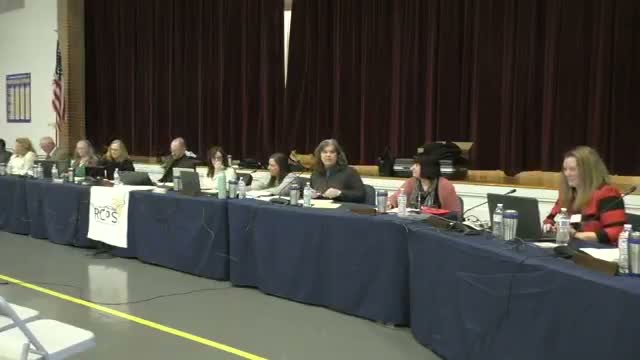
Miss Jewell, presenting the school division's first formal five-year Capital Improvements Plan (CIP), laid out a multi-year list of urgent projects and the funding plan for fiscal 2027 through 2031. The top-priority items are a reroofing project for the primary shelter building and extensive HVAC work at the high school, followed by ADA upgrades, auditorium safety work and door replacement in older portions of the building.
Why it matters: the schools say deferred maintenance has accumulated and several systems now require multi‑year projects that exceed the division's annual operating capacity. The CIP is intended to show both need and options so elected officials can decide whether to allocate local funds, seek bond financing or ask voters to approve a dedicated revenue source.
The details: the school division reported it had been awarded a $450,000 grant from the Virginia Department of Emergency Management (VDEM) for a metal roof on the county's second primary shelter. Miss Jewell said that leaves roughly $304,000 in local funds to complete the estimated roof project and that bids will be sought in the coming weeks. The plan lists HVAC replacements as a multi-year priority after engineering studies identified critical components and aging equipment.
On financing, staff identified two predictable streams and one possible ballot measure. The known items are (1) an annual state capital allocation of $200,000 that the presenters proposed dedicating to school capital needs, and (2) available grant funding such as the confirmed VDEM award. As an alternative to issuing bonds, Miss Jewell described pending General Assembly bills that would allow localities to place a 1% local-option sales-tax question on the ballot restricted to school capital; projected revenue under the presenters' assumptions was roughly $1.175 million in the first year of collection (FY28) rising slightly in later years and about $4.8 million over four years.
Miss Jewell framed the sales-tax option as a way to avoid borrowing: "This plan expects $0 in bonds to be issued for school capital projects," she said, adding the cash alternative could avoid about $2.3 million in interest costs over a 20-year bond term if voters approve the tax and the board elects to use that revenue to pay projects rather than borrow.
Board and supervisory reaction: supervisors and school-board members said the CIP provides much-needed transparency. Several acknowledged the political difficulty of asking voters to raise a tax, and noted that if the General Assembly's final language does not allow fronting of funds in FY27, the division may shift the timing of some projects so revenue and costs align.
What happens next: staff said they will return to the supervisors' March meeting with a recommended appropriation to cover the local share of the roof project and will continue public outreach if the board pursues a local sales‑tax referendum. The supervisors did not make a final decision on the sales-tax question at the joint meeting.
Why it matters: the schools say deferred maintenance has accumulated and several systems now require multi‑year projects that exceed the division's annual operating capacity. The CIP is intended to show both need and options so elected officials can decide whether to allocate local funds, seek bond financing or ask voters to approve a dedicated revenue source.
The details: the school division reported it had been awarded a $450,000 grant from the Virginia Department of Emergency Management (VDEM) for a metal roof on the county's second primary shelter. Miss Jewell said that leaves roughly $304,000 in local funds to complete the estimated roof project and that bids will be sought in the coming weeks. The plan lists HVAC replacements as a multi-year priority after engineering studies identified critical components and aging equipment.
On financing, staff identified two predictable streams and one possible ballot measure. The known items are (1) an annual state capital allocation of $200,000 that the presenters proposed dedicating to school capital needs, and (2) available grant funding such as the confirmed VDEM award. As an alternative to issuing bonds, Miss Jewell described pending General Assembly bills that would allow localities to place a 1% local-option sales-tax question on the ballot restricted to school capital; projected revenue under the presenters' assumptions was roughly $1.175 million in the first year of collection (FY28) rising slightly in later years and about $4.8 million over four years.
Miss Jewell framed the sales-tax option as a way to avoid borrowing: "This plan expects $0 in bonds to be issued for school capital projects," she said, adding the cash alternative could avoid about $2.3 million in interest costs over a 20-year bond term if voters approve the tax and the board elects to use that revenue to pay projects rather than borrow.
Board and supervisory reaction: supervisors and school-board members said the CIP provides much-needed transparency. Several acknowledged the political difficulty of asking voters to raise a tax, and noted that if the General Assembly's final language does not allow fronting of funds in FY27, the division may shift the timing of some projects so revenue and costs align.
What happens next: staff said they will return to the supervisors' March meeting with a recommended appropriation to cover the local share of the roof project and will continue public outreach if the board pursues a local sales‑tax referendum. The supervisors did not make a final decision on the sales-tax question at the joint meeting.
Don't Miss a Word: See the Full Meeting!
Go beyond summaries. Unlock every video, transcript, and key insight with a Founder Membership.
✓
Get instant access to full meeting videos
✓
Search and clip any phrase from complete transcripts
✓
Receive AI-powered summaries & custom alerts
✓
Enjoy lifetime, unrestricted access to government data
30-day money-back guarantee
