Superintendent: health insurance and teacher compensation are the largest budget drivers for FY27
February 11, 2026 | Rappahannock County, Virginia
This article was created by AI summarizing key points discussed. AI makes mistakes, so for full details and context, please refer to the video of the full meeting. Please report any errors so we can fix them. Report an error »
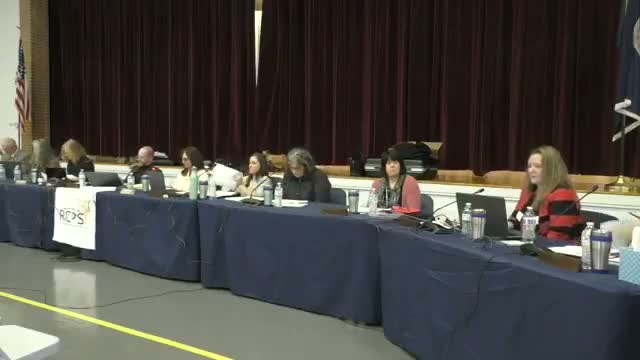
Dr. Grimsley presented the school division's FY27 budget building blocks, tying them to the division's comprehensive plan and six priority areas. She told supervisors and school-board members that average-daily membership (ADM) trends have stabilized since the COVID dip, and that community-survey responses continue to emphasize teacher salaries and school capital among top priorities.
On revenue, she said projected Standards of Quality (SOQ) funds were roughly $3.2 million in the state projection cited to the board, with modest increases in categorical and lottery funds. In explaining likely cost pressures, Grimsley highlighted two very large and uncertain inputs: compensation adjustments and health-insurance increases. "It's your raises, your compensation adjustments... It's your raises and your health insurance that's the the big drivers of any cost increases at the schools," she said.
She walked the board through scenarios: a 2% bonus in FY26 was estimated at about $161,000 (already appropriated in the model), a 2% salary increase in future years was modeled at roughly $180,887 of local cost in one scenario, and larger multi-year increases approaching a 5% pace would push costs much higher. She also noted reduction in the Virginia Retirement System (VRS) rate as a modest offset in employer cost.
Supervisors pressed staff about the timing of firm health-insurance numbers; Grimsley said the district expected the carrier's rate soon and that staff would provide the local-share calculations. Elected officials asked for a clearer separation of recurring operating needs and one-time capital asks; staff signaled they will publish a staffing worksheet and an administrative review in March.
What happens next: the superintendent said the division will present a more detailed budget proposal at the March meeting when the staffing-analysis report and updated insurance rates are available. The item will be central to the March public hearing on the FY27 budget.
On revenue, she said projected Standards of Quality (SOQ) funds were roughly $3.2 million in the state projection cited to the board, with modest increases in categorical and lottery funds. In explaining likely cost pressures, Grimsley highlighted two very large and uncertain inputs: compensation adjustments and health-insurance increases. "It's your raises, your compensation adjustments... It's your raises and your health insurance that's the the big drivers of any cost increases at the schools," she said.
She walked the board through scenarios: a 2% bonus in FY26 was estimated at about $161,000 (already appropriated in the model), a 2% salary increase in future years was modeled at roughly $180,887 of local cost in one scenario, and larger multi-year increases approaching a 5% pace would push costs much higher. She also noted reduction in the Virginia Retirement System (VRS) rate as a modest offset in employer cost.
Supervisors pressed staff about the timing of firm health-insurance numbers; Grimsley said the district expected the carrier's rate soon and that staff would provide the local-share calculations. Elected officials asked for a clearer separation of recurring operating needs and one-time capital asks; staff signaled they will publish a staffing worksheet and an administrative review in March.
What happens next: the superintendent said the division will present a more detailed budget proposal at the March meeting when the staffing-analysis report and updated insurance rates are available. The item will be central to the March public hearing on the FY27 budget.
View the Full Meeting & All Its Details
This article offers just a summary. Unlock complete video, transcripts, and insights as a Founder Member.
✓
Watch full, unedited meeting videos
✓
Search every word spoken in unlimited transcripts
✓
AI summaries & real-time alerts (all government levels)
✓
Permanent access to expanding government content
30-day money-back guarantee
