Committee tables bill to standardize state no‑access notices as lawmakers, state police and sponsor discuss data and implementation
February 11, 2026 | 2026 Legislature ME, Maine
This article was created by AI summarizing key points discussed. AI makes mistakes, so for full details and context, please refer to the video of the full meeting. Please report any errors so we can fix them. Report an error »
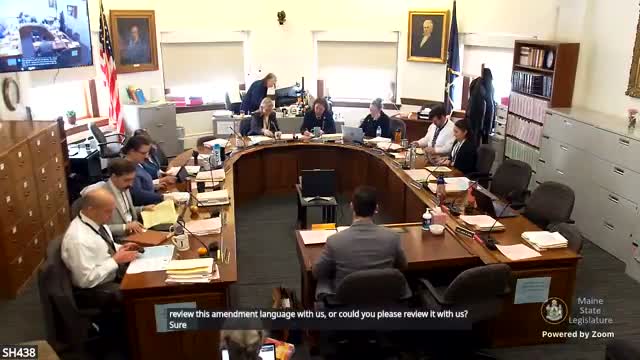
The committee opened LD 2150, an act to establish procedures for restricting access to state property, building from an amendment drafted by OPLA and the sponsor. Analyst Eli Murphy explained the draft removes reliance on the Protection From Harassment standard and proposes that notices or communications restricting access to state property be treated as final agency action for review under Title 5, chapter 375 (the Administrative Procedures Act). The amendment would also exclude institutions of higher education from the definition of "entity of the state" for this section and add a new state police data‑collection requirement.
Sponsor Senator Nicole Burrowski described the policy goal as making the ADC process easier to use and gathering limited data so the committee can evaluate whether the administrative path is adequate or a separate procedure is needed later. She said the proposal would require agencies to notify restricted individuals of the reason and available recourse and would ask state police to compile certain data points and report back so the Legislature can assess whether the change meets public‑access and due‑process aims.
Major Tyler Stevenson of the Maine State Police testified about current operational practice: "It is not something that is put into a database ... It is kept in house," and there is no centralized record of no‑trespass or similar restrictions that would automatically surface to every law enforcement agency. He told the committee existing systems (PFAs, bail conditions) are searchable on encounter but agencies do not get automatic statewide notifications of every PFA or order.
Members raised concerns that adding a reporting requirement might change frontline behavior—turning a quick, on‑scene de‑escalation into a recordable event—and asked how local police, county sheriff's offices and agency locations (DMVs, DHHS offices, state parks) would be notified. Several members suggested a compromise: require any law enforcement agency that serves a notice on state property to notify Maine State Police, which could track notices within existing resources.
After discussion, the chair proposed tabling LD 2150 so the sponsor can refine the amendment and coordinate with state police, the Department of Corrections and other stakeholders. The committee voted to table the bill; the chair announced the tabling motion carried unanimously of those present and the LD 2150 work session concluded.
Sponsor Senator Nicole Burrowski described the policy goal as making the ADC process easier to use and gathering limited data so the committee can evaluate whether the administrative path is adequate or a separate procedure is needed later. She said the proposal would require agencies to notify restricted individuals of the reason and available recourse and would ask state police to compile certain data points and report back so the Legislature can assess whether the change meets public‑access and due‑process aims.
Major Tyler Stevenson of the Maine State Police testified about current operational practice: "It is not something that is put into a database ... It is kept in house," and there is no centralized record of no‑trespass or similar restrictions that would automatically surface to every law enforcement agency. He told the committee existing systems (PFAs, bail conditions) are searchable on encounter but agencies do not get automatic statewide notifications of every PFA or order.
Members raised concerns that adding a reporting requirement might change frontline behavior—turning a quick, on‑scene de‑escalation into a recordable event—and asked how local police, county sheriff's offices and agency locations (DMVs, DHHS offices, state parks) would be notified. Several members suggested a compromise: require any law enforcement agency that serves a notice on state property to notify Maine State Police, which could track notices within existing resources.
After discussion, the chair proposed tabling LD 2150 so the sponsor can refine the amendment and coordinate with state police, the Department of Corrections and other stakeholders. The committee voted to table the bill; the chair announced the tabling motion carried unanimously of those present and the LD 2150 work session concluded.
Don't Miss a Word: See the Full Meeting!
Go beyond summaries. Unlock every video, transcript, and key insight with a Founder Membership.
✓
Get instant access to full meeting videos
✓
Search and clip any phrase from complete transcripts
✓
Receive AI-powered summaries & custom alerts
✓
Enjoy lifetime, unrestricted access to government data
30-day money-back guarantee
