Committee discusses narrowed automatic sealing amendment for misdemeanors; judicial branch warns of paper‑record implementation costs
February 11, 2026 | 2026 Legislature ME, Maine
This article was created by AI summarizing key points discussed. AI makes mistakes, so for full details and context, please refer to the video of the full meeting. Please report any errors so we can fix them. Report an error »
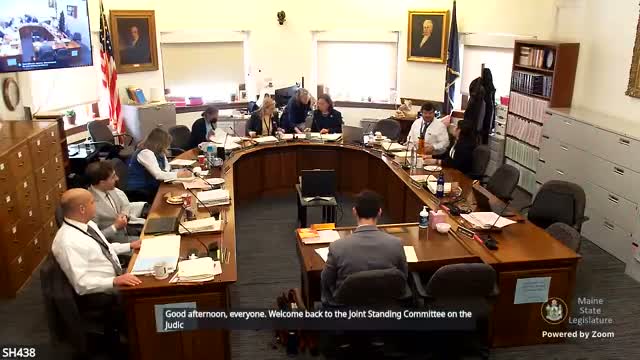
The Judiciary Committee reviewed a substantial amendment to LD 1911 that would streamline and expand automatic sealing for low‑level criminal records while narrowing eligibility in other respects.
Analyst Eli Murphy told the committee the amendment removes class B and C crimes from eligibility and limits automatic sealing to class E and D misdemeanors, with a set of statutory exceptions. The sponsor, Senator Talbot Ross, said four class D offenses were added to the exceptions list—terrorizing, criminal threatening, criminal restraint and reckless conduct—based on a Department of Health and Human Services licensing matrix that disqualifies applicants for certain direct‑care and daycare work.
Sponsor Talbot Ross framed the bill: "The most important significant change that we could make would be to automatically seal class e and class d misdemeanors ..." and described the goal as improving access to housing and employment for people with low‑level records who have completed waiting periods.
Julie Finn, representing the Judicial Branch, said the branch takes no position on policy but stressed implementation challenges. Much of the historical case record remains on paper across courthouses and archives; a monthly automated look‑back that reaches back five years and further (a phased look‑back covering many earlier years) would require collecting and reviewing paper files and would demand additional temporary personnel to avoid pulling staff from courtrooms.
Media and press groups raised First Amendment concerns and shared a legal opinion arguing presumptive sealing can implicate access to court records; Ryan Ewing of the Clean Slate Initiative countered that state courts are not strictly bound by federal circuit precedent and pointed to other states (Massachusetts, Rhode Island, New Hampshire) that have implemented presumptive sealing for non‑convictions or clean‑slate approaches without fatal constitutional outcomes. He described an implementation design that applies digital flags to docket records and prevents dissemination from centralized SBI repositories without requiring staff to reprocess every paper file.
Committee members asked technical questions about how SBI disseminates dismissals and non‑conviction results, whether deferred dispositions are treated as convictions or non‑convictions for purposes of eligibility, and whether the judicial branch could phase implementation. The bill includes an implementation date and sequencing; the sponsor noted an implementation date of 2028 in the amendment and the committee discussed staggered approaches to reduce immediate resource needs.
No final floor vote on LD 1911 was recorded in this session; members requested additional drafting and coordination with SBI, DPFR and the Judicial Branch to reconcile technical language and implementation timelines.
Analyst Eli Murphy told the committee the amendment removes class B and C crimes from eligibility and limits automatic sealing to class E and D misdemeanors, with a set of statutory exceptions. The sponsor, Senator Talbot Ross, said four class D offenses were added to the exceptions list—terrorizing, criminal threatening, criminal restraint and reckless conduct—based on a Department of Health and Human Services licensing matrix that disqualifies applicants for certain direct‑care and daycare work.
Sponsor Talbot Ross framed the bill: "The most important significant change that we could make would be to automatically seal class e and class d misdemeanors ..." and described the goal as improving access to housing and employment for people with low‑level records who have completed waiting periods.
Julie Finn, representing the Judicial Branch, said the branch takes no position on policy but stressed implementation challenges. Much of the historical case record remains on paper across courthouses and archives; a monthly automated look‑back that reaches back five years and further (a phased look‑back covering many earlier years) would require collecting and reviewing paper files and would demand additional temporary personnel to avoid pulling staff from courtrooms.
Media and press groups raised First Amendment concerns and shared a legal opinion arguing presumptive sealing can implicate access to court records; Ryan Ewing of the Clean Slate Initiative countered that state courts are not strictly bound by federal circuit precedent and pointed to other states (Massachusetts, Rhode Island, New Hampshire) that have implemented presumptive sealing for non‑convictions or clean‑slate approaches without fatal constitutional outcomes. He described an implementation design that applies digital flags to docket records and prevents dissemination from centralized SBI repositories without requiring staff to reprocess every paper file.
Committee members asked technical questions about how SBI disseminates dismissals and non‑conviction results, whether deferred dispositions are treated as convictions or non‑convictions for purposes of eligibility, and whether the judicial branch could phase implementation. The bill includes an implementation date and sequencing; the sponsor noted an implementation date of 2028 in the amendment and the committee discussed staggered approaches to reduce immediate resource needs.
No final floor vote on LD 1911 was recorded in this session; members requested additional drafting and coordination with SBI, DPFR and the Judicial Branch to reconcile technical language and implementation timelines.
Don't Miss a Word: See the Full Meeting!
Go beyond summaries. Unlock every video, transcript, and key insight with a Founder Membership.
✓
Get instant access to full meeting videos
✓
Search and clip any phrase from complete transcripts
✓
Receive AI-powered summaries & custom alerts
✓
Enjoy lifetime, unrestricted access to government data
30-day money-back guarantee
