Brookline public hearing exposes deep divide over Chestnut Hill West rezoning
February 11, 2026 | Town of Brookline, Norfolk County, Massachusetts
This article was created by AI summarizing key points discussed. AI makes mistakes, so for full details and context, please refer to the video of the full meeting. Please report any errors so we can fix them. Report an error »
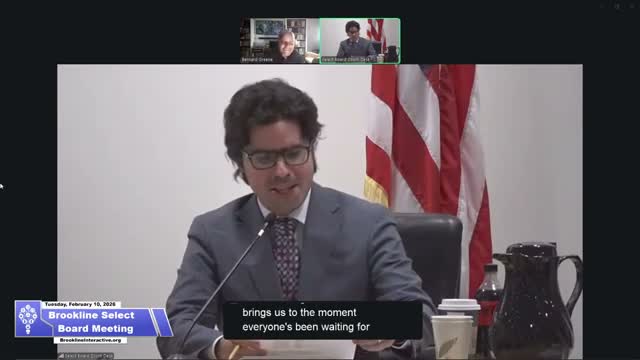
Brookline's Select Board on Feb. 10 heard more than two dozen residents, committee members and local boards in a public hearing on proposed overlay zoning for the Chestnut Hill West commercial area, a rezoning that backers say is needed to generate new commercial tax revenue and add housing and that opponents say is being shaped around a single developer's proposal.
The hearing opened after staff updates from Meredith Mooney, the town's economic development director, who told the board the planning team has been coordinating with neighboring Newton and expects transportation capacity testing results by the end of the week. "We've been in communications with Newton's planning staff as well as their transportation staff throughout this process," Mooney said.
Much of the testimony focused on two competing claims: proponents argued the overlay would unlock significant revenue and housing, while neighbors said the scale and process are flawed. Christopher Mutti, executive director of the Brookline Chamber of Commerce, urged the board to send the articles to Town Meeting, calling the rezoning "critical to Brookline addressing our structural deficit" and saying it represents a "tremendous opportunity to grow our commercial base." Jonathan Klein, a member of the housing advisory board, told the board the project would add "more than 250 new homes" and estimated recurring net new tax revenue of "$5,600,000 per year," and said the plan would generate $11,000,000 for the Affordable Housing Trust.
Neighborhood speakers and several community advisory committee members urged lower heights and more comprehensive study. Linda Roseman, a member of the advisory committee, said the zoning "would be tailored to City Realty's project proposal," and warned that it risks setting a townwide precedent. Multiple residents who live closest to the site asked that maximum heights be reduced from the proposed bonus 14 stories to 10 or 12 stories to protect neighborhood character and reduce traffic impacts.
Experts and town advisory boards were sharply split. George Cole, chair of an EDAB ad hoc committee that examined feasibility, argued the rezoning "makes development feasible, possible, and probably probable," and warned that cutting height would reduce feasibility and tax revenue. By contrast, Neil Gordon of the advocacy group PACS and others cautioned that a too-aggressive zoning warrant invites amendments and political pushback at Town Meeting that could defeat the main motion.
Traffic and intermunicipal coordination were recurring concerns. Lyle Baker, a longtime member of the Newton City Council, said outreach to Newton must be deeper and warned that concepts like vehicle "arc cuts" would impede cross-Route 9 movement for local residents. Several speakers stressed that some property owners in the proposed subdistrict have no current redevelopment plans, arguing rezoning should wait until market signals or owner interest emerge.
Select Board members acknowledged the difficulty of balancing neighborhood concerns, town fiscal needs and development feasibility. Board members repeatedly urged continued engagement and suggested working to find a proposal that could reach the votes necessary at Town Meeting. "We need to come up with something, a solution that can get a two-thirds Town Meeting vote," one Select Board member said.
The public hearing closed after several hours of testimony; the Select Board did not adopt a final position at the meeting. The project and overlay zoning remain subject to further analysis, additional public input and the Town Meeting process.
What happens next: staff expect more technical information from traffic studies, a March workshop to discuss implementation, and continued outreach ahead of the May Town Meeting warrant process. The Select Board agreed to continue deliberations and explore adjustments intended to broaden support in advance of a possible May warrant submission.
The hearing opened after staff updates from Meredith Mooney, the town's economic development director, who told the board the planning team has been coordinating with neighboring Newton and expects transportation capacity testing results by the end of the week. "We've been in communications with Newton's planning staff as well as their transportation staff throughout this process," Mooney said.
Much of the testimony focused on two competing claims: proponents argued the overlay would unlock significant revenue and housing, while neighbors said the scale and process are flawed. Christopher Mutti, executive director of the Brookline Chamber of Commerce, urged the board to send the articles to Town Meeting, calling the rezoning "critical to Brookline addressing our structural deficit" and saying it represents a "tremendous opportunity to grow our commercial base." Jonathan Klein, a member of the housing advisory board, told the board the project would add "more than 250 new homes" and estimated recurring net new tax revenue of "$5,600,000 per year," and said the plan would generate $11,000,000 for the Affordable Housing Trust.
Neighborhood speakers and several community advisory committee members urged lower heights and more comprehensive study. Linda Roseman, a member of the advisory committee, said the zoning "would be tailored to City Realty's project proposal," and warned that it risks setting a townwide precedent. Multiple residents who live closest to the site asked that maximum heights be reduced from the proposed bonus 14 stories to 10 or 12 stories to protect neighborhood character and reduce traffic impacts.
Experts and town advisory boards were sharply split. George Cole, chair of an EDAB ad hoc committee that examined feasibility, argued the rezoning "makes development feasible, possible, and probably probable," and warned that cutting height would reduce feasibility and tax revenue. By contrast, Neil Gordon of the advocacy group PACS and others cautioned that a too-aggressive zoning warrant invites amendments and political pushback at Town Meeting that could defeat the main motion.
Traffic and intermunicipal coordination were recurring concerns. Lyle Baker, a longtime member of the Newton City Council, said outreach to Newton must be deeper and warned that concepts like vehicle "arc cuts" would impede cross-Route 9 movement for local residents. Several speakers stressed that some property owners in the proposed subdistrict have no current redevelopment plans, arguing rezoning should wait until market signals or owner interest emerge.
Select Board members acknowledged the difficulty of balancing neighborhood concerns, town fiscal needs and development feasibility. Board members repeatedly urged continued engagement and suggested working to find a proposal that could reach the votes necessary at Town Meeting. "We need to come up with something, a solution that can get a two-thirds Town Meeting vote," one Select Board member said.
The public hearing closed after several hours of testimony; the Select Board did not adopt a final position at the meeting. The project and overlay zoning remain subject to further analysis, additional public input and the Town Meeting process.
What happens next: staff expect more technical information from traffic studies, a March workshop to discuss implementation, and continued outreach ahead of the May Town Meeting warrant process. The Select Board agreed to continue deliberations and explore adjustments intended to broaden support in advance of a possible May warrant submission.
View the Full Meeting & All Its Details
This article offers just a summary. Unlock complete video, transcripts, and insights as a Founder Member.
✓
Watch full, unedited meeting videos
✓
Search every word spoken in unlimited transcripts
✓
AI summaries & real-time alerts (all government levels)
✓
Permanent access to expanding government content
30-day money-back guarantee
