Committee reviews draft to create Vermont Homelessness Response Continuum; debate centers on triggers, municipal grants and administrative approach
February 11, 2026 | Human Services, HOUSE OF REPRESENTATIVES, Committees, Legislative , Vermont
This article was created by AI summarizing key points discussed. AI makes mistakes, so for full details and context, please refer to the video of the full meeting. Please report any errors so we can fix them. Report an error »
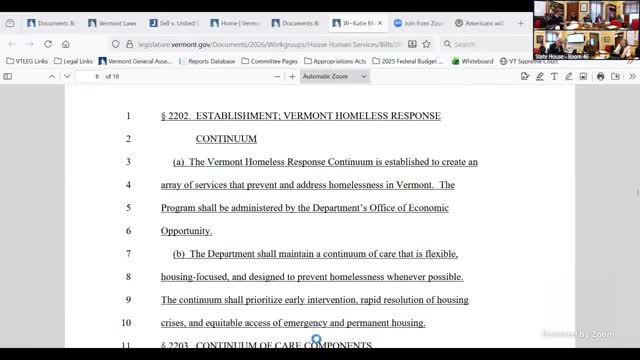
Legislative members and staff on the committee spent the session conducting line-by-line markup of a draft bill to establish the Vermont Homelessness Response Continuum, a state-administered program intended to coordinate prevention, emergency and permanent housing services across the state.
The draft (Section 2202) assigns administration to the Office of Economic Opportunity and directs the department to maintain a flexible, housing-focused continuum prioritizing early intervention, rapid resolution of housing crises and equitable access to emergency and permanent housing. Speaker 2 read the bill text aloud: “The Vermont Homelessness Response Continuum is established to create an array of services that prevent and address homelessness in Vermont.”
Why it matters: the measure ties service categories to separate budget line items and anticipates transfers among Agency of Human Services departments to implement different service buckets. Committee members pressed for clarity on budget language and administrative responsibility so municipalities and community-based organizations can access funds consistently.
Prevention, diversion and rapid-exit: The bill designates prevention and diversion as the primary entry point and requires standardized assessments and flexible funding for households requesting assistance. Committee members raised concerns that the HUD definition of diversion (which excludes shelter-based services) might prevent flexible funds being used for brief hotel placements that later lead to stable housing. Lily suggested adding an explicit 'exit' or rapid-exit component to capture funds now used to help people move from shelter into housing or treatment.
Emergency housing services and municipal grants: Section 2205 lists emergency housing provisions, including a bucket of funds intended for municipalities to ensure equitable access to shelter when the National Weather Service issues a cold-weather advisory, plus provisions for community partners that operate shelters statewide. Members debated whether grants should flow directly to municipalities, to statewide administrators such as Vermont Interfaith Action, or to community partners via state agreements. Andy Carpenter (rental consultant) and others noted existing local arrangements and urged language that preserves flexibility.
Activation triggers and seasonal alternatives: A central point of contention was how to trigger emergency shelter eligibility. The draft references both a numeric 10-degree threshold and the National Weather Service's cold-weather advisory; members observed the advisory’s criteria vary by region and can correspond to substantially colder apparent-temperature thresholds (wind chill). To avoid uneven or overly cold triggers, several members proposed using a predictable seasonal date range (for example, Dec. 1–Mar. 31) as an alternative or complement to temperature-based language.
Motels and hotels (December–March): The bill includes a provision to allow motel and hotel placements between Dec. 1 and March 31 when no other temporary or permanent shelter is available; those placements would require coordinated entry assessments and assignment of case management. Committee members debated whether limits on motel usage should be expressed as a dollar cap set via appropriation (a funding-based limit) rather than a fixed number of days, and how prioritization would be managed through coordinated entry to avoid first-come, first-served outcomes.
Administration, data and reporting: Committee members discussed operational details including whether the state or local coordinators should make reservations and referrals, and whether the state can enter agreements with community partners to administer funds. Speaker 1 said the state plans to use the Homeless Management Information System (HMIS) for data. Several members urged keeping data reporting minimal for episodic emergency responses while still ensuring accountability.
Appropriations, definitions and next steps: The chair noted appropriations for each service 'bucket' will be specified in the bill’s appropriation section; specific amounts were not read during markup and are not specified in the draft text discussed. Committee members asked for a Vermont-specific definition of 'permanent supportive housing' that reflects local practice. The committee scheduled related hearings (including a joint meeting with the Senate Health and Welfare committee and a public hearing featuring people with lived experience) and asked members to submit recommendations for which community partners should testify.
Representative Lee joined the meeting and several staff members and outside advisors were named during discussion. The committee recessed with instructions to return with clarified language on triggers, administrative roles and appropriation mechanics.
The committee did not take any formal votes during this session; the chair asked members to provide written recommendations and to prepare for a tighter set of funding recommendations in light of budget constraints.
The draft (Section 2202) assigns administration to the Office of Economic Opportunity and directs the department to maintain a flexible, housing-focused continuum prioritizing early intervention, rapid resolution of housing crises and equitable access to emergency and permanent housing. Speaker 2 read the bill text aloud: “The Vermont Homelessness Response Continuum is established to create an array of services that prevent and address homelessness in Vermont.”
Why it matters: the measure ties service categories to separate budget line items and anticipates transfers among Agency of Human Services departments to implement different service buckets. Committee members pressed for clarity on budget language and administrative responsibility so municipalities and community-based organizations can access funds consistently.
Prevention, diversion and rapid-exit: The bill designates prevention and diversion as the primary entry point and requires standardized assessments and flexible funding for households requesting assistance. Committee members raised concerns that the HUD definition of diversion (which excludes shelter-based services) might prevent flexible funds being used for brief hotel placements that later lead to stable housing. Lily suggested adding an explicit 'exit' or rapid-exit component to capture funds now used to help people move from shelter into housing or treatment.
Emergency housing services and municipal grants: Section 2205 lists emergency housing provisions, including a bucket of funds intended for municipalities to ensure equitable access to shelter when the National Weather Service issues a cold-weather advisory, plus provisions for community partners that operate shelters statewide. Members debated whether grants should flow directly to municipalities, to statewide administrators such as Vermont Interfaith Action, or to community partners via state agreements. Andy Carpenter (rental consultant) and others noted existing local arrangements and urged language that preserves flexibility.
Activation triggers and seasonal alternatives: A central point of contention was how to trigger emergency shelter eligibility. The draft references both a numeric 10-degree threshold and the National Weather Service's cold-weather advisory; members observed the advisory’s criteria vary by region and can correspond to substantially colder apparent-temperature thresholds (wind chill). To avoid uneven or overly cold triggers, several members proposed using a predictable seasonal date range (for example, Dec. 1–Mar. 31) as an alternative or complement to temperature-based language.
Motels and hotels (December–March): The bill includes a provision to allow motel and hotel placements between Dec. 1 and March 31 when no other temporary or permanent shelter is available; those placements would require coordinated entry assessments and assignment of case management. Committee members debated whether limits on motel usage should be expressed as a dollar cap set via appropriation (a funding-based limit) rather than a fixed number of days, and how prioritization would be managed through coordinated entry to avoid first-come, first-served outcomes.
Administration, data and reporting: Committee members discussed operational details including whether the state or local coordinators should make reservations and referrals, and whether the state can enter agreements with community partners to administer funds. Speaker 1 said the state plans to use the Homeless Management Information System (HMIS) for data. Several members urged keeping data reporting minimal for episodic emergency responses while still ensuring accountability.
Appropriations, definitions and next steps: The chair noted appropriations for each service 'bucket' will be specified in the bill’s appropriation section; specific amounts were not read during markup and are not specified in the draft text discussed. Committee members asked for a Vermont-specific definition of 'permanent supportive housing' that reflects local practice. The committee scheduled related hearings (including a joint meeting with the Senate Health and Welfare committee and a public hearing featuring people with lived experience) and asked members to submit recommendations for which community partners should testify.
Representative Lee joined the meeting and several staff members and outside advisors were named during discussion. The committee recessed with instructions to return with clarified language on triggers, administrative roles and appropriation mechanics.
The committee did not take any formal votes during this session; the chair asked members to provide written recommendations and to prepare for a tighter set of funding recommendations in light of budget constraints.
Don't Miss a Word: See the Full Meeting!
Go beyond summaries. Unlock every video, transcript, and key insight with a Founder Membership.
✓
Get instant access to full meeting videos
✓
Search and clip any phrase from complete transcripts
✓
Receive AI-powered summaries & custom alerts
✓
Enjoy lifetime, unrestricted access to government data
30-day money-back guarantee
