McCormick County Council reviews proposed one‑year water/sewer contract with Clearwater Solution LLC, moves to executive session
September 27, 2024 | McCormick County, South Carolina
This article was created by AI summarizing key points discussed. AI makes mistakes, so for full details and context, please refer to the video of the full meeting. Please report any errors so we can fix them. Report an error »
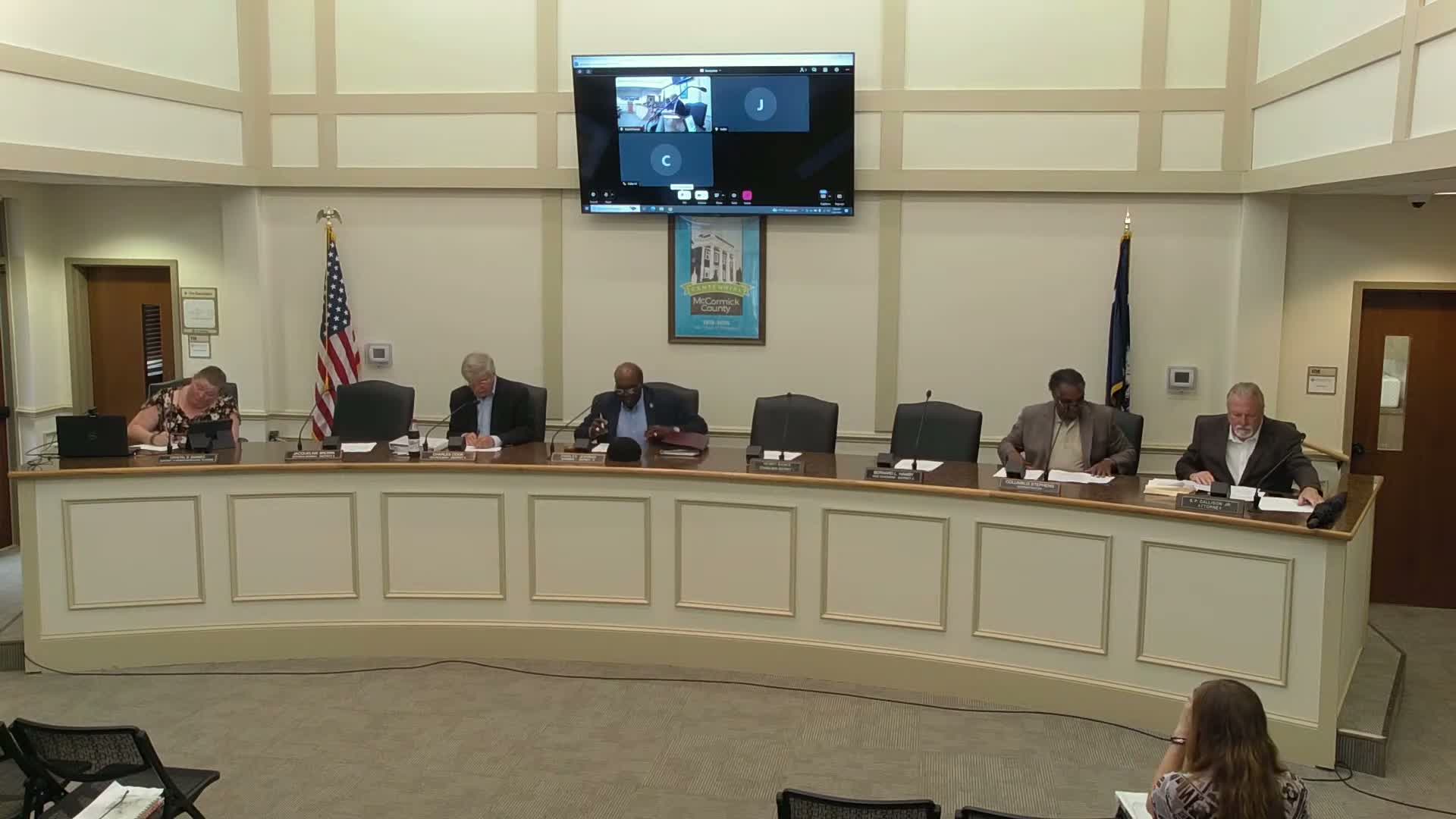
McCormick County councilors spent most of a Sept. 26 special call reviewing a proposed one‑year professional services agreement with Clearwater Solution LLC (CWS) before moving into executive session to discuss contract modifications and a pending legal matter.
The meeting opened with invocation and roll call. The chair introduced Decision Item 1: authorization for the administrator to sign a one‑year professional service contract with Clearwater Solution LLC. Councilman Charles Cook asked whether the contract before the board was identical to the version previously emailed to members and said he had not had adequate time to review the document.
Cook pressed staff and counsel on multiple provisions, seeking clearer language in several places. On a clause allowing the contractor to “rehabilitate, expand, or modify the treatment facility,” Cook said he was unaware McCormick County maintained a treatment facility and questioned whether the provision would instead apply to lift stations. Staff responded that the clause reads “if any” and could be clarified to reference the distribution/collection system rather than implying a county‑owned treatment plant.
Members discussed the contract’s use of the term “best management practices.” A county attorney or staff member told the council such a term is commonly interpreted to include state regulators (for example, the South Carolina Department of Health and Environmental Control), industry standards and federal requirements, and that leaving the phrase broad is typical legal practice. Councilors asked whether the contract should more specifically reference industry standards or DHEC requirements; staff said the county could add clarifying language but that the phrase as written is not unusual in service agreements.
The council debated operational responsibilities tied to sewer line incidents. Councilman Cook suggested replacing wording that mentioned “line breaks” with language listing “installation of sewer taps, sewer lines, manhole locations, and repairs” so the contractor’s duties would clearly include repair and maintenance. On fire hydrants, one councilor said he had heard reports that hydrants had been missing or unreplaced for more than a year and asked that the contract explicitly require hydrant testing, repairs, replacement and pressure checks; staff replied that routine maintenance language likely covers replacement but agreed adding “hydrant testing” is reasonable.
Councilors also raised questions about maintenance recordkeeping and data ownership. A county staff member confirmed the county owns the software package used to maintain records and that data would remain county property if the contractor departed.
On compensation and budget, members discussed how the contract fee interacts with existing line‑item allocations. Councilors cited figures in discussion: the annual contractor fee shown in materials had been reduced in presentation from $2,100,000 to $1,750,000, and a separate repairs and maintenance (R&M) line of approximately $450,000 was referenced. County staff and the administrator said the water and sewer operation is managed as an enterprise fund, that the $4,000,000 appropriation previously approved by the council includes the relevant line items, and that the contractor submits monthly invoices for reimbursable categories. Staff said the fee covers labor, benefits and other employment costs and that the budget treatment is similar to other county departments.
With several wording changes proposed and open questions remaining, a motion was made and seconded to move into executive session. The chair stated the executive session would cover “modifications of the agreement with SLV Windfall Group” and to receive legal advice regarding “a circuit court case on referendum.” The council proceeded into executive session; no final public vote on the Clearwater Solution LLC contract appears in the public portion of the transcript.
Next steps: The council paused the public meeting to go into executive session to discuss the contract modifications and the legal update; the transcript ends with the council preparing to reconvene following the closed session.
The meeting opened with invocation and roll call. The chair introduced Decision Item 1: authorization for the administrator to sign a one‑year professional service contract with Clearwater Solution LLC. Councilman Charles Cook asked whether the contract before the board was identical to the version previously emailed to members and said he had not had adequate time to review the document.
Cook pressed staff and counsel on multiple provisions, seeking clearer language in several places. On a clause allowing the contractor to “rehabilitate, expand, or modify the treatment facility,” Cook said he was unaware McCormick County maintained a treatment facility and questioned whether the provision would instead apply to lift stations. Staff responded that the clause reads “if any” and could be clarified to reference the distribution/collection system rather than implying a county‑owned treatment plant.
Members discussed the contract’s use of the term “best management practices.” A county attorney or staff member told the council such a term is commonly interpreted to include state regulators (for example, the South Carolina Department of Health and Environmental Control), industry standards and federal requirements, and that leaving the phrase broad is typical legal practice. Councilors asked whether the contract should more specifically reference industry standards or DHEC requirements; staff said the county could add clarifying language but that the phrase as written is not unusual in service agreements.
The council debated operational responsibilities tied to sewer line incidents. Councilman Cook suggested replacing wording that mentioned “line breaks” with language listing “installation of sewer taps, sewer lines, manhole locations, and repairs” so the contractor’s duties would clearly include repair and maintenance. On fire hydrants, one councilor said he had heard reports that hydrants had been missing or unreplaced for more than a year and asked that the contract explicitly require hydrant testing, repairs, replacement and pressure checks; staff replied that routine maintenance language likely covers replacement but agreed adding “hydrant testing” is reasonable.
Councilors also raised questions about maintenance recordkeeping and data ownership. A county staff member confirmed the county owns the software package used to maintain records and that data would remain county property if the contractor departed.
On compensation and budget, members discussed how the contract fee interacts with existing line‑item allocations. Councilors cited figures in discussion: the annual contractor fee shown in materials had been reduced in presentation from $2,100,000 to $1,750,000, and a separate repairs and maintenance (R&M) line of approximately $450,000 was referenced. County staff and the administrator said the water and sewer operation is managed as an enterprise fund, that the $4,000,000 appropriation previously approved by the council includes the relevant line items, and that the contractor submits monthly invoices for reimbursable categories. Staff said the fee covers labor, benefits and other employment costs and that the budget treatment is similar to other county departments.
With several wording changes proposed and open questions remaining, a motion was made and seconded to move into executive session. The chair stated the executive session would cover “modifications of the agreement with SLV Windfall Group” and to receive legal advice regarding “a circuit court case on referendum.” The council proceeded into executive session; no final public vote on the Clearwater Solution LLC contract appears in the public portion of the transcript.
Next steps: The council paused the public meeting to go into executive session to discuss the contract modifications and the legal update; the transcript ends with the council preparing to reconvene following the closed session.
View the Full Meeting & All Its Details
This article offers just a summary. Unlock complete video, transcripts, and insights as a Founder Member.
✓
Watch full, unedited meeting videos
✓
Search every word spoken in unlimited transcripts
✓
AI summaries & real-time alerts (all government levels)
✓
Permanent access to expanding government content
30-day money-back guarantee
