Port Richey council approves multiple code changes, aligns sign and temporary-shelter rules with state law
February 11, 2026 | Port Richey City, Pasco County, Florida
This article was created by AI summarizing key points discussed. AI makes mistakes, so for full details and context, please refer to the video of the full meeting. Please report any errors so we can fix them. Report an error »
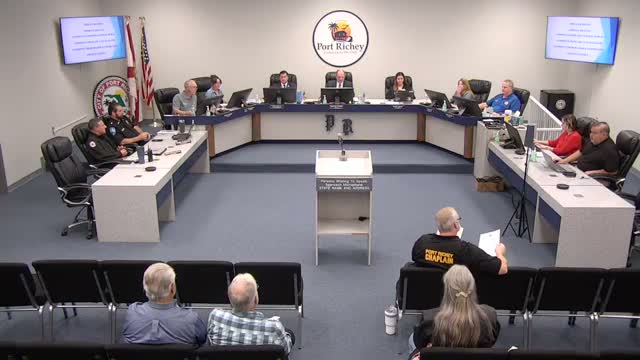
Port Richey 2D The Port Richey City Council voted Tuesday to approve a string of ordinance updates that city staff said mainly reorganize local rules and align the city27s code with recent state law.
At a public hearing, City Attorney Nancy Meyer read Ordinance 26-742, described by staff as repealing more restrictive local requirements that predated Senate Bill 180. Meyer then read Ordinance 26-743, which moves language about temporary shelters to the correct code sections and adds references to section 163.0335 of the Florida Statutes; staff told council the change is intended to correct where the rule is located in the code, not to alter substantive requirements. Both ordinances were approved on second reading by voice vote with no members of the public registered to speak.
On related matters, council approved on first reading Ordinance 26-740, a reorganization and revision of the city27s sign chapter to remove outdated or preempted provisions and to reflect prevailing First Amendment case law. Council also approved the first reading of Ordinance 26-741, which makes sign requirements in the Waterfront Overlay District consistent with the general sign code; council members noted the revision could allow digital signage under the unified code.
"Ordinance number 26-742...providing for severability, providing for codification, and providing for an effective date," City Attorney Nancy Meyer read aloud as part of the record during the hearing.
City staff said the sign-code revisions follow several workshops and include substantive edits that required the item to return to council for another first reading. Councilmembers did not ask for further public hearings on those readings and approved them to proceed through the ordinance process.
What happens next: the ordinances approved on first reading will return for subsequent readings as required by local procedure; items approved on second reading become effective according to the language in the ordinances unless an effective date elsewhere is specified. Planning-and-zoning review and any required public-notice steps remain part of the process for projects that rely on changes to the code.
At a public hearing, City Attorney Nancy Meyer read Ordinance 26-742, described by staff as repealing more restrictive local requirements that predated Senate Bill 180. Meyer then read Ordinance 26-743, which moves language about temporary shelters to the correct code sections and adds references to section 163.0335 of the Florida Statutes; staff told council the change is intended to correct where the rule is located in the code, not to alter substantive requirements. Both ordinances were approved on second reading by voice vote with no members of the public registered to speak.
On related matters, council approved on first reading Ordinance 26-740, a reorganization and revision of the city27s sign chapter to remove outdated or preempted provisions and to reflect prevailing First Amendment case law. Council also approved the first reading of Ordinance 26-741, which makes sign requirements in the Waterfront Overlay District consistent with the general sign code; council members noted the revision could allow digital signage under the unified code.
"Ordinance number 26-742...providing for severability, providing for codification, and providing for an effective date," City Attorney Nancy Meyer read aloud as part of the record during the hearing.
City staff said the sign-code revisions follow several workshops and include substantive edits that required the item to return to council for another first reading. Councilmembers did not ask for further public hearings on those readings and approved them to proceed through the ordinance process.
What happens next: the ordinances approved on first reading will return for subsequent readings as required by local procedure; items approved on second reading become effective according to the language in the ordinances unless an effective date elsewhere is specified. Planning-and-zoning review and any required public-notice steps remain part of the process for projects that rely on changes to the code.
Don't Miss a Word: See the Full Meeting!
Go beyond summaries. Unlock every video, transcript, and key insight with a Founder Membership.
✓
Get instant access to full meeting videos
✓
Search and clip any phrase from complete transcripts
✓
Receive AI-powered summaries & custom alerts
✓
Enjoy lifetime, unrestricted access to government data
30-day money-back guarantee
