Debate over proposed ban on landfill expansion into wetlands centers on Juniper Ridge, PFAS risks and statewide capacity
February 11, 2026 | 2026 Legislature ME, Maine
This article was created by AI summarizing key points discussed. AI makes mistakes, so for full details and context, please refer to the video of the full meeting. Please report any errors so we can fix them. Report an error »
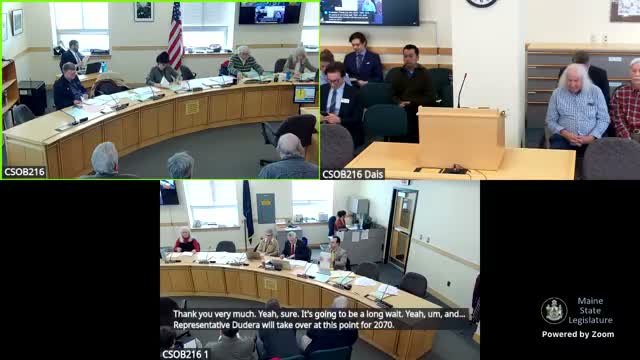
The Environment and Natural Resources Committee took testimony Feb. 14 on LD 2,070, a bill proposed by Representative Jim Dill that would prohibit expansion of solid waste landfills into freshwater wetlands. The hearing drew extensive public testimony for and against the measure and detailed questioning by committee members on PFAS risks, monitoring, alternatives, and statewide waste planning.
Sponsor’s rationale
Representative Jim Dill (House District 26), who presented the bill, argued wetlands and vernal pools are ecologically critical and cannot be adequately replaced by mitigation when a landfill expands into acres of wetland. “Expanding a landfill into acres of wetlands and vernal pools is an entirely different scale of impact,” Dill said, and “I believe no amount of mitigation can truly replace” the functions such wetlands provide.
Agency and state operator testimony
Carla Hopkins, Director of the Division of Materials Management at DEP, testified in opposition. She said existing statutes and DEP rules (including solid waste rules, Chapter 401, and NRPA processes) provide a robust, site‑specific review pathway that requires avoidance where practicable, minimization, and compensation when impacts are unavoidable. “This well established system is robust,” Hopkins said, warning that a single‑sector ban would remove DEP’s discretion and could short‑circuit protections that are already in place.
Jonas Mains, an associate speaking for the Bureau of General Services on behalf of the state operator, described the Juniper Ridge Landfill (JRL) expansion application and said the currently applied alternative analysis showed the proposed phased 57‑acre expansion would impact about 3.75 acres of wetland function. He told the committee the applicant proposes $763,000 in compensation to the DEP in‑lieu fee program to offset lost wetland function and argued the expansion is needed to meet statewide capacity needs; without it the state faces difficult alternatives for waste disposal.
Community, tribal and environmental testimony
Residents, tribal representatives and conservation groups strongly supported the ban. Testimony from Old Town and Penobscot‑area residents described local health and water concerns and past contamination cases; Dawn Neptune Adams and Molly Ann Bryant (Wabanaki Alliance) framed the proposed expansion as an environmental‑justice issue for the Penobscot Nation. Local witnesses and conservation groups emphasized PFAS in leachate and the risk of long‑term groundwater contamination, with multiple speakers saying landfills eventually leak and wetlands increase contaminant mobility.
Industry and business concerns
Casella Waste Services — the private operator involved with JRL — and representatives of construction, manufacturing and recycling sectors opposed the bill. Brian Rayback, counsel for Casella, described the volumity of the application materials, stressed that wetland permitting is rigorous (the wetland application alone runs many pages) and said a categorical ban would make it difficult to find new, suitably engineered sites in a state with abundant wetlands. He also noted the court remanded the public‑benefit determination back to DEP for additional explanation rather than rejecting it outright.
Points of contention and technical follow‑up
- PFAS and monitoring: Legislators repeatedly asked whether existing leachate containment and monitoring systems prevent PFAS migration into surrounding wetlands and drinking water; DEP and applicants said the liners, leachate collection, and monitoring plans are designed to contain and detect releases and that the record includes leachate monitoring and design plans, but committee members requested specific monitoring data and evidence about nearby well contamination for the work session.
- Compensation and mitigation: The proposed in‑lieu payment ($763,000) and methods for awarding restoration grants were discussed; committee members asked DEP and the applicant for specifics on how in‑lieu funds are allocated and whether they result in ‘in‑kind’ freshwater wetland restoration.
- Capacity trade‑offs: Operators and some legislators warned that without expansion Juniper Ridge would reach capacity and the state lacks time to site and permit a new regional facility; proponents responded that some impacts are unacceptable regardless of capacity constraints and urged a precautionary approach.
Next steps
The committee closed the public hearing and asked for technical follow‑up to be provided at work session — including hydrological studies, monitoring protocols and data, details on the in‑lieu fee calculation and recipients, PFAS testing results, and alternatives analysis — before members take any committee action.
Sponsor’s rationale
Representative Jim Dill (House District 26), who presented the bill, argued wetlands and vernal pools are ecologically critical and cannot be adequately replaced by mitigation when a landfill expands into acres of wetland. “Expanding a landfill into acres of wetlands and vernal pools is an entirely different scale of impact,” Dill said, and “I believe no amount of mitigation can truly replace” the functions such wetlands provide.
Agency and state operator testimony
Carla Hopkins, Director of the Division of Materials Management at DEP, testified in opposition. She said existing statutes and DEP rules (including solid waste rules, Chapter 401, and NRPA processes) provide a robust, site‑specific review pathway that requires avoidance where practicable, minimization, and compensation when impacts are unavoidable. “This well established system is robust,” Hopkins said, warning that a single‑sector ban would remove DEP’s discretion and could short‑circuit protections that are already in place.
Jonas Mains, an associate speaking for the Bureau of General Services on behalf of the state operator, described the Juniper Ridge Landfill (JRL) expansion application and said the currently applied alternative analysis showed the proposed phased 57‑acre expansion would impact about 3.75 acres of wetland function. He told the committee the applicant proposes $763,000 in compensation to the DEP in‑lieu fee program to offset lost wetland function and argued the expansion is needed to meet statewide capacity needs; without it the state faces difficult alternatives for waste disposal.
Community, tribal and environmental testimony
Residents, tribal representatives and conservation groups strongly supported the ban. Testimony from Old Town and Penobscot‑area residents described local health and water concerns and past contamination cases; Dawn Neptune Adams and Molly Ann Bryant (Wabanaki Alliance) framed the proposed expansion as an environmental‑justice issue for the Penobscot Nation. Local witnesses and conservation groups emphasized PFAS in leachate and the risk of long‑term groundwater contamination, with multiple speakers saying landfills eventually leak and wetlands increase contaminant mobility.
Industry and business concerns
Casella Waste Services — the private operator involved with JRL — and representatives of construction, manufacturing and recycling sectors opposed the bill. Brian Rayback, counsel for Casella, described the volumity of the application materials, stressed that wetland permitting is rigorous (the wetland application alone runs many pages) and said a categorical ban would make it difficult to find new, suitably engineered sites in a state with abundant wetlands. He also noted the court remanded the public‑benefit determination back to DEP for additional explanation rather than rejecting it outright.
Points of contention and technical follow‑up
- PFAS and monitoring: Legislators repeatedly asked whether existing leachate containment and monitoring systems prevent PFAS migration into surrounding wetlands and drinking water; DEP and applicants said the liners, leachate collection, and monitoring plans are designed to contain and detect releases and that the record includes leachate monitoring and design plans, but committee members requested specific monitoring data and evidence about nearby well contamination for the work session.
- Compensation and mitigation: The proposed in‑lieu payment ($763,000) and methods for awarding restoration grants were discussed; committee members asked DEP and the applicant for specifics on how in‑lieu funds are allocated and whether they result in ‘in‑kind’ freshwater wetland restoration.
- Capacity trade‑offs: Operators and some legislators warned that without expansion Juniper Ridge would reach capacity and the state lacks time to site and permit a new regional facility; proponents responded that some impacts are unacceptable regardless of capacity constraints and urged a precautionary approach.
Next steps
The committee closed the public hearing and asked for technical follow‑up to be provided at work session — including hydrological studies, monitoring protocols and data, details on the in‑lieu fee calculation and recipients, PFAS testing results, and alternatives analysis — before members take any committee action.
Don't Miss a Word: See the Full Meeting!
Go beyond summaries. Unlock every video, transcript, and key insight with a Founder Membership.
✓
Get instant access to full meeting videos
✓
Search and clip any phrase from complete transcripts
✓
Receive AI-powered summaries & custom alerts
✓
Enjoy lifetime, unrestricted access to government data
30-day money-back guarantee
