Mountain View council adopts updated R3 zoning rules to spur housing, adds live-work allowance
February 11, 2026 | Mountain View, Santa Clara County, California
This article was created by AI summarizing key points discussed. AI makes mistakes, so for full details and context, please refer to the video of the full meeting. Please report any errors so we can fix them. Report an error »
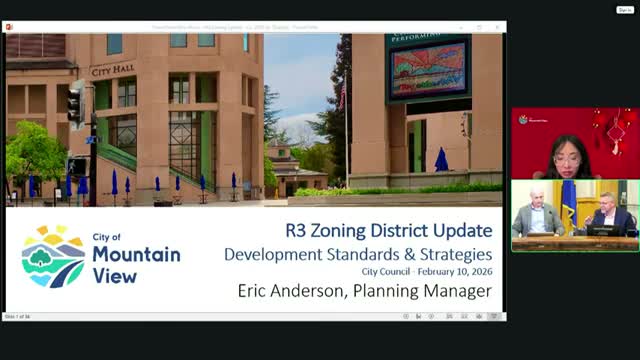
Mountain View's City Council voted to adopt a comprehensive update to the R3 residential zoning district on Feb. 10, approving a package of changes intended to make multiunit housing more feasible while adding objective standards for facade, massing and street activation.
The council's action updates heights and floor-area ratios, reduces some setbacks and establishes clearer, objective design measures intended to speed review and produce more housing types including stacked flats and live-work units. Councilmember Peter Ramirez moved the measure with amendments directing staff to allow permissive ground-floor commercial and live-work spaces in certain subdistricts and to develop guidance for front setbacks; Councilmember Showalter seconded the motion. The motion passed on a 5-1 roll-call vote.
City staff said the changes respond to the city's housing goals and state laws that favor objective standards. Advanced Planning Manager Eric Anderson described the update as a package of technical changes and new standards for building form, front-facing habitable space, parking placement and pedestrian circulation meant to allow the densities the general plan already contemplates.
"These are written down in plain language, so everybody can understand them," Councilmember Showalter said in the meeting, explaining the move toward objective standards that can be used by applicants and staff alike.
Council amendments ask staff to: (a) permit live-work uses and limited ground-floor commercial in multiple R3 subdistricts with objective criteria to prevent nuisance impacts; (b) drop a proposed lot-consolidation penalty and instead encourage consolidation via guidelines; (c) create interim guidance and later objective standards for how front setbacks should be programmed (shade, stormwater, landscaping, plazas) rather than left as sterile open strips; (d) add ornamentation alternatives to massing features to allow material and transparency variety rather than prescriptive protrusions; and (e) evaluate modest FAR increases in appropriate subdistricts to make stacked-flat ownership products more feasible.
Staff said the council-level directions will be folded into final code text and the environmental review process. An environmental impact report (EIR) is expected to be circulated for public review in the next phase. Eric Anderson and Community Development Director Christian Murdoch told the council they will prioritize items that are practicable before the end of the year and will carry more complex items into related follow-up work such as the SP-79 implementation effort.
The council vote was opposed by one member who said the city should move slower and expressed concerns about parking, open space and service impacts. Supporters argued the package balances design controls with the need to unlock feasible housing on smaller parcels.
What happens next: staff will prepare final ordinance language, fold in the council's directed changes, and proceed with environmental review and public outreach ahead of adoption steps.
The council's action updates heights and floor-area ratios, reduces some setbacks and establishes clearer, objective design measures intended to speed review and produce more housing types including stacked flats and live-work units. Councilmember Peter Ramirez moved the measure with amendments directing staff to allow permissive ground-floor commercial and live-work spaces in certain subdistricts and to develop guidance for front setbacks; Councilmember Showalter seconded the motion. The motion passed on a 5-1 roll-call vote.
City staff said the changes respond to the city's housing goals and state laws that favor objective standards. Advanced Planning Manager Eric Anderson described the update as a package of technical changes and new standards for building form, front-facing habitable space, parking placement and pedestrian circulation meant to allow the densities the general plan already contemplates.
"These are written down in plain language, so everybody can understand them," Councilmember Showalter said in the meeting, explaining the move toward objective standards that can be used by applicants and staff alike.
Council amendments ask staff to: (a) permit live-work uses and limited ground-floor commercial in multiple R3 subdistricts with objective criteria to prevent nuisance impacts; (b) drop a proposed lot-consolidation penalty and instead encourage consolidation via guidelines; (c) create interim guidance and later objective standards for how front setbacks should be programmed (shade, stormwater, landscaping, plazas) rather than left as sterile open strips; (d) add ornamentation alternatives to massing features to allow material and transparency variety rather than prescriptive protrusions; and (e) evaluate modest FAR increases in appropriate subdistricts to make stacked-flat ownership products more feasible.
Staff said the council-level directions will be folded into final code text and the environmental review process. An environmental impact report (EIR) is expected to be circulated for public review in the next phase. Eric Anderson and Community Development Director Christian Murdoch told the council they will prioritize items that are practicable before the end of the year and will carry more complex items into related follow-up work such as the SP-79 implementation effort.
The council vote was opposed by one member who said the city should move slower and expressed concerns about parking, open space and service impacts. Supporters argued the package balances design controls with the need to unlock feasible housing on smaller parcels.
What happens next: staff will prepare final ordinance language, fold in the council's directed changes, and proceed with environmental review and public outreach ahead of adoption steps.
View the Full Meeting & All Its Details
This article offers just a summary. Unlock complete video, transcripts, and insights as a Founder Member.
✓
Watch full, unedited meeting videos
✓
Search every word spoken in unlimited transcripts
✓
AI summaries & real-time alerts (all government levels)
✓
Permanent access to expanding government content
30-day money-back guarantee
