Library of Congress conservator links rare maguey (agave) paper to pulque production
February 11, 2026 | U.S. Copyright Office, Library of Congress, Legislative, Federal
This article was created by AI summarizing key points discussed. AI makes mistakes, so for full details and context, please refer to the video of the full meeting. Please report any errors so we can fix them. Report an error »
Betsy Hoddy, a conservator in the Conservation Division at the Library of Congress, told an audience at the John W. Kluge Center that maguey (agave) paper—a rare Mesoamerican sheet material used in some colonial manuscripts—appears closely tied to the production and ritual use of pulque, an agave-based fermented beverage.
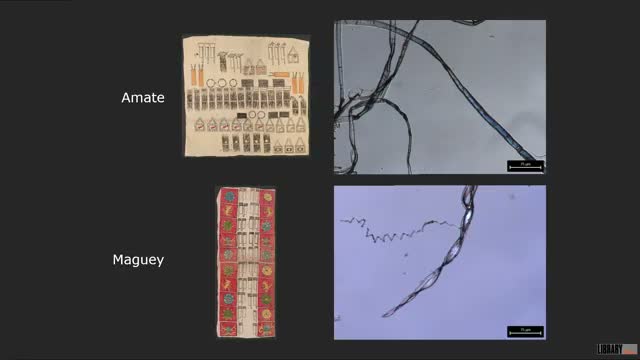
Hoddy opened the presentation by placing paper within cultural contexts, saying it is not merely a substrate but “a medium of communication utilized throughout the world” that reveals production choices and social uses. She described maguey paper as materially distinct from amate (ficus) sheets and said microscopic fiber analysis is the definitive method to distinguish them: maguey fibers twist along their length and contain thin zigzag fibers, while amate fibers retain a tubular shape.
The conservator reviewed holdings and provenance. She noted the Library of Congress holds four early colonial codices, and that the 1531 Huejotzingo Codex contains both amate and maguey sheets. Hoddy said maguey paper is rare: “Until 2024, only 10 sheets of maguey paper were known to exist,” and added that with a recent identification in the Newberry Library the tally of known Mesoamerican paper sheets has risen; “With this discovery, there are now 59 sheets of Mesoamerican paper in the world,” she said.
To explain how maguey paper might have been produced and distributed, Hoddy described agave processing and pulque manufacture. She said pulque is “a viscous milky liquid made from the fermented sap of agaves,” produced by creating a central ‘well’ in the plant, siphoning sap with a gourd multiple times a day, collecting it in vats, and allowing it to ferment rapidly; the beverage spoils within days. Hoddy argued that the inner agave leaves removed during sap collection produce the fine fibers suitable for paper, and that artisans likely processed those leaves into sheets immediately during pulque production cycles.
Hoddy supported this linkage with archaeological and iconographic evidence: stone paper beaters (tools for pounding sheets) were found in many of the same regions known for pulque cults; ritual images such as those in the Codex Borgia show frothing pulque vessels adorned with ritual paper elements and V-shaped paper designs. She cited botanist Howard Scott Gentry and colleagues who identified agave species (for example, Agave salmiana and Agave mapesaga) likely used for both pulque and paper.
On geography and manufacture, Hoddy said she is reconsidering earlier assumptions that maguey paper was confined to Tlaxcala and Huejotzingo. She pointed to evidence—including a Newberry Library manuscript created in Mexico City and the discovery of stone beaters there—that maguey paper may also have been produced in Mexico City and other high-altitude areas where the right agave species grew.
Audience members pressed Hoddy on iconography and materials. Tom Blake (Collections Digitization) asked whether the V designs indicate maguey specifically; Hoddy said the designs appear across several codices and are not a definitive marker by themselves, and invited scholars to report additional examples. Other questioners asked about why indigenous paintings were on native papers while Spanish legal texts were on European paper; Hoddy said indigenous artists used familiar materials and techniques even when court records were entered on European sheets.
Hoddy closed by stressing that these artifacts were made by highly skilled people connected to craft networks: pulque, textiles, ropes and paper were part of a holistic use of agave plants rather than single isolated industries. She thanked the Kluge Center and the Conservation Division for support during her fellowship.
The presentation concluded with questions from both the in-person and online audience and a brief set of clarifications about codex distribution and material history. No formal actions or votes occurred at the event.
Hoddy opened the presentation by placing paper within cultural contexts, saying it is not merely a substrate but “a medium of communication utilized throughout the world” that reveals production choices and social uses. She described maguey paper as materially distinct from amate (ficus) sheets and said microscopic fiber analysis is the definitive method to distinguish them: maguey fibers twist along their length and contain thin zigzag fibers, while amate fibers retain a tubular shape.
The conservator reviewed holdings and provenance. She noted the Library of Congress holds four early colonial codices, and that the 1531 Huejotzingo Codex contains both amate and maguey sheets. Hoddy said maguey paper is rare: “Until 2024, only 10 sheets of maguey paper were known to exist,” and added that with a recent identification in the Newberry Library the tally of known Mesoamerican paper sheets has risen; “With this discovery, there are now 59 sheets of Mesoamerican paper in the world,” she said.
To explain how maguey paper might have been produced and distributed, Hoddy described agave processing and pulque manufacture. She said pulque is “a viscous milky liquid made from the fermented sap of agaves,” produced by creating a central ‘well’ in the plant, siphoning sap with a gourd multiple times a day, collecting it in vats, and allowing it to ferment rapidly; the beverage spoils within days. Hoddy argued that the inner agave leaves removed during sap collection produce the fine fibers suitable for paper, and that artisans likely processed those leaves into sheets immediately during pulque production cycles.
Hoddy supported this linkage with archaeological and iconographic evidence: stone paper beaters (tools for pounding sheets) were found in many of the same regions known for pulque cults; ritual images such as those in the Codex Borgia show frothing pulque vessels adorned with ritual paper elements and V-shaped paper designs. She cited botanist Howard Scott Gentry and colleagues who identified agave species (for example, Agave salmiana and Agave mapesaga) likely used for both pulque and paper.
On geography and manufacture, Hoddy said she is reconsidering earlier assumptions that maguey paper was confined to Tlaxcala and Huejotzingo. She pointed to evidence—including a Newberry Library manuscript created in Mexico City and the discovery of stone beaters there—that maguey paper may also have been produced in Mexico City and other high-altitude areas where the right agave species grew.
Audience members pressed Hoddy on iconography and materials. Tom Blake (Collections Digitization) asked whether the V designs indicate maguey specifically; Hoddy said the designs appear across several codices and are not a definitive marker by themselves, and invited scholars to report additional examples. Other questioners asked about why indigenous paintings were on native papers while Spanish legal texts were on European paper; Hoddy said indigenous artists used familiar materials and techniques even when court records were entered on European sheets.
Hoddy closed by stressing that these artifacts were made by highly skilled people connected to craft networks: pulque, textiles, ropes and paper were part of a holistic use of agave plants rather than single isolated industries. She thanked the Kluge Center and the Conservation Division for support during her fellowship.
The presentation concluded with questions from both the in-person and online audience and a brief set of clarifications about codex distribution and material history. No formal actions or votes occurred at the event.
Don't Miss a Word: See the Full Meeting!
Go beyond summaries. Unlock every video, transcript, and key insight with a Founder Membership.
✓
Get instant access to full meeting videos
✓
Search and clip any phrase from complete transcripts
✓
Receive AI-powered summaries & custom alerts
✓
Enjoy lifetime, unrestricted access to government data
30-day money-back guarantee
