CIRM presents FY24–25 results and wins approval for $505 million research budget for 2025–26
December 31, 2025 | State Controller's Office, Other State Agencies, Executive, California
This article was created by AI summarizing key points discussed. AI makes mistakes, so for full details and context, please refer to the video of the full meeting. Please report any errors so we can fix them. Report an error »
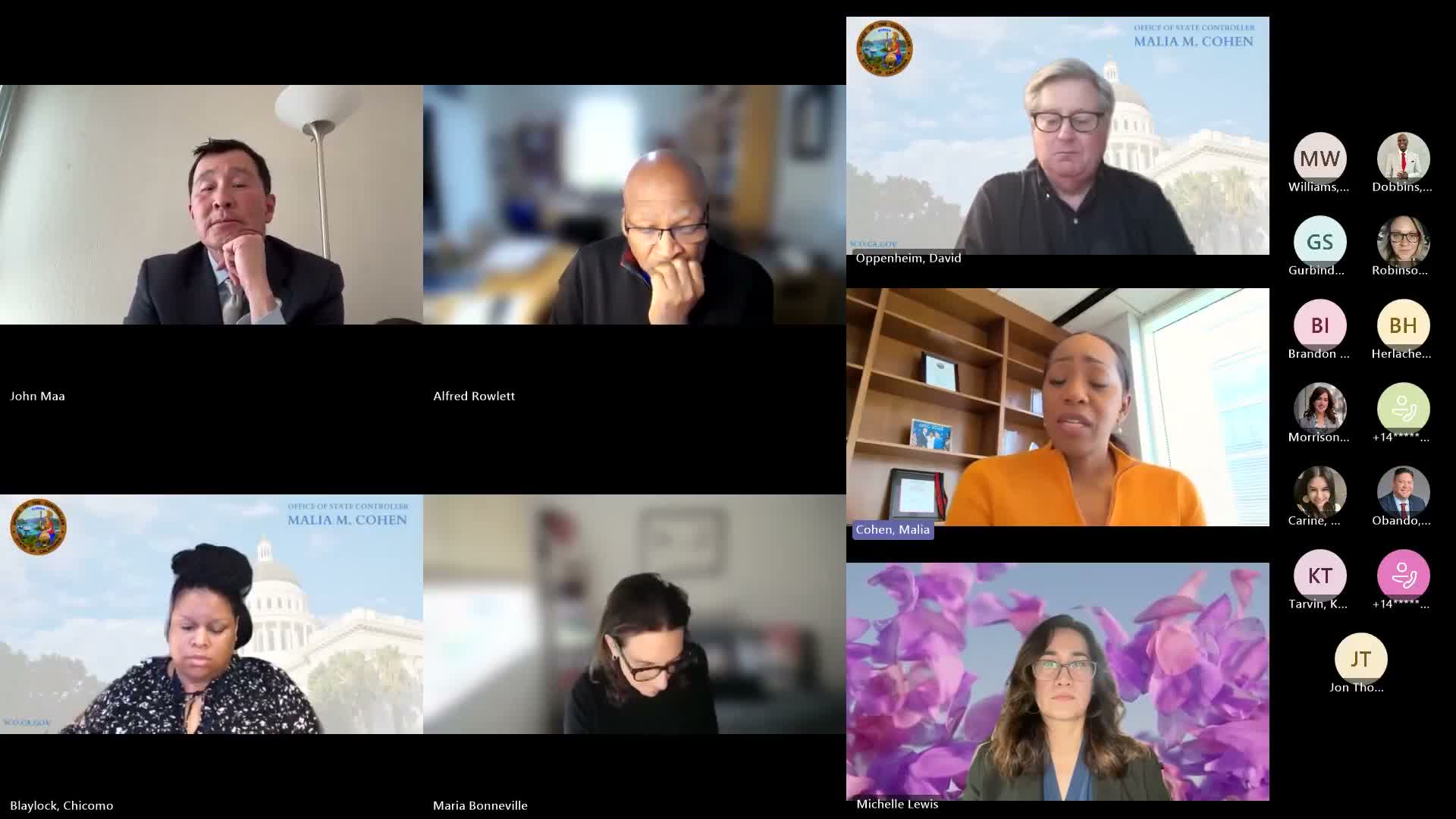
The California Institute for Regenerative Medicine (CIRM) presented its FY24–25 financial results and its approved FY25–26 budgets to the Citizens Financial Accountability Oversight Committee on Dec. 30, 2025. Michelle Lewis, CIRM's director of finance, reviewed Proposition 14 totals, research encumbrances, and drivers of budget variances, and outlined the agency's approved $505 million research budget for 2025–26.
Lewis told the committee Proposition 14 provides $5,500,000,000 and said "it is broken into 4 major categories," including a $4.9 billion research/grants allocation and administrative categories for grant administration, general administration and bond issuance costs. She reported CIRM's total available research funding is about $7.7 billion when combining Propositions 14 and 71 and said CIRM had encumbered "53% of its research dollars," meaning funds have been committed to awards or board-approved multi-year projects.
For FY24–25 CIRM reported nearly $300 million in research grants awarded, a net position increase discussed by auditors, and specific program variances that drove a $149 million difference between the approved $458 million research budget and the commitments recorded for that year. Lewis identified the top drivers as clinical ($38 million variance), discovery ($46 million) and infrastructure ($61 million), and said the discovery timeline was pushed into FY25–26 because devastating wildfires in early 2025 delayed some award processes.
Lewis walked through the FY25–26 approved research budget, totaling $505 million: $135 million for clinical trials (expected to yield 9–12 awards), $160 million for preclinical/translational development (about 16 anticipated awards), $158.2 million for discovery (including DISC0 and DISC4 foundation awards), $1.5 million for education grants and $51 million for the Community Care Centers of Excellence program (split into $36M delivery and $15M support).
Committee members asked how CIRM defines and measures "equitable" access in its mission to deliver treatments "in an equitable manner to a diverse California and world." A CIRM representative said applicants are required to provide an accessibility plan for commercialization and that the agency's vice chair is leading work on accessibility and affordability; the representative added CIRM is "fully open for business" and will return with program-level metrics in a future session.
Members also pressed for detail on the 53% encumbrance breakdown; Lewis said she did not have the exact category breakdown at the meeting but committed to provide it later. On underspent administrative dollars, Lewis said underspent funds do roll over and are reallocated to the following year's budget as needed. Deputy Controller Dave Oppenheim and others expressed concern that a roughly 33% variance between budgeted and actual expenditures weakens public confidence in budget projections; CIRM representatives said the board-approved budget process is comprehensive and that extraordinary events—such as wildfires—were primary causes of underspending.
Why it matters: The presentation updates the oversight committee on how bond proceeds and grant funds authorized by Propositions 14 and 71 are being allocated and spent, and it raised follow-up questions the committee requested CIRM provide, including a detailed encumbrance breakdown, further program outcomes and tighter variance explanations.
The committee agreed to revisit program-level questions—including the impact of artificial intelligence on research—at a future meeting and closed with instructions for staff to post the next meeting notice at least 10 days in advance.
Lewis told the committee Proposition 14 provides $5,500,000,000 and said "it is broken into 4 major categories," including a $4.9 billion research/grants allocation and administrative categories for grant administration, general administration and bond issuance costs. She reported CIRM's total available research funding is about $7.7 billion when combining Propositions 14 and 71 and said CIRM had encumbered "53% of its research dollars," meaning funds have been committed to awards or board-approved multi-year projects.
For FY24–25 CIRM reported nearly $300 million in research grants awarded, a net position increase discussed by auditors, and specific program variances that drove a $149 million difference between the approved $458 million research budget and the commitments recorded for that year. Lewis identified the top drivers as clinical ($38 million variance), discovery ($46 million) and infrastructure ($61 million), and said the discovery timeline was pushed into FY25–26 because devastating wildfires in early 2025 delayed some award processes.
Lewis walked through the FY25–26 approved research budget, totaling $505 million: $135 million for clinical trials (expected to yield 9–12 awards), $160 million for preclinical/translational development (about 16 anticipated awards), $158.2 million for discovery (including DISC0 and DISC4 foundation awards), $1.5 million for education grants and $51 million for the Community Care Centers of Excellence program (split into $36M delivery and $15M support).
Committee members asked how CIRM defines and measures "equitable" access in its mission to deliver treatments "in an equitable manner to a diverse California and world." A CIRM representative said applicants are required to provide an accessibility plan for commercialization and that the agency's vice chair is leading work on accessibility and affordability; the representative added CIRM is "fully open for business" and will return with program-level metrics in a future session.
Members also pressed for detail on the 53% encumbrance breakdown; Lewis said she did not have the exact category breakdown at the meeting but committed to provide it later. On underspent administrative dollars, Lewis said underspent funds do roll over and are reallocated to the following year's budget as needed. Deputy Controller Dave Oppenheim and others expressed concern that a roughly 33% variance between budgeted and actual expenditures weakens public confidence in budget projections; CIRM representatives said the board-approved budget process is comprehensive and that extraordinary events—such as wildfires—were primary causes of underspending.
Why it matters: The presentation updates the oversight committee on how bond proceeds and grant funds authorized by Propositions 14 and 71 are being allocated and spent, and it raised follow-up questions the committee requested CIRM provide, including a detailed encumbrance breakdown, further program outcomes and tighter variance explanations.
The committee agreed to revisit program-level questions—including the impact of artificial intelligence on research—at a future meeting and closed with instructions for staff to post the next meeting notice at least 10 days in advance.
Don't Miss a Word: See the Full Meeting!
Go beyond summaries. Unlock every video, transcript, and key insight with a Founder Membership.
✓
Get instant access to full meeting videos
✓
Search and clip any phrase from complete transcripts
✓
Receive AI-powered summaries & custom alerts
✓
Enjoy lifetime, unrestricted access to government data
30-day money-back guarantee
