Ashland County committee approves damage pricing and payouts as elk-related crop losses rise
February 11, 2026 | Ashland County, Wisconsin
This article was created by AI summarizing key points discussed. AI makes mistakes, so for full details and context, please refer to the video of the full meeting. Please report any errors so we can fix them. Report an error »
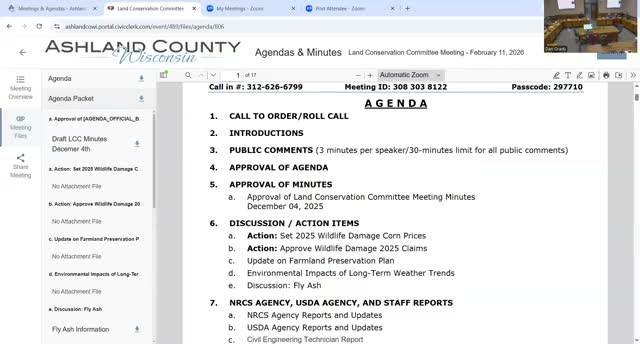
The Ashland County Land Conservation Committee on Monday approved the per-unit price schedule that underpins reimbursements for wildlife damage claims and authorized payout of eligible claims from last season.
Ethan Rose, the damage program coordinator for USDA/DNR wildlife services, presented the price sheet the committee adopted for appraisals: field corn at $4.08 per bushel, soybeans $9.65 per bushel, bee colonies $189.09 per colony and honey $10.60 per pound. The committee voted to adopt the schedule before considering individual claims.
Rose said eight producers enrolled in the county damage program last season, seven of whom were eligible for claims; two claim submissions were found ineligible (one because the landowner declined to allow public hunting and another because the loss was below the $500 deductible). He reiterated that reimbursement payments come from DNR-administered funds once the committee approves the appraisals and prices.
The committee then moved and approved the set of claims presented. A committee member disclosed a conflict for claims tied to fields they own and abstained; the chair asked that the abstention be recorded in the minutes.
Why it matters: Rose told the committee the county is seeing a sharp late-season spike in elk damage in parts of the county, especially the Butternut area, where one producer experienced effectively a total loss of 39 acres. He said appraisals and payments are limited by program rules — a $500 deductible and a $10,000 per-producer annual cap — which can leave large losses only partially covered.
Rose described how he documents damage: field sampling (three samples per field), aerial photos and formula-based ratings that convert visible field damage into bushels and acreage. He said the DNR performs regional airplane flights during harvest season to collect imagery; drones take higher-quality photos but are constrained by federal certification and limited certified operators, so airplanes remain the primary tool for broad coverage.
The committee heard details about abatement and relocation work. Rose said DNR trapping and relocation recently reduced a problematic herd in the Butternut area by roughly half and that three elk from that herd were collared and released to help monitor movement. He described nonlethal deterrents used in the county, including solar-powered radios that broadcast recorded sounds to reduce nighttime livestock and stored-feed losses.
Rose also summarized predator investigations: last year the county recorded multiple wolf investigations and used deterrence measures such as radios and other nonlethal tools to support producers.
The committee noted the program’s growing uptake — from about five enrollees the previous year to eight — and Rose said he expects enrollments and appraised acreage to increase as more producers become aware that elk damage can qualify for claims.
The committee did not change program eligibility rules at the meeting; staff said they would follow up on procedural questions and that detailed claim documentation and abstention records will be reflected in the meeting minutes.
Ethan Rose, the damage program coordinator for USDA/DNR wildlife services, presented the price sheet the committee adopted for appraisals: field corn at $4.08 per bushel, soybeans $9.65 per bushel, bee colonies $189.09 per colony and honey $10.60 per pound. The committee voted to adopt the schedule before considering individual claims.
Rose said eight producers enrolled in the county damage program last season, seven of whom were eligible for claims; two claim submissions were found ineligible (one because the landowner declined to allow public hunting and another because the loss was below the $500 deductible). He reiterated that reimbursement payments come from DNR-administered funds once the committee approves the appraisals and prices.
The committee then moved and approved the set of claims presented. A committee member disclosed a conflict for claims tied to fields they own and abstained; the chair asked that the abstention be recorded in the minutes.
Why it matters: Rose told the committee the county is seeing a sharp late-season spike in elk damage in parts of the county, especially the Butternut area, where one producer experienced effectively a total loss of 39 acres. He said appraisals and payments are limited by program rules — a $500 deductible and a $10,000 per-producer annual cap — which can leave large losses only partially covered.
Rose described how he documents damage: field sampling (three samples per field), aerial photos and formula-based ratings that convert visible field damage into bushels and acreage. He said the DNR performs regional airplane flights during harvest season to collect imagery; drones take higher-quality photos but are constrained by federal certification and limited certified operators, so airplanes remain the primary tool for broad coverage.
The committee heard details about abatement and relocation work. Rose said DNR trapping and relocation recently reduced a problematic herd in the Butternut area by roughly half and that three elk from that herd were collared and released to help monitor movement. He described nonlethal deterrents used in the county, including solar-powered radios that broadcast recorded sounds to reduce nighttime livestock and stored-feed losses.
Rose also summarized predator investigations: last year the county recorded multiple wolf investigations and used deterrence measures such as radios and other nonlethal tools to support producers.
The committee noted the program’s growing uptake — from about five enrollees the previous year to eight — and Rose said he expects enrollments and appraised acreage to increase as more producers become aware that elk damage can qualify for claims.
The committee did not change program eligibility rules at the meeting; staff said they would follow up on procedural questions and that detailed claim documentation and abstention records will be reflected in the meeting minutes.
View the Full Meeting & All Its Details
This article offers just a summary. Unlock complete video, transcripts, and insights as a Founder Member.
✓
Watch full, unedited meeting videos
✓
Search every word spoken in unlimited transcripts
✓
AI summaries & real-time alerts (all government levels)
✓
Permanent access to expanding government content
30-day money-back guarantee
