Family testimony highlights failures in NES's critical-referral program for medically fragile residents
February 11, 2026 | Transportation & Infrastructure Meetings, Nashville, Davidson County, Tennessee
This article was created by AI summarizing key points discussed. AI makes mistakes, so for full details and context, please refer to the video of the full meeting. Please report any errors so we can fix them. Report an error »
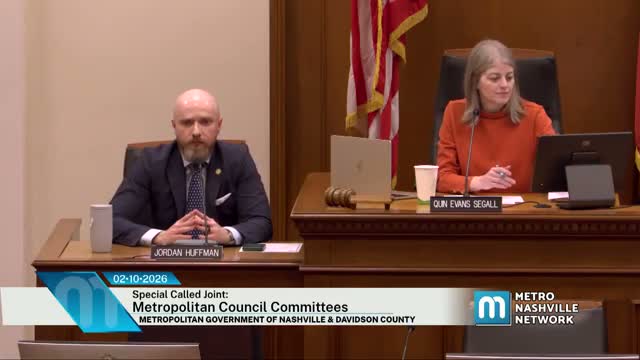
NASHVILLE — During the public-comment portion of the joint Transportation & Infrastructure and Public Health & Safety committees, Elisa Hill, a District 34 resident and mother of an eight-year-old child with life-sustaining medical needs, said her family was enrolled in NES's Critical Referral Program but received no prioritization when power was out.
"My daughter depends on electricity for essential aspects of her medical care," Hill told council members. "We enrolled in the critical referral program because we were told it existed to identify and protect family like ours during emergencies. Yet this catastrophic outage ... provided no prioritization at all."
Hill said NES staff told her restoration was prioritized by number of customers affected in each outage area, not by the critical-referral designation; she reported being advised to "find another option" when her refrigerated medical supplies ran low. She asked the council and Metro agencies to examine the program's operational purpose, protections for medically vulnerable residents during prolonged outages, and policy or infrastructure changes to ensure life-sustaining medical needs are prioritized in future disasters.
Council members used the hearing to press NES and OEM on how critical-referral lists are maintained and acted on during large-area outages. NES acknowledged gaps exposed by the storm, said it will expand capacity to identify which critical-referral customers remain during restoration and will coordinate with OEM for targeted wellness checks and generator deliveries where appropriate.
OEM and NES told the committees they were updating their processes and planned greater outreach and onboarding efforts to ensure more medically dependent residents are captured and known to city and utility responders.
What's next: Council members asked NES to return with a clearer plan for outreach, prioritization criteria and an explanation of how signups are verified and communicated to emergency-management partners. The utility said it would pursue those improvements and coordinate with OEM on distribution for those identified as most at risk.
(Reporting from the joint committee meeting: Elisa Hill's public comment and subsequent council questioning.)
"My daughter depends on electricity for essential aspects of her medical care," Hill told council members. "We enrolled in the critical referral program because we were told it existed to identify and protect family like ours during emergencies. Yet this catastrophic outage ... provided no prioritization at all."
Hill said NES staff told her restoration was prioritized by number of customers affected in each outage area, not by the critical-referral designation; she reported being advised to "find another option" when her refrigerated medical supplies ran low. She asked the council and Metro agencies to examine the program's operational purpose, protections for medically vulnerable residents during prolonged outages, and policy or infrastructure changes to ensure life-sustaining medical needs are prioritized in future disasters.
Council members used the hearing to press NES and OEM on how critical-referral lists are maintained and acted on during large-area outages. NES acknowledged gaps exposed by the storm, said it will expand capacity to identify which critical-referral customers remain during restoration and will coordinate with OEM for targeted wellness checks and generator deliveries where appropriate.
OEM and NES told the committees they were updating their processes and planned greater outreach and onboarding efforts to ensure more medically dependent residents are captured and known to city and utility responders.
What's next: Council members asked NES to return with a clearer plan for outreach, prioritization criteria and an explanation of how signups are verified and communicated to emergency-management partners. The utility said it would pursue those improvements and coordinate with OEM on distribution for those identified as most at risk.
(Reporting from the joint committee meeting: Elisa Hill's public comment and subsequent council questioning.)
View the Full Meeting & All Its Details
This article offers just a summary. Unlock complete video, transcripts, and insights as a Founder Member.
✓
Watch full, unedited meeting videos
✓
Search every word spoken in unlimited transcripts
✓
AI summaries & real-time alerts (all government levels)
✓
Permanent access to expanding government content
30-day money-back guarantee
