Senate committee advances substitute to SB 242 after hours of Salt Lake City testimony
February 09, 2026 | 2026 Utah Legislature, Utah Legislature, Utah Legislative Branch, Utah
This article was created by AI summarizing key points discussed. AI makes mistakes, so for full details and context, please refer to the video of the full meeting. Please report any errors so we can fix them. Report an error »
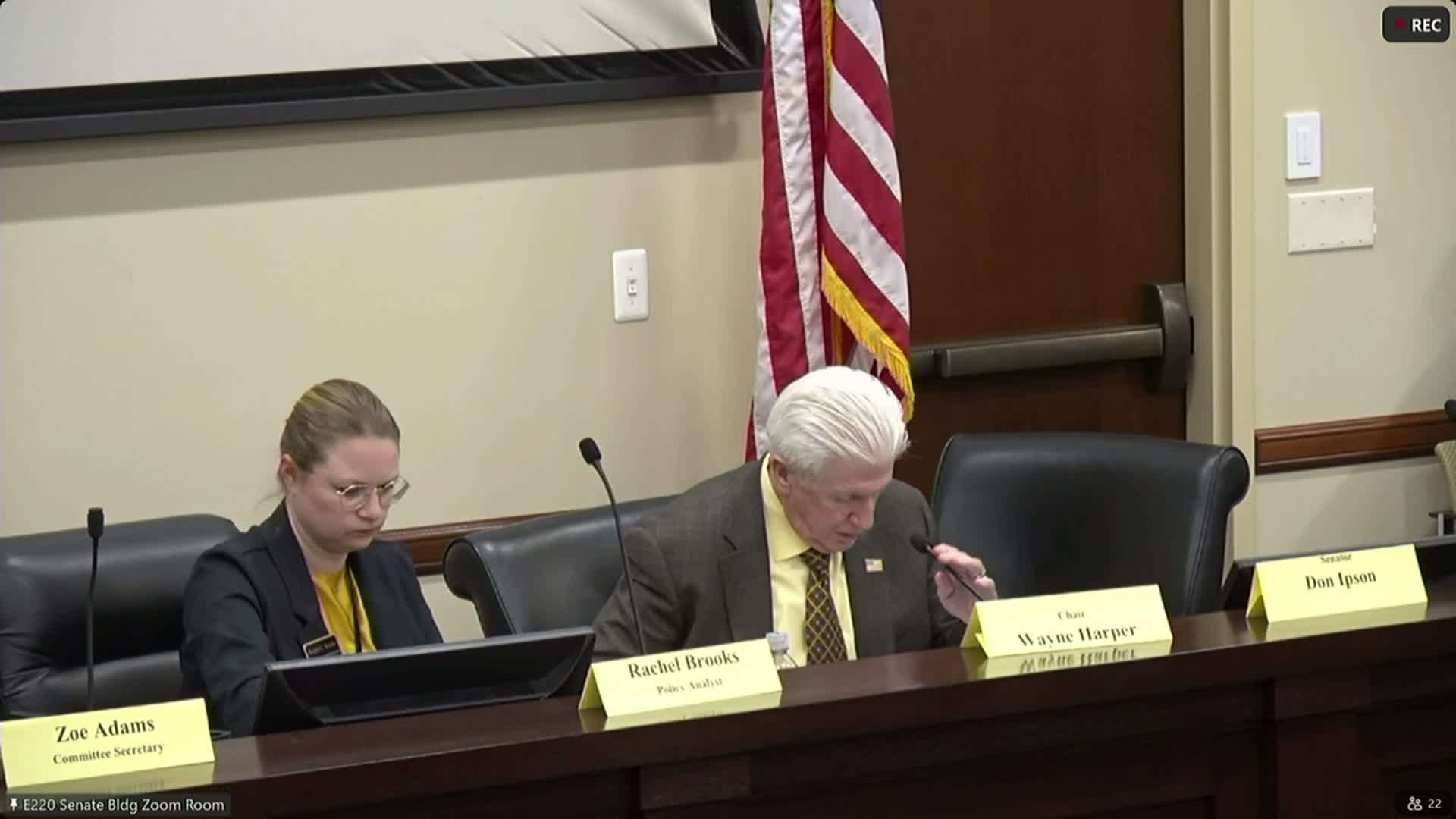
Senate Transportation Committee Chair Senator Harper moved and the committee advanced first substitute Senate Bill 242 on a 4–2 vote after roughly two hours of public comment and questions from members.
The substitute bill, the sponsor said, bundles a dozen-plus changes into a single framework the state and Salt Lake City can use on a set of regionally significant roads. "This bill establishes the framework," Senator Harper told the committee, saying the substitute clarifies tiered road management, updates lane-width language (reducing a 12-foot reference to 11 feet in one place), preserves Salt Lake City's authority over parking, and requires that a 0.1 portion of a county's added quarter-cent transit levy stay in the county for transit use.
Why it matters: the substitute is pitched as a compromise to create consistent statewide performance measures while preserving local implementation. Opponents said the language still risks undoing local street designs that prioritize walking, biking and transit; supporters said the framework improves coordination on projects that affect regional travel and major events.
Public testimony centered on safety and local control. Alejandro Puy, chair of the Salt Lake City Council, thanked sponsors "for the work that we have done together" and said the city welcomes codified community outreach and partnership with UDOT ahead of the temple reopening and the 2034 Winter Olympics. "We appreciate that this bill codifies enhancement of community outreach," Puy said.
Advocacy groups and residents pushed back. Dave Eltus of Cycling Utah called the substitute an "overreach by the state," saying Salt Lake City transportation staff are experts and that the bill could micromanage local choices. Multiple residents and planners warned that requirements for additional studies and a state review on tier 1 streets could delay or constrain local safety projects such as protected bike lanes and traffic-calming measures.
Several speakers described personal safety concerns. Elizabeth Converse, who said she was struck by a car while biking at a UDOT intersection, told the committee about medical costs and the state's low personal-injury threshold; she urged attention to safety and to existing laws that could mitigate harm. Sam Tresco, who also described a collision, cited the concept of "induced demand" to argue adding or widening lanes typically does not reduce congestion and can reduce safety.
Sponsor response and next steps: Senator Harper repeatedly characterized the substitute as a framework for collaboration, not a blanket state takeover. He said the bill also formally repeals provisions of last year's SB 195 and builds reporting and mitigation requirements into the implementation process. Multiple committee members said they had more technical drafting suggestions and expected additional work before the bill reached the floor.
Committee action: After debate and individual members' statements, the committee voted to pass out the first substitute with a favorable recommendation; the record indicates Senators Kwan and Ravey voted no and the motion passed with the remaining committee members voting yes.
The committee also heard several unrelated bills later in the session and moved them forward with favorable recommendations. The committee adjourned after concluding the day's agenda.
The substitute bill, the sponsor said, bundles a dozen-plus changes into a single framework the state and Salt Lake City can use on a set of regionally significant roads. "This bill establishes the framework," Senator Harper told the committee, saying the substitute clarifies tiered road management, updates lane-width language (reducing a 12-foot reference to 11 feet in one place), preserves Salt Lake City's authority over parking, and requires that a 0.1 portion of a county's added quarter-cent transit levy stay in the county for transit use.
Why it matters: the substitute is pitched as a compromise to create consistent statewide performance measures while preserving local implementation. Opponents said the language still risks undoing local street designs that prioritize walking, biking and transit; supporters said the framework improves coordination on projects that affect regional travel and major events.
Public testimony centered on safety and local control. Alejandro Puy, chair of the Salt Lake City Council, thanked sponsors "for the work that we have done together" and said the city welcomes codified community outreach and partnership with UDOT ahead of the temple reopening and the 2034 Winter Olympics. "We appreciate that this bill codifies enhancement of community outreach," Puy said.
Advocacy groups and residents pushed back. Dave Eltus of Cycling Utah called the substitute an "overreach by the state," saying Salt Lake City transportation staff are experts and that the bill could micromanage local choices. Multiple residents and planners warned that requirements for additional studies and a state review on tier 1 streets could delay or constrain local safety projects such as protected bike lanes and traffic-calming measures.
Several speakers described personal safety concerns. Elizabeth Converse, who said she was struck by a car while biking at a UDOT intersection, told the committee about medical costs and the state's low personal-injury threshold; she urged attention to safety and to existing laws that could mitigate harm. Sam Tresco, who also described a collision, cited the concept of "induced demand" to argue adding or widening lanes typically does not reduce congestion and can reduce safety.
Sponsor response and next steps: Senator Harper repeatedly characterized the substitute as a framework for collaboration, not a blanket state takeover. He said the bill also formally repeals provisions of last year's SB 195 and builds reporting and mitigation requirements into the implementation process. Multiple committee members said they had more technical drafting suggestions and expected additional work before the bill reached the floor.
Committee action: After debate and individual members' statements, the committee voted to pass out the first substitute with a favorable recommendation; the record indicates Senators Kwan and Ravey voted no and the motion passed with the remaining committee members voting yes.
The committee also heard several unrelated bills later in the session and moved them forward with favorable recommendations. The committee adjourned after concluding the day's agenda.
View the Full Meeting & All Its Details
This article offers just a summary. Unlock complete video, transcripts, and insights as a Founder Member.
✓
Watch full, unedited meeting videos
✓
Search every word spoken in unlimited transcripts
✓
AI summaries & real-time alerts (all government levels)
✓
Permanent access to expanding government content
30-day money-back guarantee
