State demographer: Brainerd Public Schools could lose roughly one‑fifth of enrollment in a decade
February 11, 2026 | BRAINERD PUBLIC SCHOOL DISTRICT, School Boards, Minnesota
This article was created by AI summarizing key points discussed. AI makes mistakes, so for full details and context, please refer to the video of the full meeting. Please report any errors so we can fix them. Report an error »
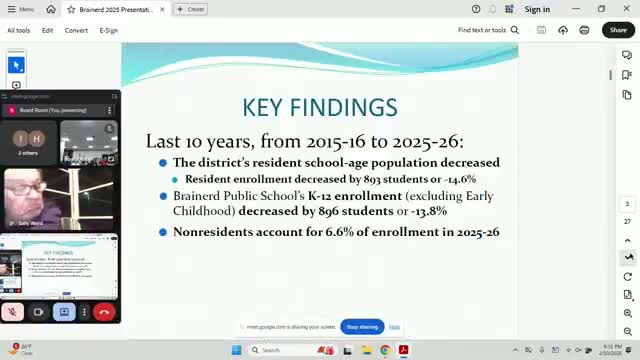
Hazel Reinhardt, identified in the meeting as a state demographer, told the Brainerd Public Schools Board that resident enrollment has dropped sharply and that current demographic trends point to further declines.
Reinhardt presented a long‑range enrollment study showing resident enrollment in Brainerd Public Schools decreased by 893 students — about 15% — over the past 10 years. She said total enrollment fell by 896 students in that period and stressed the decline is driven primarily by a drop in residents attending district schools rather than by fewer nonresident students.
The study cites three main contributors to the loss: more district residents choosing nonpublic schools, a rise in homeschooling, and continued open enrollment out. Reinhardt highlighted a steep fall in resident births: Minnesota saw a 12.2% drop in resident births from 2009–2024, while Crow Wing County’s resident births fell by about 24%, a figure she said closely correlates with kindergarten counts in the district. "Resident enrollment in the Brainerd Public Schools decreased by 893 students or about 15% in those 10 years," she told the board.
Reinhardt also described methodology and assumptions used in the projections. She said the district’s recent kindergarten capture rate averaged about 52.3% and that her models used capture‑rate scenarios roughly between 51.6% and 53%, plus Minnesota State Demography Center birth projections for longer‑term births. Under those assumptions her mid‑range projections show enrollment declining "21 to 24%" over 10 years, with differences between the high and low projections of roughly 170 students.
Board members pressed for remedies. Reinhardt told them she had not seen any durable examples where incentives alone reversed fertility trends; instead she recommended focusing on factors the district can influence, including why families choose nonpublic options and whether programming, curriculum or service offerings could be adjusted to retain and attract students.
The study’s implications were highlighted by board members in the meeting: one board member calculated that a sustained 100‑student per‑year decline could translate to large budgetary reductions over a decade if per‑pupil funding does not change. District staff said a budget revision will follow next month and noted an earlier estimate of an approximate $1.9 million unassigned deficit for 2026–27.
The board did not take an immediate action to adopt programmatic changes. Trustees scheduled a work session to discuss the Paul Bunyan Education Cooperative in more detail and to consider adding a discussion about pursuing legislative approval for a proposed $1,000,000 transfer into the general fund. Reinhardt’s report will serve as a reference as the board and administration weigh staffing, facility and program options.
Next steps: the district will review the full demography report and the board will address budget revisions and strategic responses in upcoming meetings and the planned work session.
Reinhardt presented a long‑range enrollment study showing resident enrollment in Brainerd Public Schools decreased by 893 students — about 15% — over the past 10 years. She said total enrollment fell by 896 students in that period and stressed the decline is driven primarily by a drop in residents attending district schools rather than by fewer nonresident students.
The study cites three main contributors to the loss: more district residents choosing nonpublic schools, a rise in homeschooling, and continued open enrollment out. Reinhardt highlighted a steep fall in resident births: Minnesota saw a 12.2% drop in resident births from 2009–2024, while Crow Wing County’s resident births fell by about 24%, a figure she said closely correlates with kindergarten counts in the district. "Resident enrollment in the Brainerd Public Schools decreased by 893 students or about 15% in those 10 years," she told the board.
Reinhardt also described methodology and assumptions used in the projections. She said the district’s recent kindergarten capture rate averaged about 52.3% and that her models used capture‑rate scenarios roughly between 51.6% and 53%, plus Minnesota State Demography Center birth projections for longer‑term births. Under those assumptions her mid‑range projections show enrollment declining "21 to 24%" over 10 years, with differences between the high and low projections of roughly 170 students.
Board members pressed for remedies. Reinhardt told them she had not seen any durable examples where incentives alone reversed fertility trends; instead she recommended focusing on factors the district can influence, including why families choose nonpublic options and whether programming, curriculum or service offerings could be adjusted to retain and attract students.
The study’s implications were highlighted by board members in the meeting: one board member calculated that a sustained 100‑student per‑year decline could translate to large budgetary reductions over a decade if per‑pupil funding does not change. District staff said a budget revision will follow next month and noted an earlier estimate of an approximate $1.9 million unassigned deficit for 2026–27.
The board did not take an immediate action to adopt programmatic changes. Trustees scheduled a work session to discuss the Paul Bunyan Education Cooperative in more detail and to consider adding a discussion about pursuing legislative approval for a proposed $1,000,000 transfer into the general fund. Reinhardt’s report will serve as a reference as the board and administration weigh staffing, facility and program options.
Next steps: the district will review the full demography report and the board will address budget revisions and strategic responses in upcoming meetings and the planned work session.
Don't Miss a Word: See the Full Meeting!
Go beyond summaries. Unlock every video, transcript, and key insight with a Founder Membership.
✓
Get instant access to full meeting videos
✓
Search and clip any phrase from complete transcripts
✓
Receive AI-powered summaries & custom alerts
✓
Enjoy lifetime, unrestricted access to government data
30-day money-back guarantee
