Finance director advises caution on primary property tax; council favors project-specific secondary options
February 11, 2026 | Chino Valley, Yavapai County, Arizona
This article was created by AI summarizing key points discussed. AI makes mistakes, so for full details and context, please refer to the video of the full meeting. Please report any errors so we can fix them. Report an error »
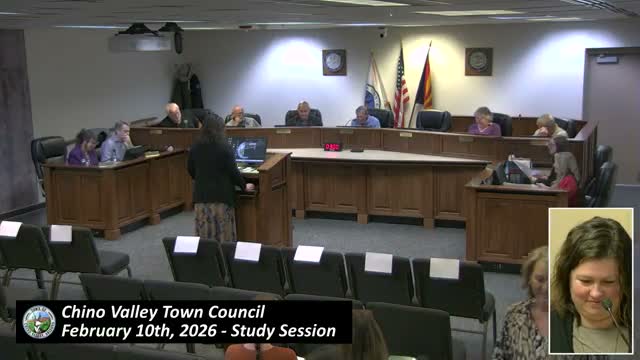
Town finance staff told the Chino Valley Town Council that pursuing a primary property tax base would require voter approval and historically performs poorly in similar Arizona municipalities, while a secondary property tax (bond or project-based levy) can be structured with a defined end date and be more palatable to voters.
Finance Director Katie Peele explained that primary property tax is an ongoing revenue source subject to Arizona’s levy limits and homeowner caps, and establishing an initial primary base requires voter authorization. She said her research found first-time municipal primary efforts in the region have tended to fail, citing past local attempts as evidence.
By contrast, Peele said, secondary property taxes are commonly used for bonds and specific capital projects (roads, public safety, buildings) and do not count toward homeowner primary caps. They require voter approval and typically expire when the debt is paid. Staff recommended secondary, project-specific ballot questions where community support and clear project scopes can help approval.
Council members asked clarifying questions about how bonds are structured, estimated household impacts under different scenarios, and whether the town could phase projects. Several councilors said they were not inclined to pursue a new primary property tax now and preferred to wait for more concrete project lists and numbers before returning to the issue.
No resolution or ballot action was taken; the council requested additional analysis on specific projects and the fiscal impacts before considering any ballot measure.
Finance Director Katie Peele explained that primary property tax is an ongoing revenue source subject to Arizona’s levy limits and homeowner caps, and establishing an initial primary base requires voter authorization. She said her research found first-time municipal primary efforts in the region have tended to fail, citing past local attempts as evidence.
By contrast, Peele said, secondary property taxes are commonly used for bonds and specific capital projects (roads, public safety, buildings) and do not count toward homeowner primary caps. They require voter approval and typically expire when the debt is paid. Staff recommended secondary, project-specific ballot questions where community support and clear project scopes can help approval.
Council members asked clarifying questions about how bonds are structured, estimated household impacts under different scenarios, and whether the town could phase projects. Several councilors said they were not inclined to pursue a new primary property tax now and preferred to wait for more concrete project lists and numbers before returning to the issue.
No resolution or ballot action was taken; the council requested additional analysis on specific projects and the fiscal impacts before considering any ballot measure.
View the Full Meeting & All Its Details
This article offers just a summary. Unlock complete video, transcripts, and insights as a Founder Member.
✓
Watch full, unedited meeting videos
✓
Search every word spoken in unlimited transcripts
✓
AI summaries & real-time alerts (all government levels)
✓
Permanent access to expanding government content
30-day money-back guarantee
