Alaska courts ask Legislature for modest FY27 increases, cite facility and program shortfalls
February 06, 2026 | 2026 Legislature Alaska, Alaska
This article was created by AI summarizing key points discussed. AI makes mistakes, so for full details and context, please refer to the video of the full meeting. Please report any errors so we can fix them. Report an error »
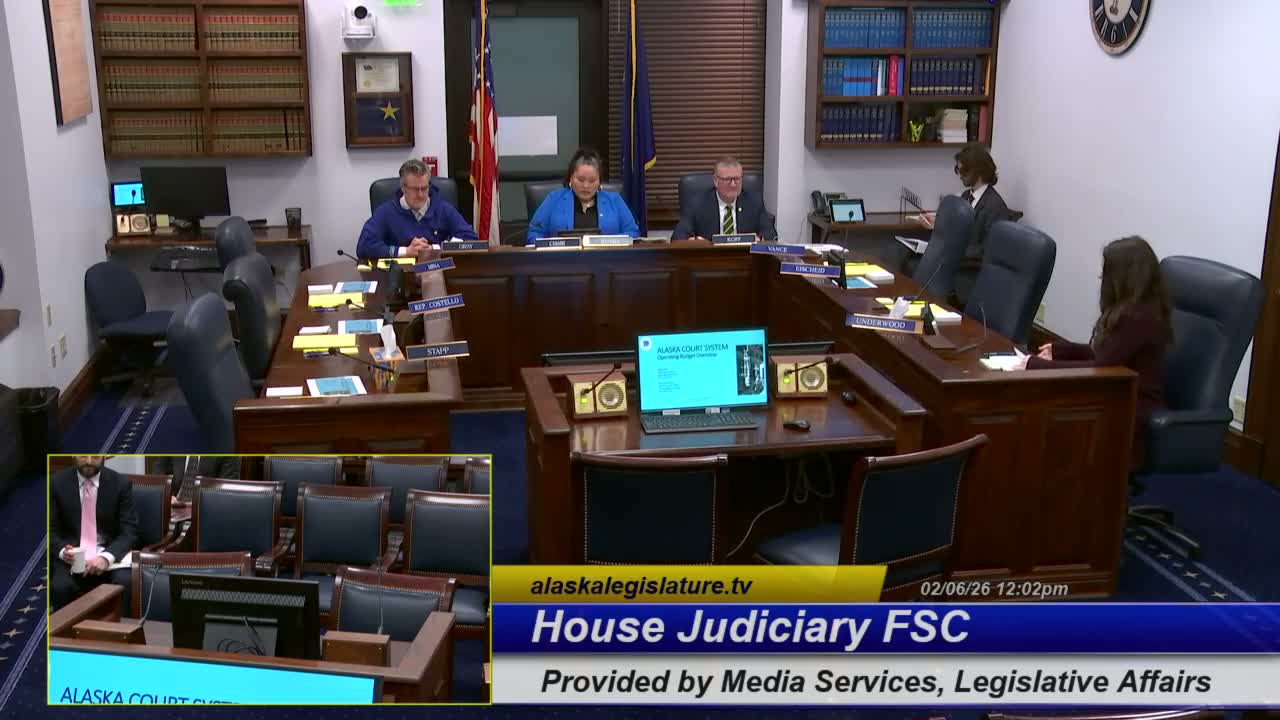
Juneau — The Alaska Court System on Feb. 6 told the House Judiciary Subcommittee it will press the Legislature for a modest set of increases for fiscal 2027 to cover facility costs, contractual court‑visitor work and staffing tied to therapeutic courts.
"We do have about a 100 when you include magistrate judges," Noah Klein, associate counsel for the Alaska Court System, told committee members as he outlined the agency’s request and operations. Klein said the court system is funded for roughly 780 positions overall, the majority clerical, and operates across four judicial districts with 38 courthouse locations.
The court’s FY27 general‑fund request includes a $700,000 operating and maintenance increment, Klein said, about $280,000 of which would cover recurring items the courts did not receive last year. He also described a mix of non‑general‑fund requests, including Mental Health Trust funding that now appears in the base and a trust‑recommended position for a behavioral health administrator to coordinate cross‑system programs.
Klein told lawmakers the court frequently seeks operating and maintenance money because its roughly 40 facilities are owned or occupied under three different arrangements — court‑owned, state‑owned occupied space, and private or municipal leases — each with different cost drivers. "We have leases with CPI inflationary adjustments," he said, explaining why requested amounts vary from year to year.
Committee members pressed for specifics. Representative Gray said the panel expected to move a bill to add a judge in Palmer and estimated the price at about $1,000,000; Klein said the legislature’s fiscal note for adding a judge would be included in the state’s overall fiscal picture and gave an estimate near $740,000 to be confirmed by finance staff.
Representative Craig asked whether the court tracks an average cost per case. Klein said the court does not maintain a single cost‑per‑case metric and noted therapeutic courts have a roughly $10 million budget with far fewer participants, leaving legislators to weigh costs against benefits such as reduced incarceration or recidivism.
On court visitors — contractor investigators who assist judges in guardianship and conservatorship reviews — Klein confirmed they are contracted positions, not regular state employees. The court told the committee it has a backlog of three‑year reviews carried over since the program moved from the Office of Public Advocacy and that climbing out of that backlog increased costs.
Rhonda McLeod, chief financial officer for the court system, told members she’s seen notable increases in contractor costs tied to services such as snow plowing and energy, and that renegotiated contracts and CPI escalators have raised costs for leased and owned properties.
Klein said the court intends to use a combination of one‑time savings and vacancy savings (the system is budgeted with about a 7% vacancy rate) to cover shortfalls if the Legislature does not fund every increment. He also said the court will try to pace backlog reviews and seek efficiencies in training and processes rather than closing courthouses.
Several legislators urged larger investments in the justice system. "I think you guys ask for too little," Representative Green said during the hearing, arguing that additional judges, prosecutors and defenders will be needed to speed case processing even if the court requests have historically been conservative.
The subcommittee did not take any formal votes during the roughly 30‑minute session. Klein told lawmakers he would provide the committee with the court’s original budget submission to legislative finance going forward if requested; the court said it hopes to improve transparency so the Legislature can review the Supreme Court’s full request.
The meeting adjourned at 12:32 p.m.
Sources: Presentation and Q&A, House Judiciary Subcommittee hearing, Feb. 6, 2026. Quotes and figures are drawn from the committee transcript and were attributed in text to the speakers who made them.
"We do have about a 100 when you include magistrate judges," Noah Klein, associate counsel for the Alaska Court System, told committee members as he outlined the agency’s request and operations. Klein said the court system is funded for roughly 780 positions overall, the majority clerical, and operates across four judicial districts with 38 courthouse locations.
The court’s FY27 general‑fund request includes a $700,000 operating and maintenance increment, Klein said, about $280,000 of which would cover recurring items the courts did not receive last year. He also described a mix of non‑general‑fund requests, including Mental Health Trust funding that now appears in the base and a trust‑recommended position for a behavioral health administrator to coordinate cross‑system programs.
Klein told lawmakers the court frequently seeks operating and maintenance money because its roughly 40 facilities are owned or occupied under three different arrangements — court‑owned, state‑owned occupied space, and private or municipal leases — each with different cost drivers. "We have leases with CPI inflationary adjustments," he said, explaining why requested amounts vary from year to year.
Committee members pressed for specifics. Representative Gray said the panel expected to move a bill to add a judge in Palmer and estimated the price at about $1,000,000; Klein said the legislature’s fiscal note for adding a judge would be included in the state’s overall fiscal picture and gave an estimate near $740,000 to be confirmed by finance staff.
Representative Craig asked whether the court tracks an average cost per case. Klein said the court does not maintain a single cost‑per‑case metric and noted therapeutic courts have a roughly $10 million budget with far fewer participants, leaving legislators to weigh costs against benefits such as reduced incarceration or recidivism.
On court visitors — contractor investigators who assist judges in guardianship and conservatorship reviews — Klein confirmed they are contracted positions, not regular state employees. The court told the committee it has a backlog of three‑year reviews carried over since the program moved from the Office of Public Advocacy and that climbing out of that backlog increased costs.
Rhonda McLeod, chief financial officer for the court system, told members she’s seen notable increases in contractor costs tied to services such as snow plowing and energy, and that renegotiated contracts and CPI escalators have raised costs for leased and owned properties.
Klein said the court intends to use a combination of one‑time savings and vacancy savings (the system is budgeted with about a 7% vacancy rate) to cover shortfalls if the Legislature does not fund every increment. He also said the court will try to pace backlog reviews and seek efficiencies in training and processes rather than closing courthouses.
Several legislators urged larger investments in the justice system. "I think you guys ask for too little," Representative Green said during the hearing, arguing that additional judges, prosecutors and defenders will be needed to speed case processing even if the court requests have historically been conservative.
The subcommittee did not take any formal votes during the roughly 30‑minute session. Klein told lawmakers he would provide the committee with the court’s original budget submission to legislative finance going forward if requested; the court said it hopes to improve transparency so the Legislature can review the Supreme Court’s full request.
The meeting adjourned at 12:32 p.m.
Sources: Presentation and Q&A, House Judiciary Subcommittee hearing, Feb. 6, 2026. Quotes and figures are drawn from the committee transcript and were attributed in text to the speakers who made them.
Don't Miss a Word: See the Full Meeting!
Go beyond summaries. Unlock every video, transcript, and key insight with a Founder Membership.
✓
Get instant access to full meeting videos
✓
Search and clip any phrase from complete transcripts
✓
Receive AI-powered summaries & custom alerts
✓
Enjoy lifetime, unrestricted access to government data
30-day money-back guarantee
