School boards, students press Alaska Legislature for steady funding, urgent repairs to aging school facilities
February 09, 2026 | 2026 Legislature Alaska, Alaska
This article was created by AI summarizing key points discussed. AI makes mistakes, so for full details and context, please refer to the video of the full meeting. Please report any errors so we can fix them. Report an error »
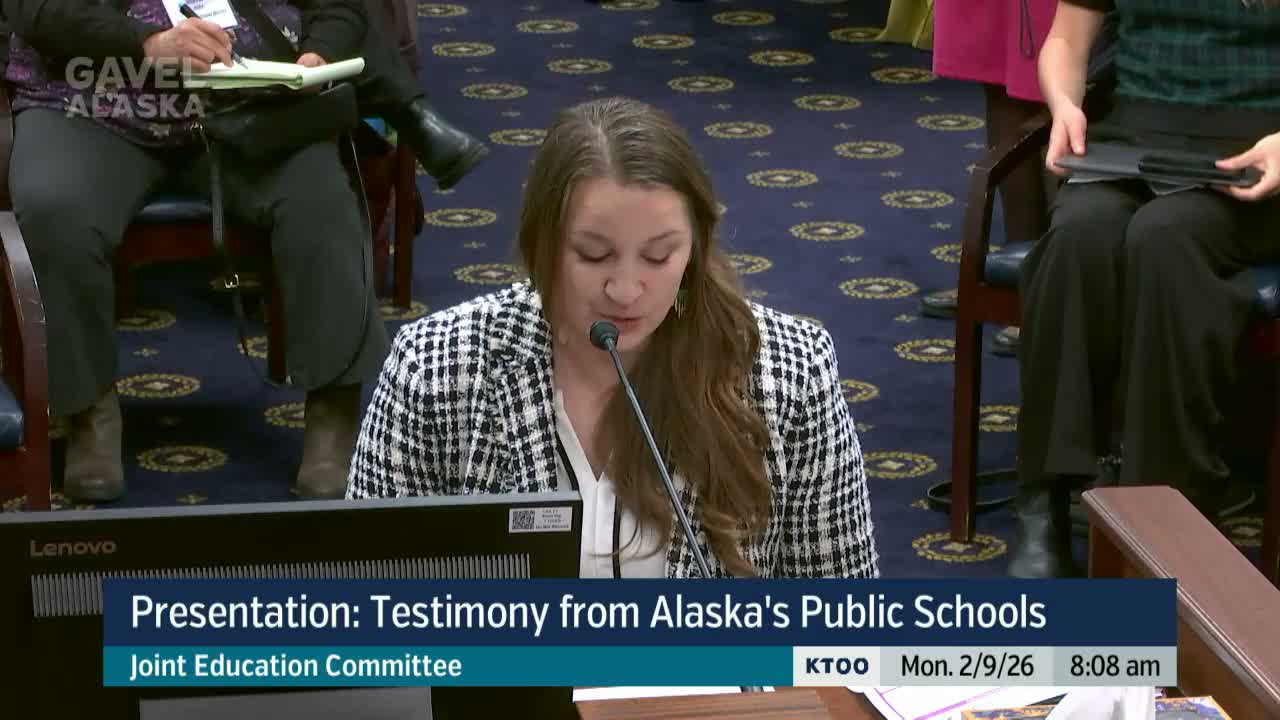
School board members and students from districts across Alaska told the joint House and Senate education committees on Feb. 9 that aging buildings, teacher shortages and inconsistent funding threaten public education in the state.
"We've heard that we're carrying a staggering $2,000,000,000 in deferred maintenance," Julia Phelan, president of the Association of Alaska School Boards, said, describing black mold, frozen septic systems and some schools with a single working restroom. "None of these are conducive to the learning environment."
Fairbanks North Star Borough board member Morgan Doolian said the district has cut $60 million since 2018, closed seven schools and eliminated elective programs, and urged a mix of targeted, one-time and structural fixes. "Although we have temporary fiscal stability, we ought not lose sight of the $60,000,000 in cuts and, more importantly, the pain those cuts have caused," Doolian said.
Students gave personal accounts of how program cuts affect opportunities. "Investments in career and technical education are what drove me to truly find my purpose," Liam Wade, a senior and student representative from North Pole High School, said. Several speakers credited recent increases in the Base Student Allocation (BSA) with some relief but said the adjustment does not cover the real costs of transportation, utilities, teacher housing and repairs.
Districts serving remote communities emphasized higher operating costs. "Because of our isolation, the cost of educating students in Yakutat is significantly higher," Raine Pavlik, Yakutat School Board president, said, citing ferry shutdowns and housing shortages that complicate recruitment and retention.
Multiple presenters urged the legislature to pass measures that stabilize funding streams, such as proposals to average student counts to reduce year-to-year volatility and to capture out-of-state sales-tax revenue to support education programs. Advocates also asked for sustained funding for counseling and behavioral-health aid, expanded CTE supports, and targeted capital investments for the oldest, most at-risk buildings.
Lon Garrison, executive director of the Association of Alaska School Boards, told lawmakers the testimony represents a statewide inflection point. "We have to be bold," he said. "Public education will not work in the state of Alaska" without additional infrastructure investment and targeted funding.
The committee did not take formal action; members heard testimony and signaled plans for follow-up hearings on specific districts and issues, including Mount Edgecumbe High School scheduled for later in the week.
"We've heard that we're carrying a staggering $2,000,000,000 in deferred maintenance," Julia Phelan, president of the Association of Alaska School Boards, said, describing black mold, frozen septic systems and some schools with a single working restroom. "None of these are conducive to the learning environment."
Fairbanks North Star Borough board member Morgan Doolian said the district has cut $60 million since 2018, closed seven schools and eliminated elective programs, and urged a mix of targeted, one-time and structural fixes. "Although we have temporary fiscal stability, we ought not lose sight of the $60,000,000 in cuts and, more importantly, the pain those cuts have caused," Doolian said.
Students gave personal accounts of how program cuts affect opportunities. "Investments in career and technical education are what drove me to truly find my purpose," Liam Wade, a senior and student representative from North Pole High School, said. Several speakers credited recent increases in the Base Student Allocation (BSA) with some relief but said the adjustment does not cover the real costs of transportation, utilities, teacher housing and repairs.
Districts serving remote communities emphasized higher operating costs. "Because of our isolation, the cost of educating students in Yakutat is significantly higher," Raine Pavlik, Yakutat School Board president, said, citing ferry shutdowns and housing shortages that complicate recruitment and retention.
Multiple presenters urged the legislature to pass measures that stabilize funding streams, such as proposals to average student counts to reduce year-to-year volatility and to capture out-of-state sales-tax revenue to support education programs. Advocates also asked for sustained funding for counseling and behavioral-health aid, expanded CTE supports, and targeted capital investments for the oldest, most at-risk buildings.
Lon Garrison, executive director of the Association of Alaska School Boards, told lawmakers the testimony represents a statewide inflection point. "We have to be bold," he said. "Public education will not work in the state of Alaska" without additional infrastructure investment and targeted funding.
The committee did not take formal action; members heard testimony and signaled plans for follow-up hearings on specific districts and issues, including Mount Edgecumbe High School scheduled for later in the week.
View the Full Meeting & All Its Details
This article offers just a summary. Unlock complete video, transcripts, and insights as a Founder Member.
✓
Watch full, unedited meeting videos
✓
Search every word spoken in unlimited transcripts
✓
AI summaries & real-time alerts (all government levels)
✓
Permanent access to expanding government content
30-day money-back guarantee
