UAF directors brief House Resources Committee on strengthening Alaska's food system; institute seeks funding
February 09, 2026 | 2026 Legislature Alaska, Alaska
This article was created by AI summarizing key points discussed. AI makes mistakes, so for full details and context, please refer to the video of the full meeting. Please report any errors so we can fix them. Report an error »
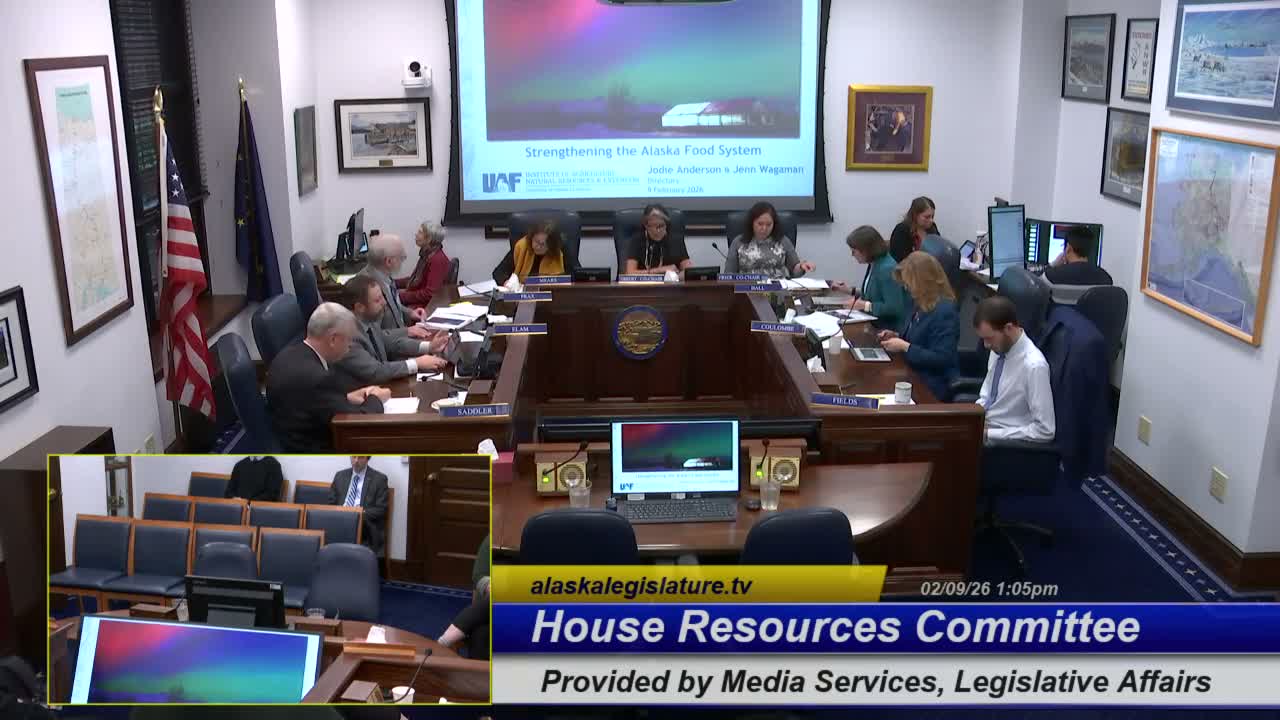
Jody Anderson, director of the University of Alaska Fairbanks Institute of Agriculture, Natural Resources, and Extension (IANRE), and Jen Wagaman, UAF Cooperative Extension director, told the House Resources Committee on Feb. 9 that the institute's research and extension work underpins Alaska's agricultural and food-security efforts and that capacity constraints limit statewide impact.
Anderson opened by describing the land-grant mission and how targeted research "listening to our stakeholders" helped develop Alaska's peony export industry. Wagaman said extension supports more than 350 publications, serves 69 communities with on-the-ground programming, and operates district offices and two agricultural/forestry experiment stations that deliver training and local services.
Why it matters: committee members pressed the presenters on funding and practical bottlenecks that affect producers statewide. Anderson told lawmakers that IANRE relies mainly on USDA capacity (formula) funds administered by the National Institute of Food and Agriculture (NIFA), which require a 1:1 nonfederal match, and that the institute also pursues competitive grants and collaborations with USDA's Agricultural Research Service (ARS). She said a $3 million operating request for food-security support (placed by the Board of Regents in the UA red book) did not appear in the governor's budget.
Key programs and findings: Wagaman highlighted community and workforce initiatives, including the Harvest Collaborative (student training and a community-supported agriculture box), pesticide safety education, expanded sewing and post-production classes in Nome, and a strong 4-H program (50 active clubs in 10 districts serving 7,563 youth). She said extension is developing a training-of-trainers curriculum to expand food-preservation instruction statewide because budget cuts left only two active preservation trainers.
Research highlights Anderson summarized include a $2 million capital investment from the governor's office (FY26) for research equipment: a Zurn plot combine and specialized plot planter to speed plot harvesting and reduce technician labor; a Calan/CowGate feeding system to enable individualized livestock nutrition trials; hydroponic greenhouse trials; kelp variety trials with the College of Fisheries and Ocean Sciences; an alfalfa perenniality study; and soils research using more than 1,000 statewide soil samples.
On plant breeding, Anderson described a public double-haploid lab that shortens breeding time for cold-adapted barley and wheat varieties, intended to prioritize Alaska-appropriate genetics rather than relying on private-sector breeders who may not focus on cold-soil varieties.
Gaps identified: both presenters emphasized post-harvest processing and cold-chain storage as a major statewide deficit that limits producers' ability to scale beyond farmers markets. "Storage and post-harvest collection and that cold chain don't exist in Alaska," Anderson told the committee, and she noted that farmers markets have grown to 68 across the state because direct-market sales remain the easiest route for many producers.
Funding and staffing: the presenters said IANRE has relied on attrition after reductions in university funding but expects to hire two new faculty this year (food science and horticulture). Anderson thanked the governor's office for capital support but reiterated the institute's operating ask: a $3,000,000 food-security operating request submitted in the UA red book that did not survive the governor's budget process.
Committee remarks and next steps: lawmakers raised questions about UA land management, use of state purchasing power to promote local food, and market linkages with supermarkets. Representative Fields urged the state to consider systematizing procurement to increase local purchasing; Anderson said extension's role is to provide expertise and work through existing systems, while supporting faculty engagement on policy conversations. Co-chair Representative Deibert closed the hearing and reminded the committee that it would reconvene Feb. 11 to finish a Hillcorp briefing and take public testimony on House Bill 271 (referred to in the transcript as "Bill 2 71, Kitchen Lights unit royalty modification"). The committee adjourned at 2:39 p.m.
Quotes: "We are predominantly federally funded," Anderson said, describing NIFA formula funds and the 1:1 match requirement. Wagaman said extension's expansion of preservation training will try to address statewide demand: "We will do a training of trainers of 5 new individuals..." Anderson thanked the governor's office for capital support: "We were very fortunate to get... $2,000,000 from the governor's office, in FY26."
What happens next: presenters offered to provide committee members links to plans of work, annual reports and impact statements; Anderson and Wagaman provided one-page impact summaries for the committee and said they are available for follow-up questions.
Anderson opened by describing the land-grant mission and how targeted research "listening to our stakeholders" helped develop Alaska's peony export industry. Wagaman said extension supports more than 350 publications, serves 69 communities with on-the-ground programming, and operates district offices and two agricultural/forestry experiment stations that deliver training and local services.
Why it matters: committee members pressed the presenters on funding and practical bottlenecks that affect producers statewide. Anderson told lawmakers that IANRE relies mainly on USDA capacity (formula) funds administered by the National Institute of Food and Agriculture (NIFA), which require a 1:1 nonfederal match, and that the institute also pursues competitive grants and collaborations with USDA's Agricultural Research Service (ARS). She said a $3 million operating request for food-security support (placed by the Board of Regents in the UA red book) did not appear in the governor's budget.
Key programs and findings: Wagaman highlighted community and workforce initiatives, including the Harvest Collaborative (student training and a community-supported agriculture box), pesticide safety education, expanded sewing and post-production classes in Nome, and a strong 4-H program (50 active clubs in 10 districts serving 7,563 youth). She said extension is developing a training-of-trainers curriculum to expand food-preservation instruction statewide because budget cuts left only two active preservation trainers.
Research highlights Anderson summarized include a $2 million capital investment from the governor's office (FY26) for research equipment: a Zurn plot combine and specialized plot planter to speed plot harvesting and reduce technician labor; a Calan/CowGate feeding system to enable individualized livestock nutrition trials; hydroponic greenhouse trials; kelp variety trials with the College of Fisheries and Ocean Sciences; an alfalfa perenniality study; and soils research using more than 1,000 statewide soil samples.
On plant breeding, Anderson described a public double-haploid lab that shortens breeding time for cold-adapted barley and wheat varieties, intended to prioritize Alaska-appropriate genetics rather than relying on private-sector breeders who may not focus on cold-soil varieties.
Gaps identified: both presenters emphasized post-harvest processing and cold-chain storage as a major statewide deficit that limits producers' ability to scale beyond farmers markets. "Storage and post-harvest collection and that cold chain don't exist in Alaska," Anderson told the committee, and she noted that farmers markets have grown to 68 across the state because direct-market sales remain the easiest route for many producers.
Funding and staffing: the presenters said IANRE has relied on attrition after reductions in university funding but expects to hire two new faculty this year (food science and horticulture). Anderson thanked the governor's office for capital support but reiterated the institute's operating ask: a $3,000,000 food-security operating request submitted in the UA red book that did not survive the governor's budget process.
Committee remarks and next steps: lawmakers raised questions about UA land management, use of state purchasing power to promote local food, and market linkages with supermarkets. Representative Fields urged the state to consider systematizing procurement to increase local purchasing; Anderson said extension's role is to provide expertise and work through existing systems, while supporting faculty engagement on policy conversations. Co-chair Representative Deibert closed the hearing and reminded the committee that it would reconvene Feb. 11 to finish a Hillcorp briefing and take public testimony on House Bill 271 (referred to in the transcript as "Bill 2 71, Kitchen Lights unit royalty modification"). The committee adjourned at 2:39 p.m.
Quotes: "We are predominantly federally funded," Anderson said, describing NIFA formula funds and the 1:1 match requirement. Wagaman said extension's expansion of preservation training will try to address statewide demand: "We will do a training of trainers of 5 new individuals..." Anderson thanked the governor's office for capital support: "We were very fortunate to get... $2,000,000 from the governor's office, in FY26."
What happens next: presenters offered to provide committee members links to plans of work, annual reports and impact statements; Anderson and Wagaman provided one-page impact summaries for the committee and said they are available for follow-up questions.
Don't Miss a Word: See the Full Meeting!
Go beyond summaries. Unlock every video, transcript, and key insight with a Founder Membership.
✓
Get instant access to full meeting videos
✓
Search and clip any phrase from complete transcripts
✓
Receive AI-powered summaries & custom alerts
✓
Enjoy lifetime, unrestricted access to government data
30-day money-back guarantee
