Senate Judiciary Committee hears bill to raise Alaska age of consent from 16 to 18
February 09, 2026 | 2026 Legislature Alaska, Alaska
This article was created by AI summarizing key points discussed. AI makes mistakes, so for full details and context, please refer to the video of the full meeting. Please report any errors so we can fix them. Report an error »
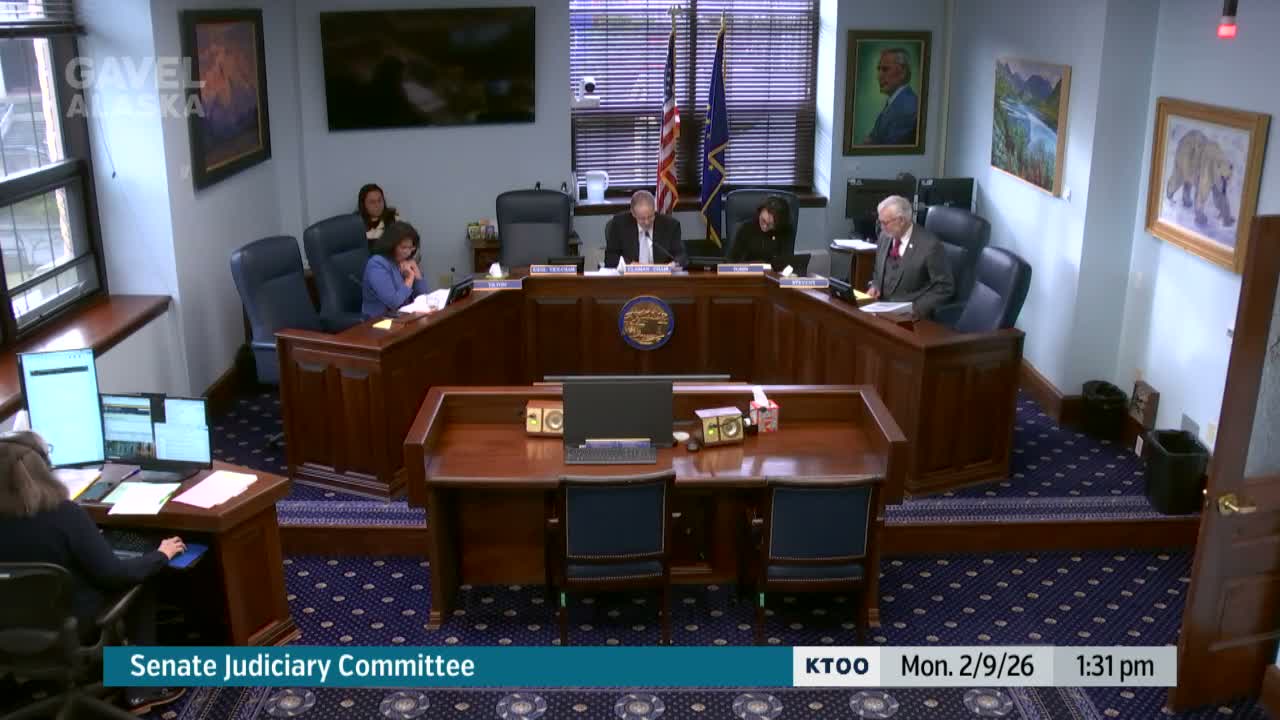
Representative Andrew Gray introduced House Bill 101 on Feb. 9 during a Senate Judiciary Committee hearing, saying the measure would raise the age of sexual consent in Alaska from 16 to 18 to reduce predation of older adults on 16- and 17-year-olds. "HB 101 does this by raising the age of consent from 16 to 18," Gray said, and emphasized that the bill includes a close‑in‑age (Romeo‑and‑Juliet) exemption to avoid criminalizing consensual peer teen relationships.
Gray framed the change as a public‑safety and prosecutorial reform. Citing state and national victimization surveys, he told the committee that Alaska’s rates of sexual violence and child sexual assault are well above the national average and that the current law can make prosecutions difficult when an alleged victim is 16 or 17. He cited an example he said involved a 63‑year‑old officer, named in testimony, to illustrate how adults in positions of authority can escape accountability under current rules unless a separate authority element applies.
Dylan Hitchcock Lopez, staff to Representative Gray, walked the committee through the bill’s sectional changes. Sections 1–6 update the statutory definition of a "minor" by raising age thresholds; sections 7–9 revise degrees of sexual‑abuse offenses with new age and age‑gap elements; sections 10–27 update related offenses (child endangerment, indecent exposure, solicitation) and sentencing guidance; and sections 30–32 address repeals, applicability, and an effective date. The sponsor and staff emphasized that the bill’s length is driven by the need to align multiple statutes to a single definition of "minor."
Supporters gave invited testimony. Randy Breker, executive director of Awake (Anchorage), said Alaska’s high rates of sexual violence and systemic reporting barriers justify raising the age of consent. "This common sense bill tells us that these adults do not, in fact, believe they are engaging in a meaningful relationship with someone their equal," Breker said, arguing the change would help prosecutors hold predatory adults to account. Kaye Wilson, executive director of STAR (Standing Together Against Rape) in Anchorage, described STAR’s victim‑service work and provided an example from Bethel (2020) involving a defendant identified in testimony as Benjamin Anderson Agamak; Wilson said events there showed gaps in accountability when victims were younger than the current statutory protection age.
Department of Law Deputy Attorney General Angie Kemp told the committee that many sexual‑offense referrals are declined for evidentiary reasons and estimated a high declination rate for sexual‑offense referrals, saying it is "somewhere in the neighborhood of roughly 89 percent." Kemp said raising the age of consent could make certain prosecutions involving 16‑ and 17‑year‑olds easier because prosecutors would not always need to prove lack of consent in the same way as under current statutes. She also warned that alcohol and drugs can complicate jury assessments, making some incapacitation‑based claims difficult to prove.
Committee members questioned the sponsor and witnesses about evidence, trafficking dynamics, and the bill’s interplay with House Bill 36 — an item Gray said had been incorporated to allow certain 16‑ and 17‑year‑olds limited access to mental‑health services (up to five visits) without parental permission. Gray and witnesses argued HB 36’s narrow mental‑health provision is consistent with HB 101’s protective aims, because it helps youth who may be trafficked or harmed by family members to access mandated reporters and services. Gray corrected an earlier overstatement about trafficking and said he would share a January 2024 Department of Justice item he cited describing familial involvement in trafficking.
Chair Senator Klayman said the committee would defer discussion of fiscal notes to a later hearing after staff provides the full set of fiscal analyses; he closed the session by setting HB 101 aside for further review. No formal vote or motion on the bill occurred at the Feb. 9 hearing. The committee scheduled a follow‑up meeting for Feb. 11 to receive the Alaska Criminal Justice Data Analysis Commission’s 2025 annual report.
The hearing record shows stakeholders supporting HB 101 primarily on child‑safety and prosecutorial‑effectiveness grounds, the Department of Law noting existing evidentiary hurdles and a high declination rate, and the committee asking for additional data and fiscal analysis before further action.
Gray framed the change as a public‑safety and prosecutorial reform. Citing state and national victimization surveys, he told the committee that Alaska’s rates of sexual violence and child sexual assault are well above the national average and that the current law can make prosecutions difficult when an alleged victim is 16 or 17. He cited an example he said involved a 63‑year‑old officer, named in testimony, to illustrate how adults in positions of authority can escape accountability under current rules unless a separate authority element applies.
Dylan Hitchcock Lopez, staff to Representative Gray, walked the committee through the bill’s sectional changes. Sections 1–6 update the statutory definition of a "minor" by raising age thresholds; sections 7–9 revise degrees of sexual‑abuse offenses with new age and age‑gap elements; sections 10–27 update related offenses (child endangerment, indecent exposure, solicitation) and sentencing guidance; and sections 30–32 address repeals, applicability, and an effective date. The sponsor and staff emphasized that the bill’s length is driven by the need to align multiple statutes to a single definition of "minor."
Supporters gave invited testimony. Randy Breker, executive director of Awake (Anchorage), said Alaska’s high rates of sexual violence and systemic reporting barriers justify raising the age of consent. "This common sense bill tells us that these adults do not, in fact, believe they are engaging in a meaningful relationship with someone their equal," Breker said, arguing the change would help prosecutors hold predatory adults to account. Kaye Wilson, executive director of STAR (Standing Together Against Rape) in Anchorage, described STAR’s victim‑service work and provided an example from Bethel (2020) involving a defendant identified in testimony as Benjamin Anderson Agamak; Wilson said events there showed gaps in accountability when victims were younger than the current statutory protection age.
Department of Law Deputy Attorney General Angie Kemp told the committee that many sexual‑offense referrals are declined for evidentiary reasons and estimated a high declination rate for sexual‑offense referrals, saying it is "somewhere in the neighborhood of roughly 89 percent." Kemp said raising the age of consent could make certain prosecutions involving 16‑ and 17‑year‑olds easier because prosecutors would not always need to prove lack of consent in the same way as under current statutes. She also warned that alcohol and drugs can complicate jury assessments, making some incapacitation‑based claims difficult to prove.
Committee members questioned the sponsor and witnesses about evidence, trafficking dynamics, and the bill’s interplay with House Bill 36 — an item Gray said had been incorporated to allow certain 16‑ and 17‑year‑olds limited access to mental‑health services (up to five visits) without parental permission. Gray and witnesses argued HB 36’s narrow mental‑health provision is consistent with HB 101’s protective aims, because it helps youth who may be trafficked or harmed by family members to access mandated reporters and services. Gray corrected an earlier overstatement about trafficking and said he would share a January 2024 Department of Justice item he cited describing familial involvement in trafficking.
Chair Senator Klayman said the committee would defer discussion of fiscal notes to a later hearing after staff provides the full set of fiscal analyses; he closed the session by setting HB 101 aside for further review. No formal vote or motion on the bill occurred at the Feb. 9 hearing. The committee scheduled a follow‑up meeting for Feb. 11 to receive the Alaska Criminal Justice Data Analysis Commission’s 2025 annual report.
The hearing record shows stakeholders supporting HB 101 primarily on child‑safety and prosecutorial‑effectiveness grounds, the Department of Law noting existing evidentiary hurdles and a high declination rate, and the committee asking for additional data and fiscal analysis before further action.
Don't Miss a Word: See the Full Meeting!
Go beyond summaries. Unlock every video, transcript, and key insight with a Founder Membership.
✓
Get instant access to full meeting videos
✓
Search and clip any phrase from complete transcripts
✓
Receive AI-powered summaries & custom alerts
✓
Enjoy lifetime, unrestricted access to government data
30-day money-back guarantee
