Portsmouth staff urges $7 million annual paving budget to lift road condition
February 11, 2026 | Portsmouth, Norfolk County, Virginia
This article was created by AI summarizing key points discussed. AI makes mistakes, so for full details and context, please refer to the video of the full meeting. Please report any errors so we can fix them. Report an error »
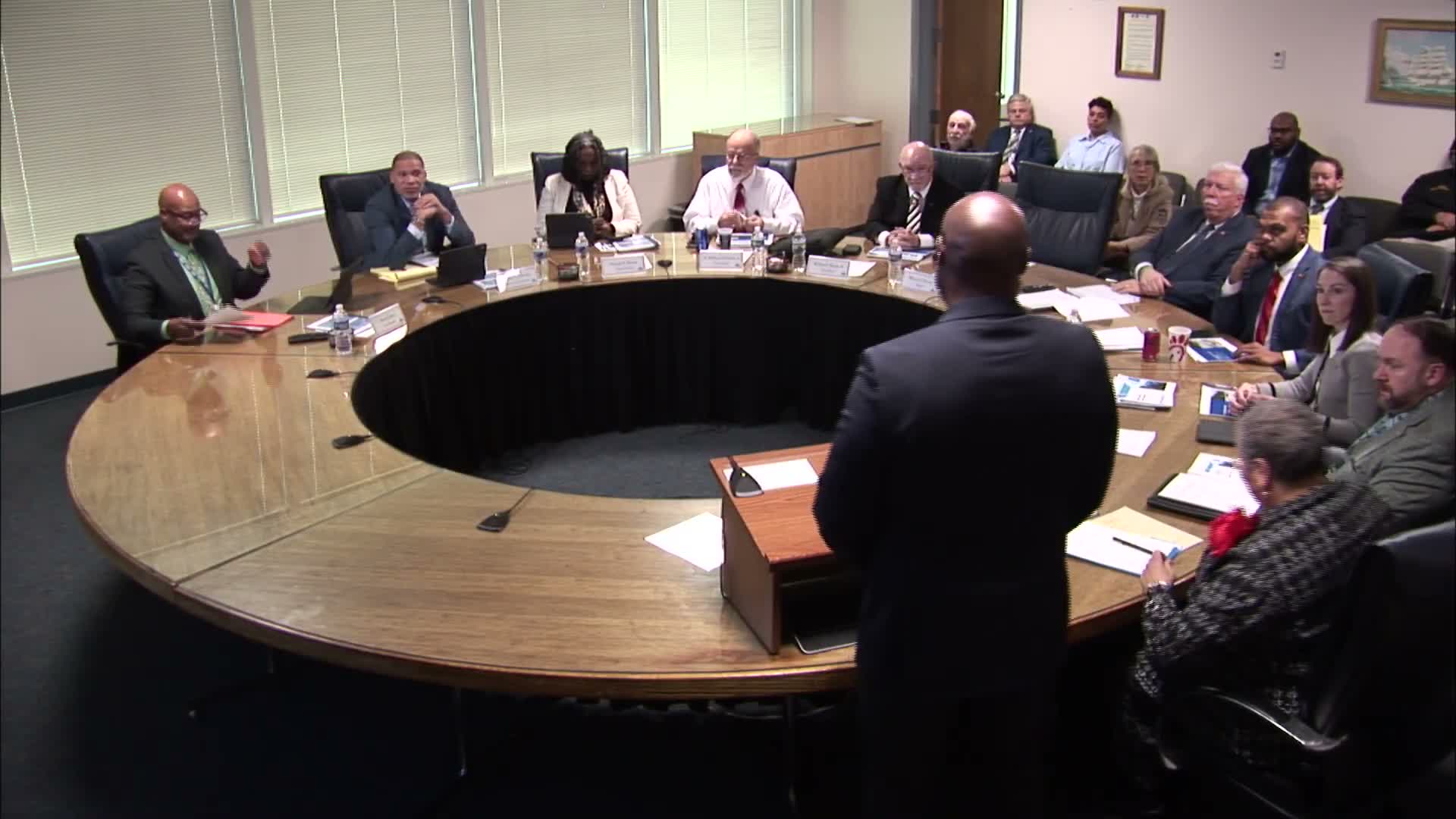
Portsmouth — Public-works staff presented a multi-year plan to repair and preserve the city’s roads, saying sustained investment is needed to move the pavement condition index from its current 48 toward a regional target. “So we have 884 total lane miles in the city of Portsmouth,” said Mister Gerard Roberts, the presentation’s lead, describing the city’s inventory of primary, collector and local streets.
Roberts told council the city’s overall pavement score is 48 on a 0–100 scale and the commonly used repair threshold is 60: “As our roads deteriorate at 60, we should be milling, overlaying and repairing our roads,” he said. He said the department’s FY26 appropriation of $5.4 million funds roughly 37–41 lane miles this year; the department estimates that a $7.0 million annual commitment would allow more milling and a $1.0 million preservation line for micro‑surfacing and slurry seal that extends pavement life.
The plan pairs near-term projects and neighborhood “bundling” with maintenance on high-volume corridors. Roberts listed priority corridors that the presentation identifies as Portsmouth Boulevard, portions of Victory Boulevard, Airline Boulevard, Hartford Street and Willard Drive. He said FY26 work should complete about 41 lane miles; FY27 is projected to record roughly 47 lane miles, which staff said would represent 4–5% of the total network each year.
Roberts also reviewed bridge work. He said the city maintains five local bridges — Churchland, Paradise Creek, two crossings identified as London bridges and Clifford Street — and that Paradise Creek replacement is under construction with an 18‑month schedule. Churchland Bridge is complete and will receive a one‑year warranty inspection in fall 2026.
Council members pressed staff on operational details: who enforces quality when outside utilities dig up newly paved sections, and whether contractor shortages or regional projects have slowed FY26 work. Roberts said oversight depends on the specific work (engineering or inspection units) and that the department will circulate a list of planned starts so internal departments and utilities can avoid re‑digging recent pavement.
Roberts said the department is seeking road‑scanning technology to supplement VDOT’s assessments and sharpen decisions on where to apply preservation treatments versus full reconstruction. He framed the $7.0 million target as a way to move the city’s condition measure modestly upward and to produce visible neighborhood improvements rather than only high‑volume corridor work. No formal vote took place at the work session; staff will carry the recommendation into the upcoming budget and chamber agenda.
Roberts told council the city’s overall pavement score is 48 on a 0–100 scale and the commonly used repair threshold is 60: “As our roads deteriorate at 60, we should be milling, overlaying and repairing our roads,” he said. He said the department’s FY26 appropriation of $5.4 million funds roughly 37–41 lane miles this year; the department estimates that a $7.0 million annual commitment would allow more milling and a $1.0 million preservation line for micro‑surfacing and slurry seal that extends pavement life.
The plan pairs near-term projects and neighborhood “bundling” with maintenance on high-volume corridors. Roberts listed priority corridors that the presentation identifies as Portsmouth Boulevard, portions of Victory Boulevard, Airline Boulevard, Hartford Street and Willard Drive. He said FY26 work should complete about 41 lane miles; FY27 is projected to record roughly 47 lane miles, which staff said would represent 4–5% of the total network each year.
Roberts also reviewed bridge work. He said the city maintains five local bridges — Churchland, Paradise Creek, two crossings identified as London bridges and Clifford Street — and that Paradise Creek replacement is under construction with an 18‑month schedule. Churchland Bridge is complete and will receive a one‑year warranty inspection in fall 2026.
Council members pressed staff on operational details: who enforces quality when outside utilities dig up newly paved sections, and whether contractor shortages or regional projects have slowed FY26 work. Roberts said oversight depends on the specific work (engineering or inspection units) and that the department will circulate a list of planned starts so internal departments and utilities can avoid re‑digging recent pavement.
Roberts said the department is seeking road‑scanning technology to supplement VDOT’s assessments and sharpen decisions on where to apply preservation treatments versus full reconstruction. He framed the $7.0 million target as a way to move the city’s condition measure modestly upward and to produce visible neighborhood improvements rather than only high‑volume corridor work. No formal vote took place at the work session; staff will carry the recommendation into the upcoming budget and chamber agenda.
View the Full Meeting & All Its Details
This article offers just a summary. Unlock complete video, transcripts, and insights as a Founder Member.
✓
Watch full, unedited meeting videos
✓
Search every word spoken in unlimited transcripts
✓
AI summaries & real-time alerts (all government levels)
✓
Permanent access to expanding government content
30-day money-back guarantee
