Oregon City commissioners direct staff to rewrite stormwater exemption rules after peer review
February 11, 2026 | Oregon City, Clackamas County, Oregon
This article was created by AI summarizing key points discussed. AI makes mistakes, so for full details and context, please refer to the video of the full meeting. Please report any errors so we can fix them. Report an error »
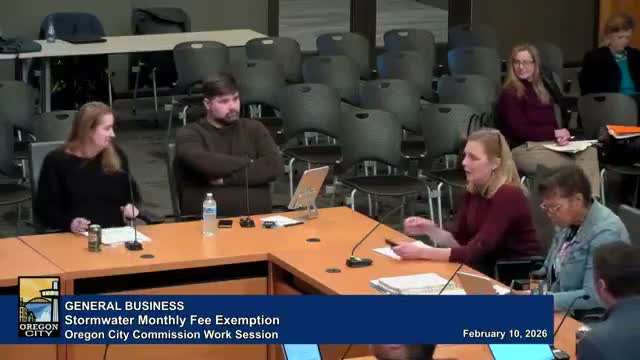
A consultant’s review of Oregon and regional stormwater programs prompted City of Oregon City commissioners on Feb. 10 to ask staff to draft code changes that would limit 100% fee exemptions and make exemptions time‑limited and verifiable.
Krista Reininga, an engineer with Brown and Caldwell, told the commission the city’s current stormwater fee structure treats a single‑family equivalent residential unit (ERU) as about 2,500 square feet and — in 2025 figures — is charged $15.95 per month. She reviewed 11 peer jurisdictions and said none of the Oregon cities she examined granted a 100% waiver of the entire stormwater fee; credits, when offered, were usually limited to the fee component tied to impervious area or to above‑and‑beyond water‑quality measures. “Even if someone keeps runoff on‑site, many of the administrative and regulatory costs remain,” Reininga said, arguing credits should be tied to the program elements that the private action actually reduces.
Commissioners pressed staff on how many exemptions exist and whether certain Abernathy‑area properties that discharge directly to a creek had been granted full waivers. Dana Webb, the city’s public works director, said utility‑billing data showed three properties along Abernathy had received full 100% exemptions; a handful of partial exemptions also exist, she said, and staff is still confirming a small number of other zero‑charged accounts that are likely outside city limits.
That inventory — and the broader concern that exemptions can undercut the city’s regulatory obligations under its MS4 permit and stream‑protection requirements — shifted commissioners toward a preferred policy approach: retain an administrative/base portion of the monthly fee that is not eligible for exemption and allow credits only on the portion tied to impervious runoff or on documented, above‑baseline water‑quality improvements.
“An exemption for life doesn’t help us as a jurisdiction,” Mayor Denise McGriff said during the discussion; commissioners generally agreed that permanent, unconditional waivers are inappropriate and that exemptions should require periodic recertification and some reporting by the property owner.
Commissioners also discussed measurement and verification. Reininga highlighted Eugene’s percent‑based approach, where a property can receive a percent credit on the impervious component equal to the percent of runoff retained on‑site, while Bend uses a budget‑apportionment method that ties credits to the share of program costs that are reduced.
Next steps: staff was directed to draft code cleanup and rate‑methodology options that would (1) divide the stormwater fee into an administrative (non‑creditable) and creditable component, (2) define eligible credits (on‑site retention, water‑quality treatment beyond baseline requirements, demonstration projects, education), (3) propose a recertification or audit schedule for exemptions, and (4) confirm utility‑billing system feasibility for implementing a split fee. Staff will return with specific code language and the list of accounts that have received exemptions.
The resolution of the exemptions issue would change policy but requires future commission action: staff did not bring an ordinance or vote on Feb. 10. The commission’s discussion focused on policy direction and drafting of implementing code changes.
Krista Reininga, an engineer with Brown and Caldwell, told the commission the city’s current stormwater fee structure treats a single‑family equivalent residential unit (ERU) as about 2,500 square feet and — in 2025 figures — is charged $15.95 per month. She reviewed 11 peer jurisdictions and said none of the Oregon cities she examined granted a 100% waiver of the entire stormwater fee; credits, when offered, were usually limited to the fee component tied to impervious area or to above‑and‑beyond water‑quality measures. “Even if someone keeps runoff on‑site, many of the administrative and regulatory costs remain,” Reininga said, arguing credits should be tied to the program elements that the private action actually reduces.
Commissioners pressed staff on how many exemptions exist and whether certain Abernathy‑area properties that discharge directly to a creek had been granted full waivers. Dana Webb, the city’s public works director, said utility‑billing data showed three properties along Abernathy had received full 100% exemptions; a handful of partial exemptions also exist, she said, and staff is still confirming a small number of other zero‑charged accounts that are likely outside city limits.
That inventory — and the broader concern that exemptions can undercut the city’s regulatory obligations under its MS4 permit and stream‑protection requirements — shifted commissioners toward a preferred policy approach: retain an administrative/base portion of the monthly fee that is not eligible for exemption and allow credits only on the portion tied to impervious runoff or on documented, above‑baseline water‑quality improvements.
“An exemption for life doesn’t help us as a jurisdiction,” Mayor Denise McGriff said during the discussion; commissioners generally agreed that permanent, unconditional waivers are inappropriate and that exemptions should require periodic recertification and some reporting by the property owner.
Commissioners also discussed measurement and verification. Reininga highlighted Eugene’s percent‑based approach, where a property can receive a percent credit on the impervious component equal to the percent of runoff retained on‑site, while Bend uses a budget‑apportionment method that ties credits to the share of program costs that are reduced.
Next steps: staff was directed to draft code cleanup and rate‑methodology options that would (1) divide the stormwater fee into an administrative (non‑creditable) and creditable component, (2) define eligible credits (on‑site retention, water‑quality treatment beyond baseline requirements, demonstration projects, education), (3) propose a recertification or audit schedule for exemptions, and (4) confirm utility‑billing system feasibility for implementing a split fee. Staff will return with specific code language and the list of accounts that have received exemptions.
The resolution of the exemptions issue would change policy but requires future commission action: staff did not bring an ordinance or vote on Feb. 10. The commission’s discussion focused on policy direction and drafting of implementing code changes.
View the Full Meeting & All Its Details
This article offers just a summary. Unlock complete video, transcripts, and insights as a Founder Member.
✓
Watch full, unedited meeting videos
✓
Search every word spoken in unlimited transcripts
✓
AI summaries & real-time alerts (all government levels)
✓
Permanent access to expanding government content
30-day money-back guarantee
