Oregon City staff to align utility codes and weigh adjustments to public‑safety fee methodology
February 11, 2026 | Oregon City, Clackamas County, Oregon
This article was created by AI summarizing key points discussed. AI makes mistakes, so for full details and context, please refer to the video of the full meeting. Please report any errors so we can fix them. Report an error »
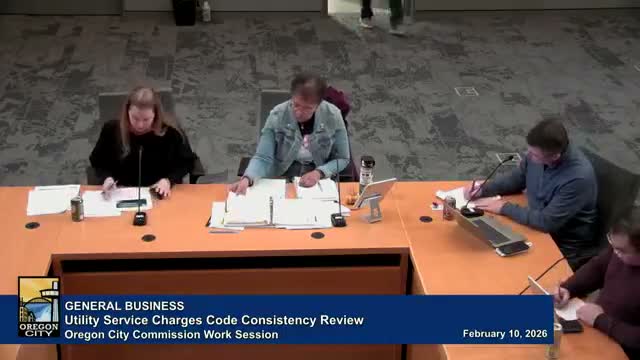
Oregon City commissioners told staff on Feb. 10 to return with cohesive municipal code amendments to make utility billing and appeals consistent across water, sewer, storm drainage and pavement maintenance, and to explain administrative workload for proposed recertification or audit programs.
Public Works Director Dana Webb outlined key inconsistencies: the city’s reduced‑rate/financial‑assistance program is administered by policy but the municipal code does not expressly authorize a reduced storm drainage rate; pavement maintenance code allows a 30‑day look‑back, while utility billing policy uses a six‑month look‑back for errors; and storm drainage code currently does not reference lien authority in a way the water and sewer sections do.
Commissioners expressed support for a single, clear administrative process so similar appeals and billing corrections are handled consistently across utilities. “If we can provide dates and criteria, we can reduce subjectivity that led to prior commission appeals,” one commissioner said; staff committed to outline implementation options and likely workloads, citing the existing annual reduced‑rate application as a possible model.
Separately, the commission heard a revenue‑methodology briefing on the City’s community safety advancement fee (C‑SAFE). Finance staff explained the current structure: a $6.50 monthly charge per utility customer (about 15,000 billed units) and a flat annual charge for businesses rolled into the business license renewal (roughly 1,100 businesses). Three revenue‑neutral options were modeled: (1) slight reductions in the residential flat rate offset by a larger institutional/commercial per‑meter charge; (2) tiering business license contributions by employee count; and (3) a hybrid of both approaches. Because residential and multifamily accounts generate most of the revenue, shifting burden to businesses produced only modest revenue changes in the examples staff presented.
Commissioners generally indicated limited appetite for major structural changes to C‑SAFE without a clear equity rationale and a measurable, administrable metric. Staff noted the fee’s enabling code says the fee “will no longer be collected once the city commission determines the costs associated with the public safety facility improvements have been satisfied,” leaving an end date to future commission discretion.
Next steps: staff will draft recommended municipal code cleanup language to align lien authority, appeals, and look‑back practices across utilities and will return with workload estimates for any proposed recertification or audit program. Any change to C‑SAFE’s structure would require additional analysis and later formal action by the commission.
Public Works Director Dana Webb outlined key inconsistencies: the city’s reduced‑rate/financial‑assistance program is administered by policy but the municipal code does not expressly authorize a reduced storm drainage rate; pavement maintenance code allows a 30‑day look‑back, while utility billing policy uses a six‑month look‑back for errors; and storm drainage code currently does not reference lien authority in a way the water and sewer sections do.
Commissioners expressed support for a single, clear administrative process so similar appeals and billing corrections are handled consistently across utilities. “If we can provide dates and criteria, we can reduce subjectivity that led to prior commission appeals,” one commissioner said; staff committed to outline implementation options and likely workloads, citing the existing annual reduced‑rate application as a possible model.
Separately, the commission heard a revenue‑methodology briefing on the City’s community safety advancement fee (C‑SAFE). Finance staff explained the current structure: a $6.50 monthly charge per utility customer (about 15,000 billed units) and a flat annual charge for businesses rolled into the business license renewal (roughly 1,100 businesses). Three revenue‑neutral options were modeled: (1) slight reductions in the residential flat rate offset by a larger institutional/commercial per‑meter charge; (2) tiering business license contributions by employee count; and (3) a hybrid of both approaches. Because residential and multifamily accounts generate most of the revenue, shifting burden to businesses produced only modest revenue changes in the examples staff presented.
Commissioners generally indicated limited appetite for major structural changes to C‑SAFE without a clear equity rationale and a measurable, administrable metric. Staff noted the fee’s enabling code says the fee “will no longer be collected once the city commission determines the costs associated with the public safety facility improvements have been satisfied,” leaving an end date to future commission discretion.
Next steps: staff will draft recommended municipal code cleanup language to align lien authority, appeals, and look‑back practices across utilities and will return with workload estimates for any proposed recertification or audit program. Any change to C‑SAFE’s structure would require additional analysis and later formal action by the commission.
View the Full Meeting & All Its Details
This article offers just a summary. Unlock complete video, transcripts, and insights as a Founder Member.
✓
Watch full, unedited meeting videos
✓
Search every word spoken in unlimited transcripts
✓
AI summaries & real-time alerts (all government levels)
✓
Permanent access to expanding government content
30-day money-back guarantee
