Coppell outlines expansion, funding and policy changes for Rolling Oaks Memorial Center
February 11, 2026 | Coppell, Dallas County, Texas
This article was created by AI summarizing key points discussed. AI makes mistakes, so for full details and context, please refer to the video of the full meeting. Please report any errors so we can fix them. Report an error »
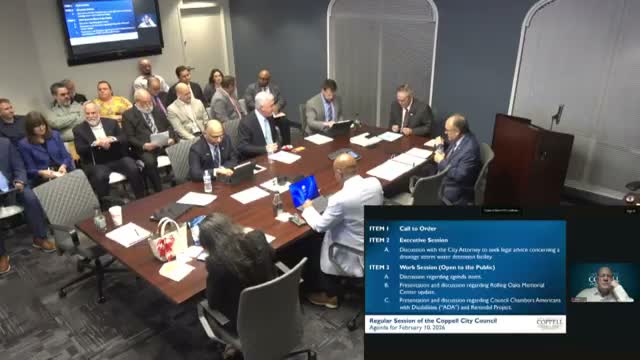
Sherry, the city staff lead for cemetery operations, and Vanessa Tarver, the assistant director of strategic financial engagement, told the Coppell City Council on Feb. 10 that Rolling Oaks Memorial Center is expanding and adjusting long‑term policies to balance revenue and resident priorities.
The council heard that bond funding and a $3,000,000 general‑fund contribution financed the cemetery expansion that opened in fiscal 2009, and that the cemetery’s two funds are structured to restrict cemetery revenues for cemetery expenses. “The fund balance of the perpetual care fund was $1,900,000 as of November,” Vanessa Tarver said, noting interest earnings in the current 3.5–3.8% environment would yield roughly $69,000 this year.
Staff described a land expansion called the Garden of Legacy that made 1,751 spaces immediately available and left 149 plotted spaces for future phases, giving a plotted total of 1,900 spaces for the expansion. Councilmember questions showed the city has additional undeveloped property that could support later phases, but staff said those areas require more site work and higher capital costs.
Operational changes announced to take effect April 1 include removing prior residency restrictions for at‑need services so “Rolling Oaks Memorial Center will now serve all families with immediate needs regardless of their residency,” Sherry said. The city also plans to lift earlier funeral‑home restrictions and to resume resident preneed appointments from the existing wait list; staff will keep nonresident preneed sales paused while they gauge service capacity.
Officials reviewed recent sales since the June 1, 2025 fee change: 55 at‑need sales, about 65% to residents and 35% to nonresidents; staff later clarified that 19 of the at‑need sales were nonresident purchases. The council also discussed a 12‑ and 24‑month payment plan option administered through the cemetery’s software provider (HMIS), with in‑house accounting for interest income.
Councilmembers pressed for projections about how much of future annual maintenance the perpetual care fund could cover at full build‑out; staff said a full projection requires more modeling of future spaces, interest assumptions and long‑term maintenance costs. As context, staff reported the current grounds‑maintenance contract costs about $140,000 per year.
The city framed the changes as methodical: staffing additions (two family services coordinators) and a modernized sales contract are intended to support growth while prioritizing residents already on the wait list. Council members asked staff to return with updated projections and confirmed that the cemetery’s management agreement for the funeral home (with SCI) leaves interior maintenance responsibilities to the funeral‑home operator.
The council did not take formal action on policy changes at the Feb. 10 meeting; staff said the April 1 operational changes are part of the planned rollout and that they will provide further updates.
The council heard that bond funding and a $3,000,000 general‑fund contribution financed the cemetery expansion that opened in fiscal 2009, and that the cemetery’s two funds are structured to restrict cemetery revenues for cemetery expenses. “The fund balance of the perpetual care fund was $1,900,000 as of November,” Vanessa Tarver said, noting interest earnings in the current 3.5–3.8% environment would yield roughly $69,000 this year.
Staff described a land expansion called the Garden of Legacy that made 1,751 spaces immediately available and left 149 plotted spaces for future phases, giving a plotted total of 1,900 spaces for the expansion. Councilmember questions showed the city has additional undeveloped property that could support later phases, but staff said those areas require more site work and higher capital costs.
Operational changes announced to take effect April 1 include removing prior residency restrictions for at‑need services so “Rolling Oaks Memorial Center will now serve all families with immediate needs regardless of their residency,” Sherry said. The city also plans to lift earlier funeral‑home restrictions and to resume resident preneed appointments from the existing wait list; staff will keep nonresident preneed sales paused while they gauge service capacity.
Officials reviewed recent sales since the June 1, 2025 fee change: 55 at‑need sales, about 65% to residents and 35% to nonresidents; staff later clarified that 19 of the at‑need sales were nonresident purchases. The council also discussed a 12‑ and 24‑month payment plan option administered through the cemetery’s software provider (HMIS), with in‑house accounting for interest income.
Councilmembers pressed for projections about how much of future annual maintenance the perpetual care fund could cover at full build‑out; staff said a full projection requires more modeling of future spaces, interest assumptions and long‑term maintenance costs. As context, staff reported the current grounds‑maintenance contract costs about $140,000 per year.
The city framed the changes as methodical: staffing additions (two family services coordinators) and a modernized sales contract are intended to support growth while prioritizing residents already on the wait list. Council members asked staff to return with updated projections and confirmed that the cemetery’s management agreement for the funeral home (with SCI) leaves interior maintenance responsibilities to the funeral‑home operator.
The council did not take formal action on policy changes at the Feb. 10 meeting; staff said the April 1 operational changes are part of the planned rollout and that they will provide further updates.
Don't Miss a Word: See the Full Meeting!
Go beyond summaries. Unlock every video, transcript, and key insight with a Founder Membership.
✓
Get instant access to full meeting videos
✓
Search and clip any phrase from complete transcripts
✓
Receive AI-powered summaries & custom alerts
✓
Enjoy lifetime, unrestricted access to government data
30-day money-back guarantee
