HCPSS CFO: state delayed minimum school funding timeline, district to add staffing before buying tracking software
February 09, 2026 | Howard County Public Schools, School Boards, Maryland
This article was created by AI summarizing key points discussed. AI makes mistakes, so for full details and context, please refer to the video of the full meeting. Please report any errors so we can fix them. Report an error »
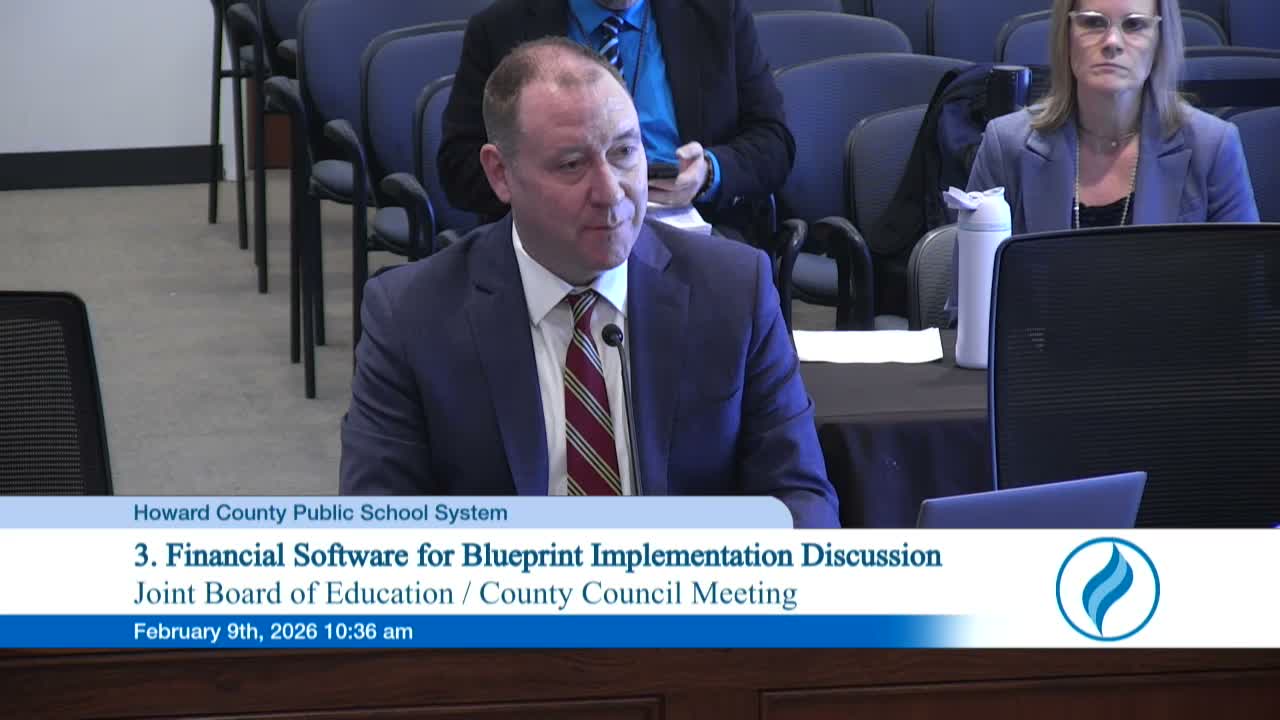
Howard County’s chief financial officer told a joint Board of Education and County Council meeting that the state has delayed full implementation of minimum school funding under the education 'blueprint' law, shifting the most significant fiscal requirement from fiscal 2027 to fiscal 2028.
Brian Hull said the timing change was the "big one" for the district’s finance office and that the district has met deadlines to date. He told the meeting that the FY27 proposed budget would include one additional position for the budget office to build capacity before the district shops for or implements a new financial-reporting software tool.
"There have been other changes, but ... the one in the finance space is the big one to me," Hull said. He added that implementing new software is a heavy lift that requires sufficient staff time and that the district wants to increase capacity before taking that step.
Carolyn Walker, chief equity and innovation officer, said proposed legislative responses from the Accountability and Implementation Board (AIB) include hold-harmless provisions to mitigate enrollment-driven funding losses and some targeted language around program elements (for example, fine arts) — though the proposals do not always come with additional funding. Board and council members said they continue to advocate with state lawmakers for implementation relief and clearer funding timelines.
The council and board also discussed widely reported estimates of software costs and staffing needs: one board member noted a widely circulated pre-arrival estimate of about $400,000 that had increased in later conversation to roughly $750,000, but Hull emphasized no new firm software budget has been submitted for FY27 and the district will scope software requirements after adding staff capacity.
Next steps: staff will continue coordination with state officials, return to the board with detailed resource needs, and pursue advocacy with state legislators and the AIB for implementation clarity and potential hold-harmless protections.
Brian Hull said the timing change was the "big one" for the district’s finance office and that the district has met deadlines to date. He told the meeting that the FY27 proposed budget would include one additional position for the budget office to build capacity before the district shops for or implements a new financial-reporting software tool.
"There have been other changes, but ... the one in the finance space is the big one to me," Hull said. He added that implementing new software is a heavy lift that requires sufficient staff time and that the district wants to increase capacity before taking that step.
Carolyn Walker, chief equity and innovation officer, said proposed legislative responses from the Accountability and Implementation Board (AIB) include hold-harmless provisions to mitigate enrollment-driven funding losses and some targeted language around program elements (for example, fine arts) — though the proposals do not always come with additional funding. Board and council members said they continue to advocate with state lawmakers for implementation relief and clearer funding timelines.
The council and board also discussed widely reported estimates of software costs and staffing needs: one board member noted a widely circulated pre-arrival estimate of about $400,000 that had increased in later conversation to roughly $750,000, but Hull emphasized no new firm software budget has been submitted for FY27 and the district will scope software requirements after adding staff capacity.
Next steps: staff will continue coordination with state officials, return to the board with detailed resource needs, and pursue advocacy with state legislators and the AIB for implementation clarity and potential hold-harmless protections.
Don't Miss a Word: See the Full Meeting!
Go beyond summaries. Unlock every video, transcript, and key insight with a Founder Membership.
✓
Get instant access to full meeting videos
✓
Search and clip any phrase from complete transcripts
✓
Receive AI-powered summaries & custom alerts
✓
Enjoy lifetime, unrestricted access to government data
30-day money-back guarantee
