Residents press safety, monitoring and local benefits at Cameron Parish forum on Hackberry CO2 sequestration permit
May 04, 2025 | Cameron Parish, Louisiana
This article was created by AI summarizing key points discussed. AI makes mistakes, so for full details and context, please refer to the video of the full meeting. Please report any errors so we can fix them. Report an error »
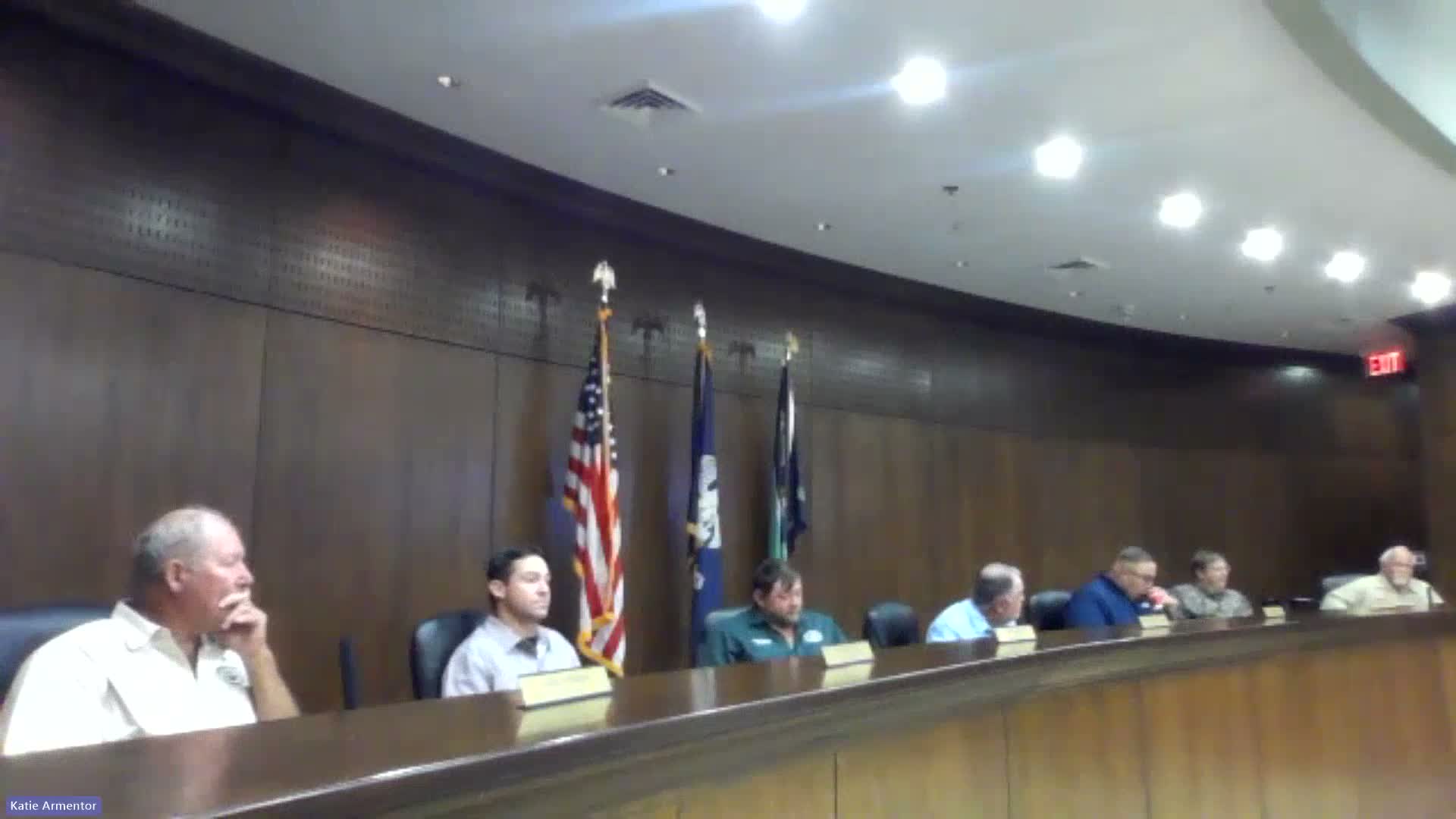
Cameron Parish residents, neighboring parish officials and project representatives met at a public forum to discuss a Class VI permit tied to a proposed carbon capture and sequestration (CCS) project serving Cameron LNG.
Organizers said the meeting’s purpose was to gather community questions ahead of a permit hearing Monday and to record concerns for state regulators. Roland, a parish official who said he organized outreach across nearby parishes, urged the Legislature to restore local authority and require stronger accountability, saying parish residents should not be forced to shoulder risk without compensation.
“There's 1 thing coming into a parish… the people elected you and this parish to protect them,” Roland said, pressing for insurance, monitoring and per‑ton payments to parishes to offset risks.
Speakers representing the project — identified in the record as a Central Infrastructure project director and a Cameron LNG external‑relations manager — described the Hackberry Harvest scope and permitting path. The director said the project centers on a capture system at Cameron LNG, a roughly 9‑mile CO2 pipeline that would route west from the facility and a single injection well about 3 miles northeast of Hackberry, with injection planned roughly 2 miles below surface into deep rock layers.
“We're going to have 1 single injector well… we're going to start injecting about 2 miles below the ground,” the project director said, adding that modeling required by the permit evaluates plume behavior for up to 100 years and that most of the project sits on company‑owned property.
Residents questioned whether the project could affect adjacent landowners, mineral rights or groundwater and whether legacy wells in the region posed additional risks. One long‑form commenter — who identified as a biologist and long‑time area resident — said CO2 streams captured from industrial sources can contain corrosive impurities and argued that monitoring and consequences for leaks have been inadequate in past U.S. projects.
“I think it's high risk, and I think there's a lot of dangers that's not being talked about,” the resident said, citing corrosion and past incidents at storage and pipeline projects.
Project engineers said capture gas is pretreated and dehydrated to reduce corrosion risk, that the pipeline would use heavier‑wall carbon steel and that well tubing would use higher‑chromium materials (described in the record as “25 chrome”) intended to resist CO2‑water corrosion. Patrick McCall, identified as a drone/engineer on the project team, said the permit includes multiple monitoring technologies (including VSP/velocity‑profile approaches), requirements for five‑year permit updates and commitments to mock emergency exercises with first responders prior to initial injection and recurring exercises every three years.
“We list out… scenarios. If this happens, here's a response time. Here's who we have to notify within 24–48 hours,” McCall said.
Attendees pressed for additional technical detail: exact valve counts and shutoff reaction times, how many monitoring lines would be pigged and how operators would detect slow migration versus a more sudden rupture. Company staff said some engineering details belong to later phases (detailed engineering and the inject/operate permit) and offered follow‑up sessions with geologists and detailed graphics; they also said the initial permitting package is lengthy (the draft permit was described in discussion as roughly 1,100 pages) and offered to produce condensed summaries for local review.
Local officials repeatedly raised the question of financial benefit and liability. Speakers described prior legislative proposals to secure per‑ton compensation and to limit eminent domain; one parish representative said earlier bills that would have required companies to insure local water systems and provide other protections were defeated and that parishes continue to press for accountability.
Company representatives said the construction permit would be followed by further applications to inject and operate, and that the public will have additional opportunities to comment. They said the project’s primary purpose is to decarbonize emissions vented from Cameron LNG, and that current engineering seeks to keep the injected CO2 plume beneath company property where feasible.
The meeting closed with organizers saying they would compile the public questions for the pending Class VI permit hearing, provide condensed permit materials and hold further community‑level sessions to address technical concerns.
Next steps: the company expects the draft construction permit to be considered at the upcoming hearing, after which further engineering, inject/operate permits and additional public review would follow.
Organizers said the meeting’s purpose was to gather community questions ahead of a permit hearing Monday and to record concerns for state regulators. Roland, a parish official who said he organized outreach across nearby parishes, urged the Legislature to restore local authority and require stronger accountability, saying parish residents should not be forced to shoulder risk without compensation.
“There's 1 thing coming into a parish… the people elected you and this parish to protect them,” Roland said, pressing for insurance, monitoring and per‑ton payments to parishes to offset risks.
Speakers representing the project — identified in the record as a Central Infrastructure project director and a Cameron LNG external‑relations manager — described the Hackberry Harvest scope and permitting path. The director said the project centers on a capture system at Cameron LNG, a roughly 9‑mile CO2 pipeline that would route west from the facility and a single injection well about 3 miles northeast of Hackberry, with injection planned roughly 2 miles below surface into deep rock layers.
“We're going to have 1 single injector well… we're going to start injecting about 2 miles below the ground,” the project director said, adding that modeling required by the permit evaluates plume behavior for up to 100 years and that most of the project sits on company‑owned property.
Residents questioned whether the project could affect adjacent landowners, mineral rights or groundwater and whether legacy wells in the region posed additional risks. One long‑form commenter — who identified as a biologist and long‑time area resident — said CO2 streams captured from industrial sources can contain corrosive impurities and argued that monitoring and consequences for leaks have been inadequate in past U.S. projects.
“I think it's high risk, and I think there's a lot of dangers that's not being talked about,” the resident said, citing corrosion and past incidents at storage and pipeline projects.
Project engineers said capture gas is pretreated and dehydrated to reduce corrosion risk, that the pipeline would use heavier‑wall carbon steel and that well tubing would use higher‑chromium materials (described in the record as “25 chrome”) intended to resist CO2‑water corrosion. Patrick McCall, identified as a drone/engineer on the project team, said the permit includes multiple monitoring technologies (including VSP/velocity‑profile approaches), requirements for five‑year permit updates and commitments to mock emergency exercises with first responders prior to initial injection and recurring exercises every three years.
“We list out… scenarios. If this happens, here's a response time. Here's who we have to notify within 24–48 hours,” McCall said.
Attendees pressed for additional technical detail: exact valve counts and shutoff reaction times, how many monitoring lines would be pigged and how operators would detect slow migration versus a more sudden rupture. Company staff said some engineering details belong to later phases (detailed engineering and the inject/operate permit) and offered follow‑up sessions with geologists and detailed graphics; they also said the initial permitting package is lengthy (the draft permit was described in discussion as roughly 1,100 pages) and offered to produce condensed summaries for local review.
Local officials repeatedly raised the question of financial benefit and liability. Speakers described prior legislative proposals to secure per‑ton compensation and to limit eminent domain; one parish representative said earlier bills that would have required companies to insure local water systems and provide other protections were defeated and that parishes continue to press for accountability.
Company representatives said the construction permit would be followed by further applications to inject and operate, and that the public will have additional opportunities to comment. They said the project’s primary purpose is to decarbonize emissions vented from Cameron LNG, and that current engineering seeks to keep the injected CO2 plume beneath company property where feasible.
The meeting closed with organizers saying they would compile the public questions for the pending Class VI permit hearing, provide condensed permit materials and hold further community‑level sessions to address technical concerns.
Next steps: the company expects the draft construction permit to be considered at the upcoming hearing, after which further engineering, inject/operate permits and additional public review would follow.
Don't Miss a Word: See the Full Meeting!
Go beyond summaries. Unlock every video, transcript, and key insight with a Founder Membership.
✓
Get instant access to full meeting videos
✓
Search and clip any phrase from complete transcripts
✓
Receive AI-powered summaries & custom alerts
✓
Enjoy lifetime, unrestricted access to government data
30-day money-back guarantee
