Developer tells council a three‑month permit delay cost $21,000 and nearly sank a rehab project
February 11, 2026 | Baltimore City, Baltimore County, Maryland
This article was created by AI summarizing key points discussed. AI makes mistakes, so for full details and context, please refer to the video of the full meeting. Please report any errors so we can fix them. Report an error »
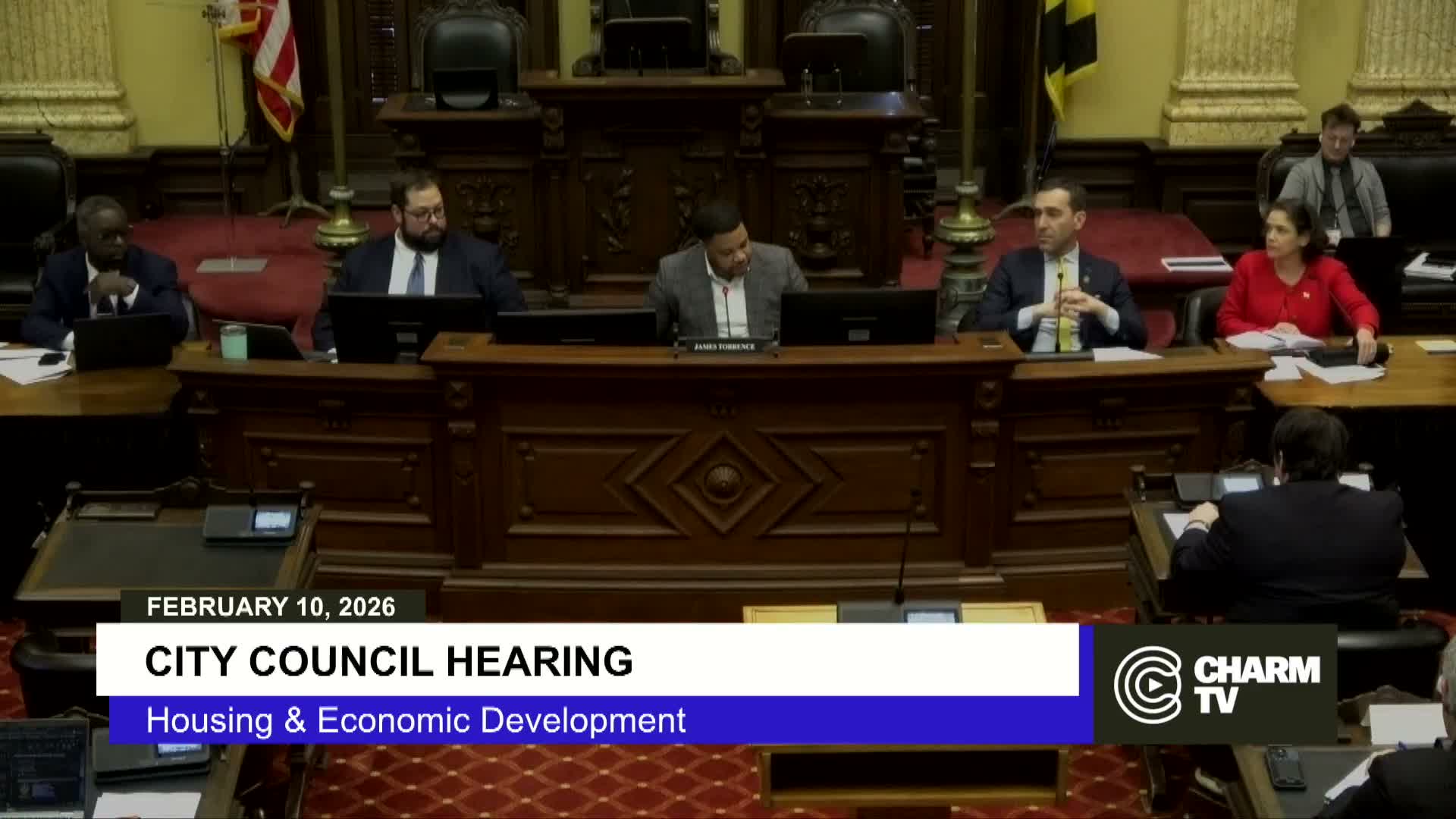
At the Housing & Economic Development Committee hearing on Feb. 10, guest witness Hassan Thamer, representing HF2 Properties, described a completed conversion of a dilapidated single‑family house into a four‑unit apartment in the Hampden neighborhood and said permitting delays almost made the project untenable.
Thamer said his company applied for a use‑and‑occupancy permit on April 3 and did not receive approval until July 4. He described multiple, unclear hold‑ups in the Office of Housing and Community Developments process: inspectors whose on‑paper inspections did not appear in Accela, late notices that a fire safety inspection was required, and two‑week scheduling delays that were not reflected promptly in the system. "Our use and occupancy permit took 3 months to obtain. We applied on April 3 and got it on July 4...This 3 month delay cost us $21,000 in direct, costs...and if I add in the 2 or 3 months of lost rent, it's over $40,000," Thamer said. (Hassan Thamer, HF2 Properties)
Thamer framed the project as the sort city leaders are trying to encourage: it improved a blighted lot, increased property tax revenue and added quality housing. He said the delays and the resulting carrying costs make small‑scale rehabilitation financially risky and deter future projects.
Committee members took the testimony seriously and asked the administration to follow up. Justin Williams, director of Permitting and Development Services, acknowledged that particular permits applied for early in the Accela rollout had encountered delays and said the department is prioritizing cleanup of older permits and automating assignment logic so new permits do not get stuck in limbo. Williams committed to follow up with the committee when feasible but did not record a specific remediation for Thamers project during the hearing.
The committee requested additional documentation and follow‑up data to corroborate and quantify the scale of similar incidents citywide.
Thamer said his company applied for a use‑and‑occupancy permit on April 3 and did not receive approval until July 4. He described multiple, unclear hold‑ups in the Office of Housing and Community Developments process: inspectors whose on‑paper inspections did not appear in Accela, late notices that a fire safety inspection was required, and two‑week scheduling delays that were not reflected promptly in the system. "Our use and occupancy permit took 3 months to obtain. We applied on April 3 and got it on July 4...This 3 month delay cost us $21,000 in direct, costs...and if I add in the 2 or 3 months of lost rent, it's over $40,000," Thamer said. (Hassan Thamer, HF2 Properties)
Thamer framed the project as the sort city leaders are trying to encourage: it improved a blighted lot, increased property tax revenue and added quality housing. He said the delays and the resulting carrying costs make small‑scale rehabilitation financially risky and deter future projects.
Committee members took the testimony seriously and asked the administration to follow up. Justin Williams, director of Permitting and Development Services, acknowledged that particular permits applied for early in the Accela rollout had encountered delays and said the department is prioritizing cleanup of older permits and automating assignment logic so new permits do not get stuck in limbo. Williams committed to follow up with the committee when feasible but did not record a specific remediation for Thamers project during the hearing.
The committee requested additional documentation and follow‑up data to corroborate and quantify the scale of similar incidents citywide.
Don't Miss a Word: See the Full Meeting!
Go beyond summaries. Unlock every video, transcript, and key insight with a Founder Membership.
✓
Get instant access to full meeting videos
✓
Search and clip any phrase from complete transcripts
✓
Receive AI-powered summaries & custom alerts
✓
Enjoy lifetime, unrestricted access to government data
30-day money-back guarantee
