Baltimore City council committee hears fire and EMS update on apparatus, trainings, hospital offload and overdose response
February 10, 2026 | Baltimore City, Baltimore County, Maryland
This article was created by AI summarizing key points discussed. AI makes mistakes, so for full details and context, please refer to the video of the full meeting. Please report any errors so we can fix them. Report an error »
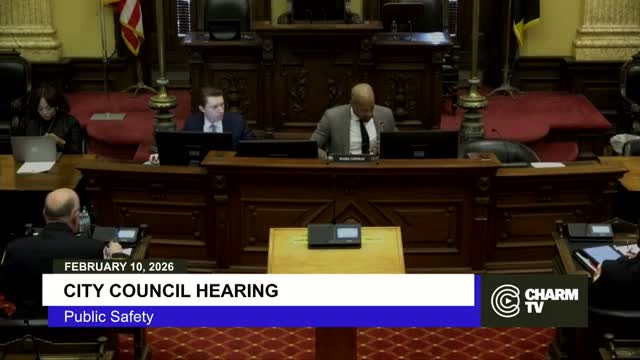
Baltimore City’s Public Safety Committee held its quarterly oversight hearing on LO25‑0006 with the Baltimore City Fire Department and EMS, receiving updates on apparatus deliveries, training innovations, inspection programs, EMS dispatch and pilot clinical programs.
Chief James Wallace told the committee the department took delivery in FY25 of six engines, two ladder trucks and 34 medic units and expects in FY26–27 an additional nine engines, four ladder trucks, two elevated platforms, six medic units and a single “pod” unit. Wallace cautioned that vendor lead times and parts shortages are extending the department’s 20‑year replacement cycle.
Wallace described the pod as a sea container outfitted with technical‑rescue gear that can be dropped on scene to reduce street congestion. He also previewed a locally built training project called “Connex City,” a configuration of containers designed to replicate row‑house firefighting scenarios (ventilation, roll‑up doors, multi‑floor rescues) to train recruits and incumbent staff.
On prevention, Wallace reported year‑over‑year growth in home inspections and smoke‑alarm work: FY24 saw roughly 57,000 home inspections with about 40,000 smoke alarms inspected and nearly 7,500 alarms installed; FY25 rose to near 60,000 inspections with over 45,000 alarms inspected and just over 8,000 installed. He said Q1 FY26 already showed more than 20,000 inspections and more than 12,000 alarms inspected.
Wallace and staff credited procedural and training changes with safety gains: the department reported approximately a 50% drop in fireground injuries year‑over‑year, large reductions in burn incidents and a decline in workers’ compensation payouts (reported figures discussed by Wallace showed roughly $8.7 million in 2024 versus about $3.9 million in 2025).
Assistant Chief James Metz reviewed EMS and 911 performance: the city’s 911 system answered more than 1.3 million calls in FY25, the department met its 106‑second dispatch‑within target about 95% of the time and met the 64‑second goal roughly 85% of the time in FY25. Metz said incidents were slightly down year‑over‑year but transports rose to levels last seen in 2019; daily averages for January–December were about 530 calls and roughly 265 transports per day.
Metz outlined operational mitigation for hospital offload delays and high transport volume: surge contracts, an AMR partnership to backfill commercial peak periods, telemedicine and a nurse navigation program that routes low‑acuity patients to alternative destinations or remote care. He said the department had begun an alternate‑destination pilot (for example transporting veterans to the VA when appropriate).
On clinical pilots, Metz and Deputy Chief Timothy Cullen said the department has trained approximately 59 paramedics (about half of the force) to perform buprenorphine inductions and has completed three inductions so far. “The feedback that we got from all 3 patients is that it did subside their symptoms,” Cullen said; two patients were transported to hospitals and one was sent directly to treatment and remained in treatment at the time of the hearing. Department staff listed operational barriers to broader rollout including controlled‑substance storage and tracking, consent rates, polysubstance presentations and the need to package and stock medication for frontline units.
Council members pressed on hospital offload times, naming Arbor Hospital as an example with recent 90th‑percentile offload times near 58 minutes. Medical Director Ben Lawner cautioned that some hospital metrics (door‑to‑doctor) do not capture offload delays and noted that reporting to regulatory authorities and Emtala audits are tools when offload becomes egregious. He said state regulatory scope (Maryland Institute for Emergency Medical Service Systems) and other governance limits shape what the city can require of hospitals.
The council asked the department for follow‑up materials: cost comparisons and timelines for pod units versus vehicles, three‑year breakdowns of fires caused by space heaters and 911 calls for burst/broken water pipes, codex removal data and current counts for VBNs and codex properties. Department staff agreed to provide many of those data requests within one to two weeks or up to a month for larger data extracts.
Chair Mark Conway closed by thanking department staff and recessed the hearing. The hearing produced no formal motions or votes recorded on the record.
Ending note: the department said it will return with requested cost comparisons, updated data on codex and VBN counts, and further detail on pilot program metrics and training timelines.
Chief James Wallace told the committee the department took delivery in FY25 of six engines, two ladder trucks and 34 medic units and expects in FY26–27 an additional nine engines, four ladder trucks, two elevated platforms, six medic units and a single “pod” unit. Wallace cautioned that vendor lead times and parts shortages are extending the department’s 20‑year replacement cycle.
Wallace described the pod as a sea container outfitted with technical‑rescue gear that can be dropped on scene to reduce street congestion. He also previewed a locally built training project called “Connex City,” a configuration of containers designed to replicate row‑house firefighting scenarios (ventilation, roll‑up doors, multi‑floor rescues) to train recruits and incumbent staff.
On prevention, Wallace reported year‑over‑year growth in home inspections and smoke‑alarm work: FY24 saw roughly 57,000 home inspections with about 40,000 smoke alarms inspected and nearly 7,500 alarms installed; FY25 rose to near 60,000 inspections with over 45,000 alarms inspected and just over 8,000 installed. He said Q1 FY26 already showed more than 20,000 inspections and more than 12,000 alarms inspected.
Wallace and staff credited procedural and training changes with safety gains: the department reported approximately a 50% drop in fireground injuries year‑over‑year, large reductions in burn incidents and a decline in workers’ compensation payouts (reported figures discussed by Wallace showed roughly $8.7 million in 2024 versus about $3.9 million in 2025).
Assistant Chief James Metz reviewed EMS and 911 performance: the city’s 911 system answered more than 1.3 million calls in FY25, the department met its 106‑second dispatch‑within target about 95% of the time and met the 64‑second goal roughly 85% of the time in FY25. Metz said incidents were slightly down year‑over‑year but transports rose to levels last seen in 2019; daily averages for January–December were about 530 calls and roughly 265 transports per day.
Metz outlined operational mitigation for hospital offload delays and high transport volume: surge contracts, an AMR partnership to backfill commercial peak periods, telemedicine and a nurse navigation program that routes low‑acuity patients to alternative destinations or remote care. He said the department had begun an alternate‑destination pilot (for example transporting veterans to the VA when appropriate).
On clinical pilots, Metz and Deputy Chief Timothy Cullen said the department has trained approximately 59 paramedics (about half of the force) to perform buprenorphine inductions and has completed three inductions so far. “The feedback that we got from all 3 patients is that it did subside their symptoms,” Cullen said; two patients were transported to hospitals and one was sent directly to treatment and remained in treatment at the time of the hearing. Department staff listed operational barriers to broader rollout including controlled‑substance storage and tracking, consent rates, polysubstance presentations and the need to package and stock medication for frontline units.
Council members pressed on hospital offload times, naming Arbor Hospital as an example with recent 90th‑percentile offload times near 58 minutes. Medical Director Ben Lawner cautioned that some hospital metrics (door‑to‑doctor) do not capture offload delays and noted that reporting to regulatory authorities and Emtala audits are tools when offload becomes egregious. He said state regulatory scope (Maryland Institute for Emergency Medical Service Systems) and other governance limits shape what the city can require of hospitals.
The council asked the department for follow‑up materials: cost comparisons and timelines for pod units versus vehicles, three‑year breakdowns of fires caused by space heaters and 911 calls for burst/broken water pipes, codex removal data and current counts for VBNs and codex properties. Department staff agreed to provide many of those data requests within one to two weeks or up to a month for larger data extracts.
Chair Mark Conway closed by thanking department staff and recessed the hearing. The hearing produced no formal motions or votes recorded on the record.
Ending note: the department said it will return with requested cost comparisons, updated data on codex and VBN counts, and further detail on pilot program metrics and training timelines.
Don't Miss a Word: See the Full Meeting!
Go beyond summaries. Unlock every video, transcript, and key insight with a Founder Membership.
✓
Get instant access to full meeting videos
✓
Search and clip any phrase from complete transcripts
✓
Receive AI-powered summaries & custom alerts
✓
Enjoy lifetime, unrestricted access to government data
30-day money-back guarantee
