Senate Transportation reviews proposed DMV inspection manual revisions; hearing planned
February 11, 2026 | Senate Transportation, SENATE, Committees, Legislative , Vermont
This article was created by AI summarizing key points discussed. AI makes mistakes, so for full details and context, please refer to the video of the full meeting. Please report any errors so we can fix them. Report an error »
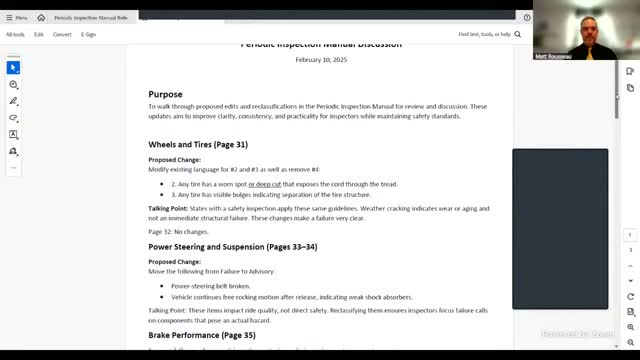
Matt Russo, deputy commissioner for the Department of Motor Vehicles, told the Senate Transportation Committee that the department plans to revise its vehicle inspection manual to focus failure criteria on safety‑critical problems and to reclassify cosmetic or ride‑quality issues as advisories. "We're just removing rust completely," Russo said, explaining the department wants to target pitting and cracks that affect braking or structural integrity rather than surface rust that does not change stopping distance.
Russo walked members through proposed edits on multiple pages: adding a "deep cut" alongside worn spots that expose cord for tires; retaining rejection for visible tire bulges; moving power‑steering belt breaks and continuous free rocking motion after release from "failure" to "advisory" because they pertain to ride quality rather than immediate safety; removing a post‑brake‑change road‑test requirement; and changing rotor/drum language to flag cracks that extend to the open edge or significant pitting rather than any rust. The manual will also move many lighting, instrument cluster and side‑window issues to advisory status and tighten failure language on sheet‑metal corrosion to only apply when structural integrity of the A, B or C pillars is compromised.
Committee members pressed for practical clarifications. Several senators said a flat "half‑inch" pitting threshold for rotors may penalize small cars more than large vehicles and asked the department to consider a percentage‑based measure or provide a diagram. Senators asked whether bulbs or LED brightness are covered; Russo said the manual does not currently regulate headlamp brightness but is proposing to remove the dedicated headlamp‑aiming section because stations rarely perform that check.
Members asked how today's review fits into formal rulemaking. The committee discussed using language in a miscellaneous DMV bill to reference manual changes and pursue expedited rules, and asked DMV to post a machine‑readable strikethrough/track‑change version so inspection stations and the public can compare old and new text. The committee agreed to schedule a public hearing that would combine the inspection manual changes and a longer discussion about a possible two‑year inspection concept; the working plan discussed in the meeting was to hold that hearing the week of Feb. 24 with an evening session and a Zoom option to accommodate inspection station operators and members of the public.
The department said it would provide diagrams showing pillar boundaries and more explicit pass/fail side‑by‑side text. Members signaled support for clarifying safety‑critical language while preserving public input time before any final rule changes. The committee did not take a vote during the meeting and gave staff directions to post the revised materials and draft statutory language for consideration.
Russo walked members through proposed edits on multiple pages: adding a "deep cut" alongside worn spots that expose cord for tires; retaining rejection for visible tire bulges; moving power‑steering belt breaks and continuous free rocking motion after release from "failure" to "advisory" because they pertain to ride quality rather than immediate safety; removing a post‑brake‑change road‑test requirement; and changing rotor/drum language to flag cracks that extend to the open edge or significant pitting rather than any rust. The manual will also move many lighting, instrument cluster and side‑window issues to advisory status and tighten failure language on sheet‑metal corrosion to only apply when structural integrity of the A, B or C pillars is compromised.
Committee members pressed for practical clarifications. Several senators said a flat "half‑inch" pitting threshold for rotors may penalize small cars more than large vehicles and asked the department to consider a percentage‑based measure or provide a diagram. Senators asked whether bulbs or LED brightness are covered; Russo said the manual does not currently regulate headlamp brightness but is proposing to remove the dedicated headlamp‑aiming section because stations rarely perform that check.
Members asked how today's review fits into formal rulemaking. The committee discussed using language in a miscellaneous DMV bill to reference manual changes and pursue expedited rules, and asked DMV to post a machine‑readable strikethrough/track‑change version so inspection stations and the public can compare old and new text. The committee agreed to schedule a public hearing that would combine the inspection manual changes and a longer discussion about a possible two‑year inspection concept; the working plan discussed in the meeting was to hold that hearing the week of Feb. 24 with an evening session and a Zoom option to accommodate inspection station operators and members of the public.
The department said it would provide diagrams showing pillar boundaries and more explicit pass/fail side‑by‑side text. Members signaled support for clarifying safety‑critical language while preserving public input time before any final rule changes. The committee did not take a vote during the meeting and gave staff directions to post the revised materials and draft statutory language for consideration.
Don't Miss a Word: See the Full Meeting!
Go beyond summaries. Unlock every video, transcript, and key insight with a Founder Membership.
✓
Get instant access to full meeting videos
✓
Search and clip any phrase from complete transcripts
✓
Receive AI-powered summaries & custom alerts
✓
Enjoy lifetime, unrestricted access to government data
30-day money-back guarantee
